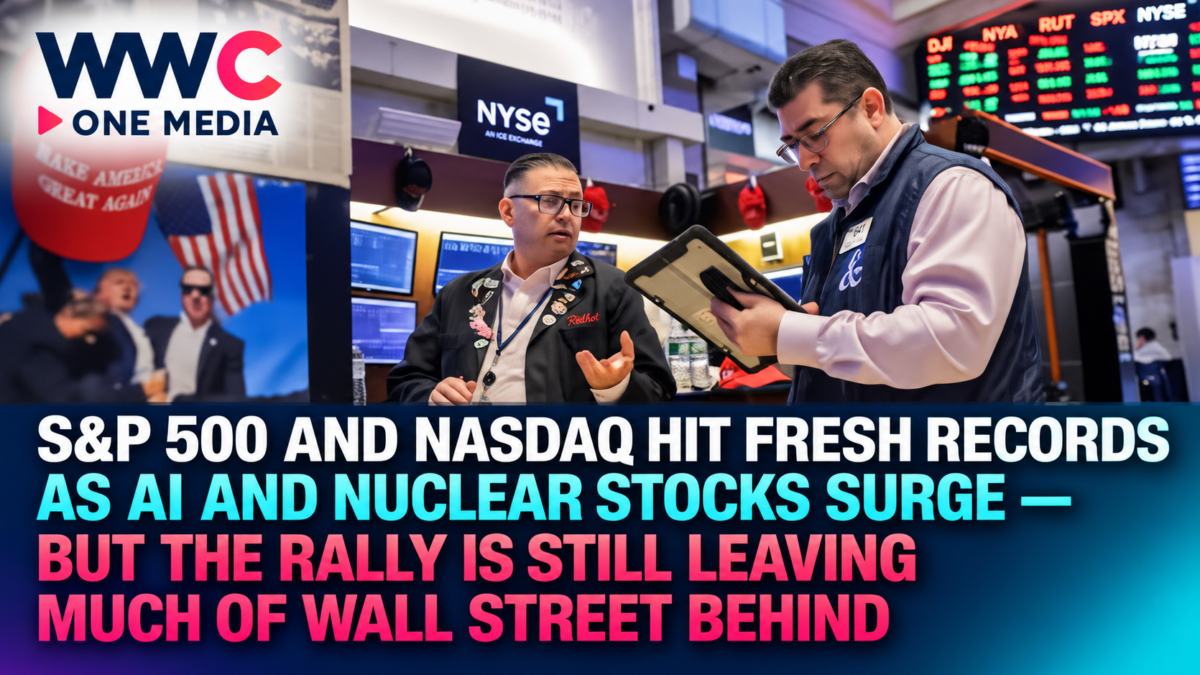
NEW YORK — Wall Street has climbed back into record territory, powered by artificial intelligence, nuclear-energy stocks and expectations for another explosive earnings season.
The S&P 500 closed at a fresh all-time high on October 6, rising about 0.6% to 7,818.93, while the Nasdaq Composite gained roughly 0.4% to 27,599.79, marking its second consecutive record close.
The Dow Jones Industrial Average also advanced, climbing about 0.5% to 51,521.28.
But underneath those headline records, the market is sending a more complicated message.
The Russell 2000 index of smaller companies actually fell about 0.6%, while the Dow remains more than 5% below its August high.
That means Wall Street’s latest record is still being driven disproportionately by large technology, AI, semiconductor and utility companies.
And that concentration may be the most important thing investors need to watch next.
Lower Treasury Yields Gave Stocks Breathing Room
The immediate catalyst was the bond market.
Long-term U.S. Treasury yields eased after recently reaching levels not seen in more than two decades.
The 10-year Treasury yield had climbed above 5.3%, while the 30-year yield had approached 5.7%, creating intense pressure on equity valuations.
Those yields matter because investors compare stocks with the returns available from supposedly safer government bonds.
When Treasuries offer more than 5%, expensive growth stocks have to produce much stronger earnings to justify their valuations.
So even a modest decline in yields can dramatically improve sentiment.
That is exactly what happened Tuesday.
As bond yields eased, investors immediately returned to the parts of the market with the strongest growth stories.
Oil Also Stopped Scaring Investors
Crude prices stabilized after weeks of volatility.
Brent crude remained around $100 a barrel, while U.S. oil traded below $90 during parts of the session.
That helped calm fears that another surge in energy prices could reignite inflation and force the Federal Reserve into faster rate increases.
The probability of another Fed hike at the October meeting fell to roughly 19%, down sharply from more than 50% the previous week, according to futures pricing cited by Reuters.
That change in expectations was important.
Wall Street is increasingly betting that the Fed can pause after September’s rate increase.
If that happens, investors may be willing to tolerate historically high yields for longer—provided corporate earnings remain strong.
Google Just Turned Nuclear Power Into an AI Trade
One of the biggest stock moves came from an unlikely corner of the market.
Constellation Energy surged more than 12% after announcing a major long-term power agreement with Google.
The deal involves upgrades to existing nuclear plants that will add 890 megawatts of new nuclear capacity, while a broader energy arrangement with Google covers significantly more power.
Investors immediately understood the significance.
AI data centers need enormous quantities of electricity.
So the AI boom is no longer benefiting only Nvidia, AMD and other chipmakers.
It is spreading into:
nuclear utilities,
power producers,
grid infrastructure,
data centers,
and energy equipment.
Utilities became the strongest-performing S&P 500 sector during the session.
That marks an important evolution in the AI investment story.
The market is no longer asking only:
Who makes the chips?
It is increasingly asking:
Who can supply enough electricity to run them?
Marvell Jumps as AI Networking Demand Accelerates
Semiconductor stocks also continued climbing.
Marvell Technology gained strongly, with investors reacting to optimistic expectations surrounding AI-related networking and custom-chip demand.
Marvell has become one of the companies Wall Street increasingly associates with the infrastructure required to connect giant AI computing clusters.
The semiconductor sector rose broadly, with AMD and other AI-linked stocks also gaining.
That matters because Nvidia can dominate the GPU market while still creating enormous opportunities elsewhere.
AI servers require:
memory,
networking chips,
optical components,
switches,
custom accelerators,
and advanced packaging.
Every layer creates another potential winner.
Nvidia Hits Another Record
Nvidia once again helped power the market.
The stock reached another all-time high during Tuesday trading, with its market capitalization moving closer to the extraordinary $6 trillion level.
The company remains Wall Street’s most important AI stock.
Its influence is now so large that even relatively modest percentage moves can materially affect the S&P 500 and Nasdaq.
That creates a strange situation.
The index may contain hundreds or thousands of companies.
But a handful of gigantic technology businesses increasingly determine what the benchmark does.
That is one reason investors are paying much more attention to market breadth.
Option Care Health Explodes on Takeover Deal
Not every major move was about AI.
Option Care Health jumped roughly 33% after agreeing to a multibillion-dollar acquisition involving McKesson and private-equity firm Clayton, Dubilier & Rice.
The transaction values the home-infusion provider at approximately $5.8 billion.
The rally highlights another active theme:
Healthcare services are increasingly moving outside hospitals and into homes, clinics and lower-cost care settings.
Private equity and large healthcare companies see that shift as a long-term growth opportunity.
Option Care’s dramatic rise also gave investors another reason to believe mergers and acquisitions remain alive despite higher interest rates.
Lamb Weston Rallies on Earnings
Food company Lamb Weston also surged after reporting better-than-expected earnings and raising its outlook.
The stock gained around 7.5%.
That is important for a different reason.
The market is approaching a crucial earnings season.
Investors currently expect S&P 500 earnings to rise around 30.6% year over year in the third quarter, according to LSEG data cited by Reuters.
That forecast is extraordinarily strong.
And it explains why investors remain willing to buy stocks despite 5%-plus bond yields.
If profits grow by 30%, high valuations become easier to defend.
If earnings disappoint, the market could suddenly look much more expensive.
Wall Street Is Betting Profits Can Beat Interest Rates
This is the core logic behind the rally.
The bond market is saying:
Money is expensive.
The stock market is answering:
Profits are growing even faster.
For now, investors believe corporate America can generate enough earnings growth to overcome higher borrowing costs.
That is especially true in technology.
AI-related spending remains enormous.
Chip demand remains strong.
Cloud companies are expanding.
Utilities are signing long-term power contracts.
And data-center infrastructure investment is accelerating.
That combination is keeping investors focused on growth rather than on rates alone.
But Small Caps Are Telling a Different Story
The Russell 2000’s decline on a day when the S&P 500 hit a record should not be ignored.
Small companies tend to be:
more dependent on bank financing,
more sensitive to borrowing costs,
less internationally diversified,
and less able to issue cheap bonds.
So high interest rates hurt them much more quickly than they hurt mega-cap technology companies.
The Russell 2000 fell 0.6% to 2,830.30 on October 6.
That divergence suggests the economy may not be as uniformly strong as the major indexes imply.
Large technology companies can thrive even when smaller businesses are struggling.
The Dow Is Also Lagging
The Dow gained Tuesday but remains well below its August record.
Reuters said the index remains more than 5% below its previous peak.
That is another clue that the rally is not equally distributed.
The S&P 500 and Nasdaq contain much heavier exposure to technology and growth companies.
The Dow contains more traditional industrial, healthcare and consumer businesses.
Its relative weakness reinforces the idea that AI-related capital spending is doing an enormous amount of the market’s heavy lifting.
Even the S&P 500 Record May Look Better Than the Average Stock
The structure of the S&P 500 matters.
It is weighted by market capitalization.
That means a trillion-dollar company moves the index far more than a smaller constituent.
When Nvidia, Microsoft, Alphabet and other giants rise, they can push the S&P 500 to a record even if many ordinary stocks remain below their own highs.
This is why headline index levels can sometimes give a misleading impression of overall market strength.
The index is healthy.
But not every company inside it is.
Investors Are Now Looking Toward Earnings Season
Third-quarter earnings are likely to determine whether the rally continues.
Analysts expect especially strong growth from:
technology,
energy,
and AI-linked companies.
If those results beat already-high expectations, the S&P 500 could continue moving higher.
But expectations themselves have become a risk.
When investors expect 30% earnings growth, merely delivering good numbers may no longer be enough.
Companies may need to deliver exceptional results and strong guidance.
That is an increasingly difficult bar.
AI Spending Is Still the Biggest Bull Case
The bullish argument remains powerful.
Microsoft, Google, Amazon, Meta and other technology giants continue investing hundreds of billions of dollars into AI infrastructure.
Nvidia continues selling advanced processors at enormous scale.
Marvell and Broadcom are benefiting from networking and custom silicon.
Memory suppliers are seeing record pricing.
Utilities are signing long-term contracts with hyperscalers.
And nuclear power is suddenly being valued as strategic AI infrastructure.
This is not a narrow software boom.
It is becoming one of the largest capital-expenditure cycles in modern economic history.
That spending supports corporate profits far beyond Silicon Valley.
But AI Is Also Creating New Risks
The same boom creating record stock prices is also pushing up:
electricity demand,
bond issuance,
capital spending,
and competition for infrastructure.
Those forces can contribute to higher interest rates.
Technology companies are borrowing huge amounts to finance AI projects.
Data centers are competing for limited power.
Governments are also issuing enormous amounts of debt.
That means the AI boom can simultaneously lift stock prices while pushing bond yields higher.
Eventually, one side may have to give.
Fed Policy Remains the Wild Card
Markets currently expect the Federal Reserve to pause this month.
But policymakers remain divided.
Inflation is still above the Fed’s 2% target.
Oil remains expensive.
Services prices remain elevated.
At the same time, September job creation slowed sharply.
That creates an uncomfortable tradeoff.
Raise rates again and the Fed risks weakening employment further.
Pause too long and inflation could become entrenched.
Every major economic report therefore has the potential to move both stocks and bonds dramatically.
Wednesday’s Fed Minutes Could Matter
Investors will next focus on the minutes from the Federal Reserve’s September meeting.
Those minutes could reveal just how strongly policymakers supported the latest rate increase and whether officials believe additional hikes will be necessary.
A hawkish message could push Treasury yields higher again.
A more cautious message could extend the stock rally.
That means Wall Street’s record highs are still vulnerable to the bond market.
Why This Rally Feels Different
The unusual part of the current market is what stocks have already survived.
Oil near $100.
Treasury yields above 5%.
A renewed Fed rate hike.
Weak employment data.
Geopolitical risk.
And yet the S&P 500 is setting records.
That resilience has encouraged investors to believe that corporate profits—especially AI-related profits—can overpower almost any macroeconomic problem.
History suggests that confidence can last a surprisingly long time.
But it rarely lasts forever.
Wall Street Is Celebrating — But the Market Is Splitting in Two
The headline is undeniably bullish.
The S&P 500 is at a record.
The Nasdaq is at a record.
Nvidia is at a record.
Constellation Energy is soaring.
AI infrastructure spending remains enormous.
But beneath those numbers:
small caps are falling,
the Dow is lagging,
bond yields remain historically high,
and oil is still near $100.
That creates a market increasingly divided between companies that benefit directly from AI spending and companies that simply have to live with the higher interest rates and higher costs that come with it.
Wall Street has proved it can hit records even with 5% Treasury yields and expensive oil.
The bigger question is whether the rest of the market can finally join the rally—or whether a handful of AI giants are carrying the indexes higher until something eventually becomes too heavy to ignore.