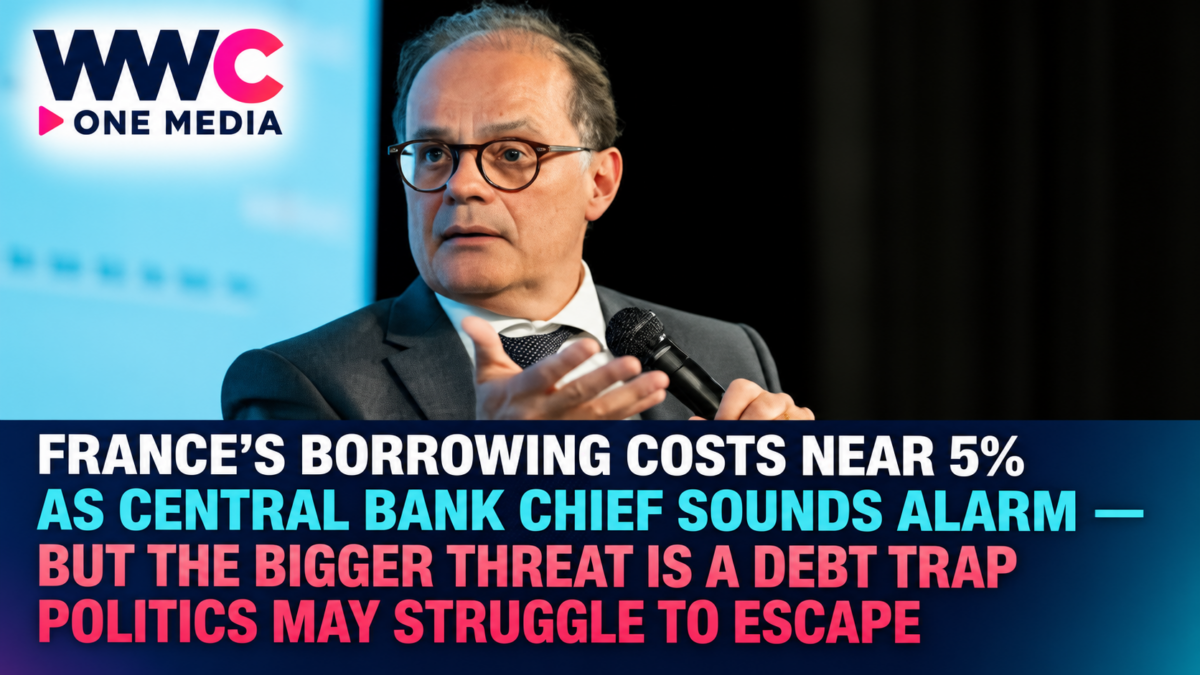
PARIS — France’s central bank governor has delivered one of the starkest warnings yet about the country’s deteriorating public finances: act on the deficit now, or risk watching rising interest payments slowly squeeze the government’s ability to spend on almost everything else.
Banque de France Governor Emmanuel Moulin warned that France could be “gradually strangled” by higher interest rates if politicians fail to convince investors that the eurozone’s second-largest economy can put its finances back under control.
His warning comes after a sharp selloff in French government bonds pushed the yield on benchmark 10-year debt close to 5%, levels not seen for more than two decades.
The risk premium investors demand to own French bonds instead of safer German government debt also briefly climbed above 150 basis points, the widest since the eurozone debt crisis era.
But Moulin also rejected the most dramatic comparisons.
France, he argued, is not Greece during the eurozone crisis.
The problem is not that Paris has suddenly lost access to financial markets.
The problem is that every year France waits, the amount of taxpayer money required simply to service its debt becomes larger — leaving less available for hospitals, schools, pensions, defence and investment.
That is how a fiscal problem can gradually become an economic trap.
France Is Sitting on Roughly €3.5 Trillion of Debt
The numbers explain why bond investors are nervous.
France’s public debt has climbed to around €3.5 trillion, equivalent to roughly 119% of gross domestic product.
Its budget deficit is running at around 5.4% of GDP, far above the European Union’s 3% ceiling.
That leaves France unusually exposed when borrowing costs rise.
Governments rarely repay all their debt at once.
Instead, they continually refinance bonds as old ones mature.
When interest rates are low, that refinancing can be relatively painless.
When yields approach 5%, replacing cheap old debt becomes much more expensive.
France therefore does not need a dramatic financial crash to experience serious consequences.
The pressure can build gradually as more of its debt is refinanced at higher rates.
Debt Interest Could Become One of France’s Biggest Government Bills
The Financial Times estimates that French debt-servicing costs could exceed €90 billion annually by 2027.
That is money that cannot simultaneously be spent elsewhere.
This is the meaning behind Moulin’s warning about France being “strangled.”
Higher borrowing costs increase the deficit.
A larger deficit requires more borrowing.
More borrowing can make investors demand still higher yields.
If confidence continues deteriorating, the process can become self-reinforcing.
This is sometimes described as a debt-interest spiral.
France is not there yet.
But markets are beginning to charge the country more for the risk.
Paris Is Proposing €43 Billion of Budget Repair
Prime Minister Sébastien Lecornu’s government has proposed roughly €43 billion in spending reductions and tax measures for the 2027 budget.
Among the measures are changes affecting pensions, healthcare spending, payroll-tax relief and other parts of the budget.
The government hopes the package will demonstrate to bond investors that France is serious about narrowing its deficit.
Moulin believes passing a credible budget could calm markets.
His message is essentially that investor confidence can still be restored before the problem becomes dramatically worse.
But passing the budget may be much harder than designing it.
France’s Real Problem Is Political Arithmetic
France does not have a straightforward parliamentary majority capable of imposing unpopular fiscal reforms.
That means virtually every substantial spending cut can become a political battle.
Teachers, students, nurses and public-sector workers have already protested against austerity measures and reductions in public spending.
Plans affecting pensions and public-sector compensation are particularly sensitive.
The political calendar makes the challenge even harder.
France will hold its next presidential election in 2027.
Few politicians enjoy campaigning on promises of:
higher taxes,
lower benefits,
slower pension increases,
or reduced public spending.
Yet bond investors increasingly want evidence that somebody is willing to make those decisions.
Marine Le Pen Is Now Campaigning on Fiscal Discipline
The pressure has become so strong that Marine Le Pen, long associated with economically populist policies, is now pitching herself as a defender of fiscal credibility.
Le Pen has proposed approximately €140 billion in net savings by 2032, saying she wants France’s deficit brought back toward EU limits.
She has also proposed a constitutional “golden rule” forcing governments to reduce deficits over time.
That shift demonstrates how dramatically French politics has changed.
Fiscal restraint is no longer merely an issue for technocrats in Brussels or central bankers in Paris.
It is becoming a central issue in the presidential campaign.
Le Pen is trying to convince nervous bond markets that a far-right government would not blow up France’s finances.
Her rivals now face the same credibility test.
France Is Starting to Trade Like Europe’s New Fiscal Problem
One of the most striking developments is how investors now view France compared with countries once considered Europe’s weak links.
During the eurozone crisis, markets focused intensely on Greece, Italy, Portugal and Spain.
France belonged to the core.
Today that distinction is becoming less comfortable.
French borrowing costs have risen sharply, while some former eurozone crisis countries have spent years improving their fiscal positions.
The FT has described France as increasingly resembling part of Europe’s “new periphery.”
That does not mean France is about to become Greece.
France has a far larger economy, deep capital markets and much stronger financial institutions.
But investor psychology matters.
Once markets start viewing a government as fiscally unreliable, reversing that perception can become expensive.
The Euro Has Already Felt the Pressure
French political and fiscal anxiety is also affecting the common European currency.
The euro recently fell to around a 17-month low against the U.S. dollar, as investors reacted to France’s debt situation and broader political uncertainty in Europe.
That matters because France is not a small peripheral economy.
It is the eurozone’s second largest.
If confidence in French government debt deteriorates substantially, the consequences could spread far beyond Paris.
Banks hold sovereign bonds.
Pension funds own them.
Insurance companies rely on them.
French government debt is deeply embedded throughout European finance.
Investors Are Watching French Banks Too
France’s major banks have already come under pressure during periods of bond-market stress.
Banks including Société Générale and Crédit Agricole have underperformed as investors worry about the broader economic and financial effects of rising sovereign yields.
Credit-default-swap prices on French debt have also increased, reflecting a higher cost of insuring against sovereign risk.
This is how government debt problems can spread into the private sector.
If sovereign yields rise, corporate financing usually becomes more expensive too.
Mortgages can rise.
Business loans become costlier.
Investment slows.
Economic growth weakens.
And weaker growth makes reducing the debt burden even harder.
France Cannot Simply Expect the ECB to Rescue It
One of Moulin’s strongest messages is that Paris should not assume the European Central Bank will automatically intervene.
The ECB created its Transmission Protection Instrument, or TPI, after the eurozone crisis to prevent unjustified market turmoil from fragmenting the currency bloc.
In theory, the ECB could buy the bonds of a member state facing disorderly pressure.
But France presents a difficult case.
Reuters notes that the TPI is intended primarily for market moves that are unwarranted and disorderly.
France’s rising borrowing costs are increasingly viewed as a response to genuine concerns about large deficits, growing debt and political paralysis.
France is also under an EU excessive-deficit procedure.
That makes intervention politically and legally harder.
In other words:
The ECB may have emergency tools.
But France may not qualify for them simply because investors have decided its debt should cost more.
Moulin’s Message: The Rescue Has to Come From Paris
This is why Moulin keeps emphasizing domestic action.
France still controls its own fiscal decisions.
Parliament can pass a credible budget.
The government can demonstrate that debt will eventually stabilize.
Political parties can agree that fiscal credibility matters regardless of who wins the presidency.
If they do, borrowing costs could fall.
France’s bond spread already tightened somewhat after reaching extreme levels, demonstrating that markets can respond quickly when confidence improves. The danger is the opposite scenario.
If investors conclude that no French government can deliver meaningful fiscal reform, they may continue demanding larger premiums.
Global Bond Markets Are Making France’s Problem Worse
France is not suffering in isolation.
Government borrowing costs have been rising worldwide.
The U.S. 10-year Treasury yield recently climbed to about 5.34%, its highest since 2002.
British and Japanese yields have also surged.
Persistent inflation, large government deficits, expensive energy and massive capital requirements for artificial intelligence infrastructure are competing for investors’ money.
That global environment matters enormously.
When safe U.S. bonds yield more than 5%, investors demand stronger compensation to hold governments perceived as riskier.
France therefore has less room for fiscal complacency than it had when interest rates were near zero.
The Iran War Has Added Another Complication
Higher energy prices have made the situation even more difficult.
The conflict involving Iran has pushed oil prices sharply higher, renewing inflation concerns.
That creates a painful combination for Europe:
higher inflation,
higher bond yields,
and weaker economic growth.
Normally, weak growth would encourage central banks to lower interest rates.
High inflation pushes them in the opposite direction.
ECB policymakers are now debating whether more monetary tightening is required even as bond markets are already tightening financial conditions substantially.
France therefore cannot necessarily depend on lower ECB rates quickly rescuing its budget.
There Is One Strange Silver Lining
Higher bond yields can themselves weaken the economy enough to reduce inflation.
ECB policymaker Olli Rehn said this week that rising long-term yields are already dampening demand and limiting how much higher energy prices spread into wages and other prices.
That could eventually reduce the need for central banks to hike short-term rates further.
But for France, this is hardly an ideal solution.
It effectively means the bond market is doing some of the central bank’s tightening.
And France’s government is paying the price.
France Is Not Greece — But That Is Not the Same as Saying Everything Is Fine
This distinction is essential.
France is not on the verge of default.
It retains enormous economic resources.
Investors are still buying French government debt.
Its financial institutions remain powerful.
Its economy remains one of the largest in the world.
But fiscal crises rarely begin with a government announcing that it can no longer borrow.
They begin when borrowing becomes steadily more expensive.
Then refinancing costs rise.
Budgets tighten.
Growth weakens.
Political resistance grows.
And investors demand even more compensation.
Moulin is warning France to act before that cycle becomes much harder to reverse.
The €43 Billion Question
The immediate test is the 2027 budget.
If Lecornu’s government can secure parliamentary approval for credible fiscal consolidation, markets may decide France is finally confronting its debt problem.
If the plan collapses under political opposition, investors could interpret that as evidence that France is effectively ungovernable on fiscal policy.
That would put renewed pressure on bond yields.
And every increase in yields makes future budgets more difficult.
This is why what looks like a dispute over pension adjustments and public-sector spending has become a market story with implications across Europe.
France Is Fighting the Bond Market and the Streets at the Same Time
Paris is trapped between two powerful forces.
The bond market wants fiscal discipline.
The street wants protection from austerity.
Cut too little, and borrowing costs may keep rising.
Cut too much, too quickly, and political opposition could explode while economic growth deteriorates.
That is the central challenge facing France heading into the 2027 presidential election.
Moulin believes the country still has time.
Markets have not shut France out.
The ECB remains capable of acting in a genuine systemic crisis.
And France’s economy is far stronger than those of countries that required bailouts during the eurozone crisis.
But time becomes more expensive when interest rates are near 5%.
France’s debt pile is already close to €3.5 trillion.
Its deficit remains above 5% of GDP.
Its borrowing costs have reached multi-decade highs.
And political parties are struggling to agree on who should bear the cost of fixing the problem.
France is not Greece.
But the real danger is that if politicians keep postponing the difficult decisions, the bond market may eventually make those decisions for them — at a much higher price.