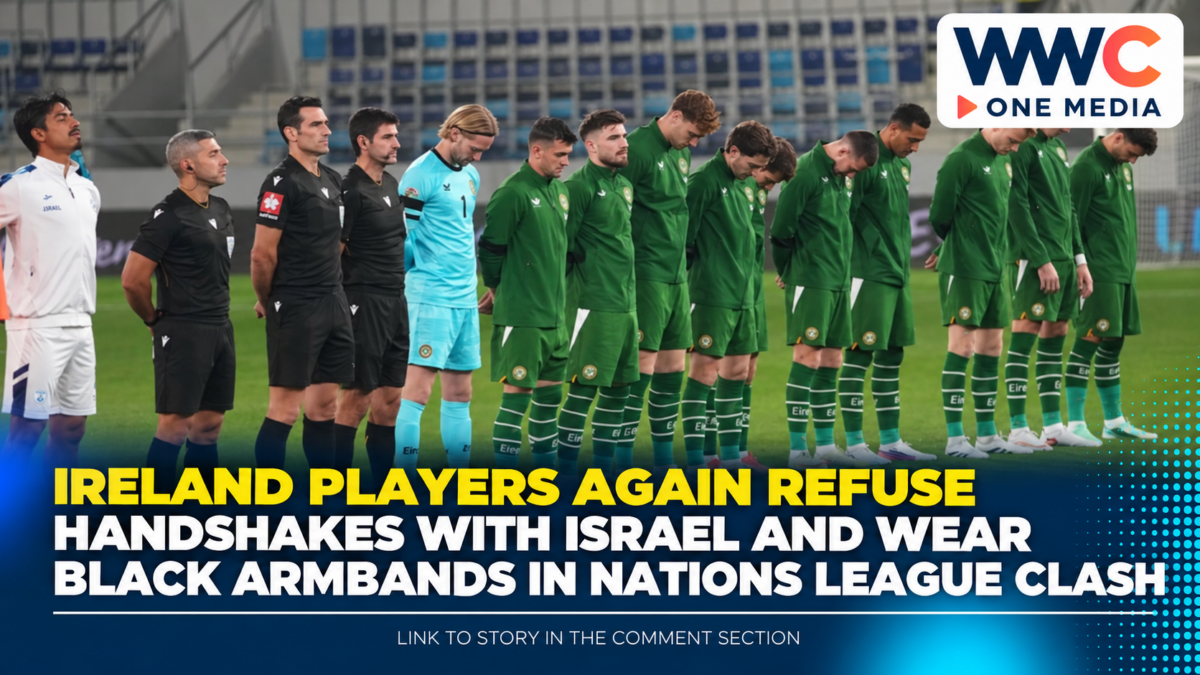
Ireland’s football players again declined to shake hands with their Israeli counterparts and wore black armbands during their UEFA Nations League meeting on Sunday (Oct. 4), continuing a protest over Israel’s actions in Gaza.
The politically charged match, held in Bačka Topola, Serbia, ended in a 1-1 draw. Irish players also bowed their heads during Israel’s national anthem before kick-off.
The gestures mirrored those made during the teams’ first Nations League meeting a week earlier in Debrecen, Hungary, when Ireland won 3-0.
Irish Players Repeat Protest
Ireland goalkeeper Caoimhín Kelleher, who captained the team in the absence of Dara O’Shea, declined to shake hands with Israel captain Dor Peretz during the pre-match formalities.
Kelleher did shake hands with the referee and one of his assistants, but avoided the customary handshake with Peretz. O’Shea had made a similar decision before the first meeting, when he declined to shake Israel captain Manor Solomon’s hand.
The Irish squad also wore black armbands and bowed their heads while Israel’s national anthem was played.
The Football Association of Ireland had previously said the armbands were intended as a mark of respect for lives lost in the Gaza conflict.
The Israeli players also wore black armbands, but for a different reason. Their gesture commemorated people killed during the Hamas-led attacks on Israel on Oct. 7, 2023. Peretz’s armband carried the date “7.10”.
Tense Atmosphere Surrounds Second Match
The second fixture had been surrounded by political controversy long before the teams took the field.
The match was originally scheduled to be played in Dublin, but the Football Association of Ireland moved it to Serbia, citing operational reasons following widespread calls for a boycott.
The FAI also decided that the match would be played without spectators.
The move came after the Irish federation had previously passed a motion calling on UEFA to exclude Israel from European club and international competitions.
Ireland has faced strong domestic pressure over the fixtures, with supporters and activists urging the team to refuse to play Israel.
More than 160 Irish sportspeople had reportedly signed an open letter calling on the FAI to reconsider its decision to proceed with the matches.
Reserve goalkeeper Gavin Bazunu was the only Ireland player to withdraw from both games. He said it was against his personal beliefs to participate in matches while innocent people were being killed.
Ireland Took the Lead Before Israel Equalised
Despite the political backdrop, the match itself remained competitive.
Ireland took the lead through Troy Parrott, who converted a penalty in the 39th minute after Peretz was adjudged to have fouled Jimmy Dunne.
Israel responded shortly after half-time. Peretz scored from close range just two minutes into the second half to bring the score level.
Israel came close to taking the lead later in the match, with substitutes Omri Gandelman and Oscar Gloukh both hitting the post.
The game ultimately finished 1-1.
Dispute Over Conduct During Match
Tensions also spilled over away from the symbolic pre-match gestures.
A disagreement broke out near the touchline as players headed toward the dressing rooms at half-time.
The match followed another controversial encounter between the teams in Hungary the previous week.
Ahead of Sunday’s game, an Israeli journalist alleged that Irish players had used a racial slur against Israeli players during the earlier match. Ireland’s communications officer Kieran Crowley rejected the allegation as false and ended the press conference.
There was also an allegation after Sunday’s match that an Israeli player spat at a member of Ireland’s coaching staff.
Ireland manager Heimir Hallgrimsson said the matter would be left for UEFA’s disciplinary process, while Israel coach Ran Ben-Shimon said he was unaware of the incident because he was in the dressing room at the time.
Ireland’s Longstanding Position on Palestine
Ireland has long been among Europe’s strongest supporters of Palestinian statehood.
Dublin formally recognised a Palestinian state in 2024, alongside Spain and Norway, and has repeatedly criticised Israel over its conduct during the Gaza conflict.
The political relationship between Ireland and Israel has deteriorated further during the war. Israel has accused the Irish government of anti-Israel bias, while Ireland has continued to call for greater protection of Palestinian civilians and accountability over the conflict.
The football controversy has therefore become part of a much broader political debate in Ireland over its relationship with Israel.
A Symbolic End to a Highly Charged Fixture
The Nations League meetings were always expected to attract attention beyond football.
Ireland’s decision to move the second match to a neutral venue, play without fans and allow players to make symbolic gestures reflected the unusually sensitive circumstances surrounding the fixtures.
For the Irish players, the black armbands, bowed heads and refusal to exchange handshakes provided a visible expression of their position on the Gaza conflict.
For Israel, the black armbands represented remembrance of those killed in the Oct. 7 attacks.
With the two Nations League meetings now completed, Ireland manager Hallgrimsson said he was relieved that the emotionally charged fixtures were over.
The football may have ended with a draw, but the political dispute surrounding the two teams has extended well beyond the pitch.