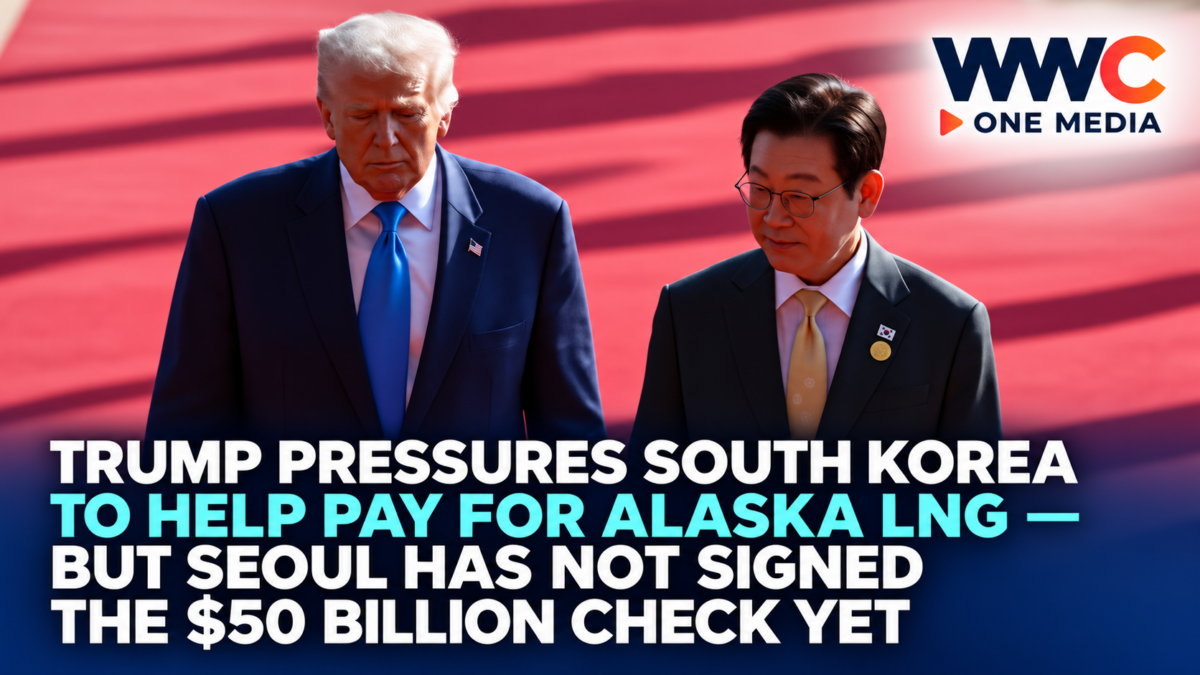
WASHINGTON/SEOUL — President Donald Trump is pressuring South Korea to help finance one of the most ambitious energy projects in the United States, saying Seoul should support the massive Alaska LNG development as part of a broader trade and investment deal — but South Korea has not yet finalized the kind of multibillion-dollar commitment Trump has publicly described.
The dispute centers on the long-planned Alaska LNG project, which would move natural gas from Alaska’s North Slope through a massive pipeline to the southern coast, where it could be liquefied and shipped to Asian buyers.
Trump has promoted the project as a cornerstone of his energy agenda and as a strategic way to strengthen U.S. exports to allies in Asia.
But he has also increasingly connected the project to trade pressure.
Trump warned that South Korea could face tougher tariffs if it does not participate in the Alaska LNG plan, according to current reporting.
That puts Seoul in a difficult position.
South Korea wants stable access to American energy.
It also wants favorable trade terms with Washington.
But committing tens of billions of dollars to one of the most expensive LNG infrastructure projects in the world is a very different decision.
Trump says South Korea should be part of the project
Trump has repeatedly presented South Korean participation as an important part of the Alaska LNG financing strategy.
He announced what he described as a $50 billion-plus South Korean investment connected to Alaska LNG, portraying it as a major milestone for the project.
Developer Glenfarne Group welcomed the announcement and said it would work with both the U.S. and Korean governments to finalize the investment structure.
But that wording is important.
The investment structure still needs to be finalized.
That means the project has political support and active negotiations — not necessarily a fully executed $50 billion Korean financing agreement.
JD Vance admits key details are still unresolved
Vice President JD Vance reinforced that distinction on October 5.
Vance said he expects the Alaska LNG project to move forward, but acknowledged that important details — especially involving South Korea — still need to be worked out.
That is a much more cautious description than simply saying South Korea has already agreed to pay.
Vance’s comments suggest the administration remains optimistic about Korean participation while recognizing that commercial and financing negotiations are incomplete.
For investors, that difference matters enormously.
A political announcement can create momentum.
A binding financing agreement actually pays for construction.
South Korea has a broader $350 billion U.S. investment package
The Alaska project is also being discussed inside a much larger economic relationship.
South Korean President Lee Jae Myung and Trump have been negotiating a broad strategic investment package worth roughly $350 billion, covering projects including energy, shipbuilding, nuclear power and other U.S. infrastructure.
Reuters reported that the Alaska LNG project is one of the initiatives being discussed under that framework.
That does not mean all $350 billion is going to Alaska LNG.
Nor does it mean Seoul has agreed to finance the project without conditions.
The package includes multiple U.S. strategic sectors.
Alaska LNG is one part of a much larger negotiation.
Why Washington wants South Korea so badly
South Korea is one of the world’s largest LNG importers.
Its economy depends heavily on imported energy because the country has limited domestic oil and gas production.
That makes Korean utilities and industrial companies natural potential buyers for Alaska LNG.
Geography also helps.
Alaska is much closer to Northeast Asia than U.S. Gulf Coast LNG terminals.
Glenfarne says shipping LNG from Alaska to Asian customers could be at least 65% cheaper than shipping from the U.S. Gulf Coast, because tankers would travel a much shorter route and avoid the Panama Canal.
That shipping advantage is one of the project’s strongest commercial arguments.
But the project itself is extremely expensive
Alaska LNG is also one of the most capital-intensive energy projects under consideration anywhere in North America.
Current estimates put total infrastructure costs at roughly $44.5 billion to $54.5 billion.
The project involves:
a gas treatment facility on Alaska’s North Slope;
hundreds of miles of pipeline;
multiple compressor stations;
in-state gas infrastructure;
and a large LNG export terminal in southern Alaska.
Those costs are significantly higher than many modern U.S. Gulf Coast LNG developments.
Glenfarne argues that comparing the projects directly is misleading because Alaska LNG includes infrastructure needed to access previously stranded North Slope gas.
That is true.
But the high upfront cost remains a serious financing challenge.
Glenfarne says Asian shipping savings make the economics work
Developer Glenfarne argues the project can justify its higher construction cost because of lower transportation expenses to Asia.
The company says its cost per million tons of annual LNG export capacity is around $1.4 billion, compared with roughly $1 billion for some newer Gulf Coast developments.
That premium is significant.
But Glenfarne says shorter shipping distances can compensate over the long term.
The company has already secured customers for approximately 13 million tonnes per annum of LNG and is targeting around 16 million tonnes to support financing.
That means the project is moving closer to the commercial threshold required for a final investment decision.
It is not there yet.
South Korea is already commercially involved
One reason Trump’s pressure is not completely disconnected from reality is that South Korean companies already have significant commercial ties to the project.
In December 2025, POSCO International finalized a 20-year agreement to buy 1 million tonnes of LNG annually from Alaska LNG.
POSCO also agreed to make an equity investment in the project before a final investment decision, although the exact amount was not publicly disclosed.
The Korean company is also expected to supply a significant portion of the steel needed for the pipeline.
So South Korea is already involved.
The dispute is over scale.
Buying LNG and investing some capital is very different from providing tens of billions of dollars in project financing.
Other customers are signing up too
Alaska LNG is not relying solely on South Korea.
Glenfarne has also signed a letter of intent with TotalEnergies for 2 million tonnes per year of LNG.
The developer has reported customer interest and preliminary agreements across Japan, Taiwan, Thailand and other Asian markets.
It has also secured upstream gas commitments.
In May, Glenfarne and ConocoPhillips Alaska signed a 30-year gas sales precedent agreement supplying enough North Slope gas to support the project’s first phase and Alaska’s own long-term energy needs.
These agreements make the project more credible.
But a final investment decision still requires far more financing and contractual certainty.
The project is being built in two phases
Glenfarne is trying to reduce risk by splitting Alaska LNG into financially independent phases.
Phase One focuses on the pipeline and delivering North Slope gas to Alaska customers.
The company says this phase is intended to address declining Cook Inlet natural-gas supply and improve energy security for Alaskans.
Phase Two would add the large LNG export facility needed to ship gas overseas.
That phased approach is strategically important.
It means some infrastructure can move forward even before the entire export project is fully financed.
It also allows Glenfarne to demonstrate progress to potential international investors.
Trump sees the pipeline as both an energy and trade weapon
For Trump, Alaska LNG serves several political goals at once.
It supports his campaign for greater U.S. fossil-fuel production.
It creates potential construction and energy jobs.
It provides an export market for American natural gas.
And it gives Washington leverage in trade negotiations with Asian allies.
That last point is increasingly important.
Trump has frequently linked tariff treatment to investment commitments.
South Korea is now facing that same approach.
The message from Washington is effectively:
Buy more American energy, invest more in U.S. projects, and help reduce the bilateral trade imbalance.
Trump has threatened tougher tariffs
Trump said South Korea could face increased tariffs if it does not sign onto the Alaska LNG project, according to reporting on his October remarks.
That changes the negotiation.
An ordinary LNG project would primarily be judged on:
price;
transport costs;
supply security;
and investment returns.
Trump is adding another factor:
access to the U.S. market.
That could make a Korean investment more politically attractive even if the standalone economics are not overwhelming.
But it also raises concerns in Seoul about being pressured into a project that must ultimately make commercial sense.
South Korea cannot simply order private companies to invest
Another important distinction is how South Korea’s economy works.
The Korean government can encourage investment.
It can negotiate trade agreements.
It can use state-backed lenders and public companies.
But much of the actual capital would likely come from corporations and financial institutions that still have to evaluate risk and return.
Companies such as POSCO may participate.
State-controlled Korea Gas Corp. could potentially become involved in purchasing.
Banks and export-credit agencies could support financing.
But those decisions require commercial structures.
A presidential announcement alone cannot substitute for them.
KOGAS is already diversifying LNG supply elsewhere
South Korea also has alternatives.
Korea Gas Corp., the country’s dominant LNG buyer, signed a 10-year contract with BP in May for 700,000 tonnes of LNG annually beginning in 2028.
That came on top of another long-term agreement for 3.3 million tonnes of U.S. LNG annually signed previously.
KOGAS has emphasized supply diversification and price competitiveness.
That means Alaska LNG must compete with:
U.S. Gulf Coast projects;
Qatar;
Australia;
Southeast Asia;
and other global suppliers.
The fact that Alaska is geographically closer does not automatically make it the cheapest source.
Energy security may still make Alaska attractive
South Korea’s experience with the Russia-Ukraine war and Middle East instability has increased the value of supply security.
The country relies on imported LNG for electricity, industry and heating.
Disruptions around the Strait of Hormuz have made diversification even more important.
Alaska offers several strategic advantages:
it is inside the United States;
it avoids Middle Eastern shipping chokepoints;
it sits closer to Northeast Asia;
and it could provide long-term contracted supply.
Those factors may justify paying somewhat more for the gas.
Energy security does not always mean buying the absolute cheapest molecule.
Sometimes it means paying for reliability.
Trump’s project also benefits from the global LNG boom
Alaska LNG is being revived at a favorable time for U.S. gas exporters.
Global demand for LNG has increased as countries seek alternatives to coal and Russian pipeline gas.
The United States has become one of the world’s largest LNG exporters.
Asia remains the biggest long-term growth market.
That creates a much stronger commercial environment than existed during some of Alaska LNG’s earlier attempts to secure financing.
But competition is also intense.
Qatar is expanding LNG production massively.
U.S. Gulf Coast developers are building new terminals.
Canada has opened new Pacific export routes.
Alaska LNG therefore has to win customers in one of the most competitive energy markets in the world.
The shorter route to Asia is genuinely valuable
The project’s geography remains its most compelling advantage.
A tanker departing Alaska can reach Japan or South Korea much faster than one leaving the Gulf of Mexico.
Gulf Coast cargoes may need to transit the Panama Canal or travel around Cape Horn.
Alaska cargoes move directly across the North Pacific.
That means:
less fuel burned;
fewer shipping days;
lower vessel costs;
and reduced exposure to canal congestion.
Glenfarne believes those savings can materially improve the project’s competitiveness.
Whether they are enough to justify the enormous construction bill remains the key commercial question.
The pipeline also matters to Alaska itself
The political discussion often focuses on exports to Asia.
But Alaska LNG also has a domestic purpose.
Southcentral Alaska has historically relied heavily on natural gas from Cook Inlet.
Those supplies are declining.
The project’s first phase could transport North Slope gas south, strengthening in-state energy security.
Glenfarne says this is why Phase One is structured to move forward independently of the export terminal.
That makes the pipeline more than an export project.
Even if overseas LNG markets change, Alaska still has an internal need for new gas supply.
Washington is also investing directly in Alaska energy infrastructure
The Trump administration is supporting broader Alaska infrastructure at the same time.
The U.S. Energy Department is preparing to provide $150 million for 223 miles of new transmission lines in Alaska, part of a roughly $400 million power project serving communities where nearly three-quarters of the state’s population lives.
That announcement reinforces the administration’s broader strategy:
build more energy infrastructure in Alaska and make the state a bigger part of U.S. national energy policy.
The LNG project is the centerpiece.
But it is not the only investment.
Politics are playing a major role
The timing also matters.
The Trump administration is pushing the Alaska project just weeks before the U.S. midterm elections.
Energy prices have become a major political vulnerability.
Gasoline and diesel costs have surged because of global conflicts and supply disruptions.
Trump has responded with a series of energy-focused initiatives.
He has expanded access to tax-exempt diesel.
Pressured allies to release strategic fuel reserves.
And promoted domestic oil and gas infrastructure.
Alaska LNG fits neatly into that message.
It allows Trump to argue that increasing U.S. production can simultaneously create jobs, strengthen allies and lower long-term energy risk.
But the project will not solve today’s fuel-price problem
That distinction is important.
Even if Alaska LNG receives financing soon, construction would take years.
The pipeline and export terminal cannot provide immediate relief from current energy prices.
The project is about long-term supply.
Not next month’s gasoline or heating bill.
Political messaging sometimes blurs that timeline.
Investors should not.
Large LNG projects require lengthy engineering, permitting, construction and commissioning.
The economic payoff comes much later.
A final investment decision remains the key milestone
The project still needs to reach a final investment decision, or FID.
That is the point where sponsors formally commit the billions required for full construction.
Before that can happen, developers generally need sufficient:
long-term customer contracts;
equity investors;
debt financing;
gas supply;
permits;
and construction agreements.
Glenfarne has made considerable progress in all of those areas.
But FID remains the real dividing line between an advanced proposal and a fully financed megaproject.
That is why South Korean participation matters so much.
A major Korean financial commitment could help push Alaska LNG across that line.
Seoul has leverage too
Trump is not the only side with negotiating power.
South Korea is an enormous LNG buyer.
Its companies could provide:
capital;
customers;
steel;
shipbuilding expertise;
and financing.
That gives Seoul leverage over commercial terms.
South Korea can ask for:
competitive LNG pricing;
favorable equity conditions;
guaranteed supply;
industrial participation;
or trade concessions.
So while Trump is publicly pressuring Korea, the negotiation works both ways.
A $50 billion project needs buyers almost as much as buyers need energy.
The real issue is not whether South Korea likes Alaska LNG
There is already evidence that Korean companies see value in the project.
POSCO has signed a 20-year purchase agreement.
Korean investment has been discussed at the presidential level.
Energy security makes the project strategically appealing.
The unresolved question is much narrower and much more important:
How much money will South Korea actually commit — and under what terms?
That is what has not yet been finalized.
Trump is trying to turn political momentum into financial certainty
Trump has successfully pushed Alaska LNG back onto the global energy agenda.
Asian customers are signing agreements.
Glenfarne says it has enough upstream gas for Phase One.
Construction preparations are advancing.
And South Korea is now part of the financing discussion.
But the gap between a political announcement and a completed project remains enormous.
Trump says South Korea should help pay for Alaska LNG and has even tied the issue to tariff pressure.
Seoul says the project is still being negotiated.
And Vice President Vance has now acknowledged the most important reality:
the details still need to be worked out.
That means the next major headline will not be another presidential promise.
It will be whether South Korea — or another group of investors — actually signs the financing agreements needed to turn the $50-billion Alaska LNG vision into a construction project.