
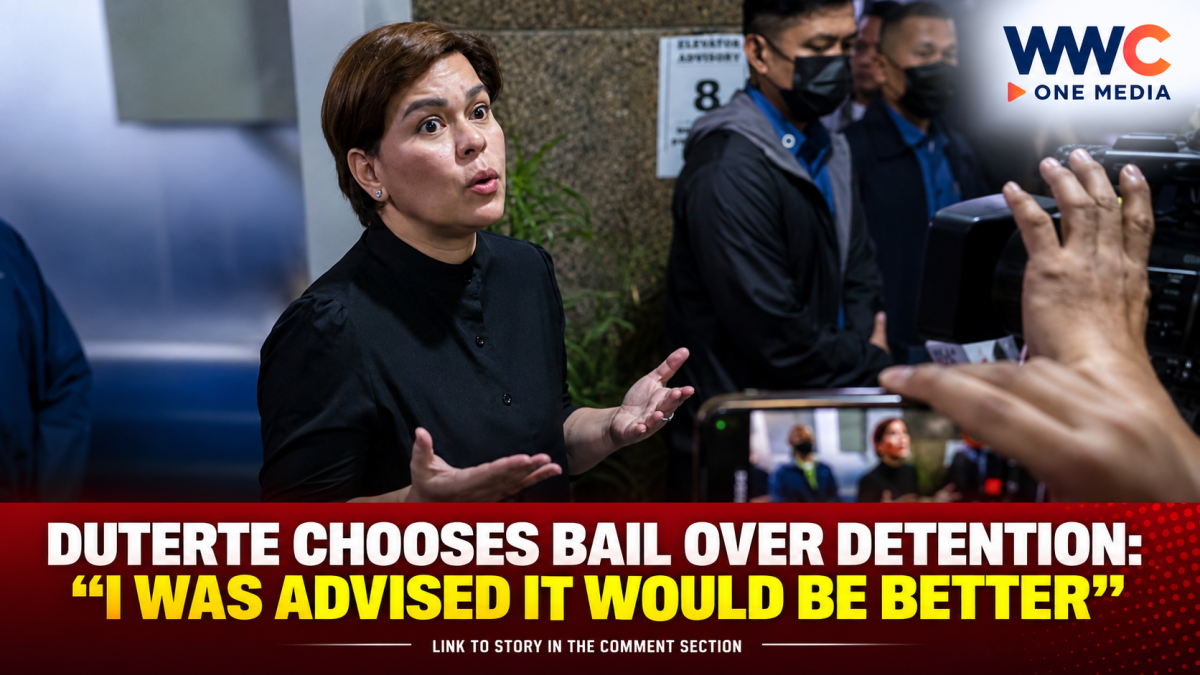
MANILA, Philippines — Vice President Sara Duterte has explained why she opted to post bail after a Quezon City court issued an arrest warrant against her, saying she had been advised that securing temporary liberty through bail would be better than remaining in detention.
Duterte’s decision came after Branch 98 of the Quezon City Regional Trial Court issued a warrant of arrest on Sept. 4 in connection with three counts of grave threats filed against her.
The court set bail at P120,000 for each count, bringing the total amount to P360,000.
On Saturday, Duterte posted bail and obtained an order lifting the arrest warrant, according to reports from The Associated Press and Reuters. Her lawyer, Paul Lawrence Lim, said the vice president had no intention of evading the law and would continue pursuing available legal remedies.
Duterte: Bail was the practical choice
Duterte has maintained that she is not guilty of the allegations and has questioned the circumstances surrounding the criminal case.
The case originated from remarks she made during an online press conference in November 2024, when she said that if she were killed, President Ferdinand Marcos Jr., First Lady Liza Araneta Marcos and then-House Speaker Martin Romualdez should also be killed.
The statements triggered a criminal investigation and eventually led to the filing of grave-threat charges. Duterte has disputed the interpretation of her remarks as an actual threat.
After the arrest order was issued, her legal team said she would comply with the legal process while continuing to challenge the case.
P360,000 bail for three charges
The court imposed P120,000 bail per count, meaning Duterte needed to post P360,000 to secure temporary release in the three cases.
Legal experts cited by the Inquirer noted that the vice president’s position does not provide immunity from criminal prosecution.
University of the Philippines College of Law Assistant Dean and constitutional law professor Paolo Emmanuel Tamase told the Inquirer that the Constitution does not give the vice president the same immunity from suit enjoyed by a sitting president.
He also explained that bail in Duterte’s case is essentially a standard legal process because the charges are bailable.
Arrest does not automatically mean conviction
The arrest warrant followed the court’s finding of probable cause to proceed with the three grave-threat charges. However, probable cause is not a finding of guilt.
Duterte remains entitled to the presumption of innocence while the criminal proceedings continue.
Her criminal case is also separate from the impeachment proceedings she is facing before the Senate.
The Inquirer reported that while the two proceedings are legally distinct, the criminal case could nevertheless influence public perceptions of the impeachment trial.
Duterte’s legal and political battles continue
The bail episode comes as Duterte faces several major legal and political challenges.
Her impeachment trial is ongoing before the Senate, where she faces allegations that include the alleged misuse of public funds and the same controversial statements involving Marcos, his wife and Romualdez.
The criminal case over the alleged threats, however, will proceed independently from the impeachment proceedings.
The development also adds another chapter to the dramatic collapse of the political alliance between the Marcos and Duterte families.
Marcos and Sara Duterte ran together in the 2022 national elections, but their relationship deteriorated sharply in the succeeding years. The dispute has since expanded into criminal, constitutional and political battles.
What happens after bail?
Posting bail does not end the criminal case.
It allows the accused to remain out of detention while complying with the conditions imposed by the court and attending required proceedings. The case itself continues unless dismissed or otherwise resolved through the judicial process.
For Duterte, that means the latest development is not the end of the controversy—it is the beginning of another phase of the legal battle.
And with her impeachment trial also underway, the question now is how the criminal case and the Senate proceedings will shape the next chapter of her political future.
WWC ONE MEDIA J.M.S




Leave a Reply