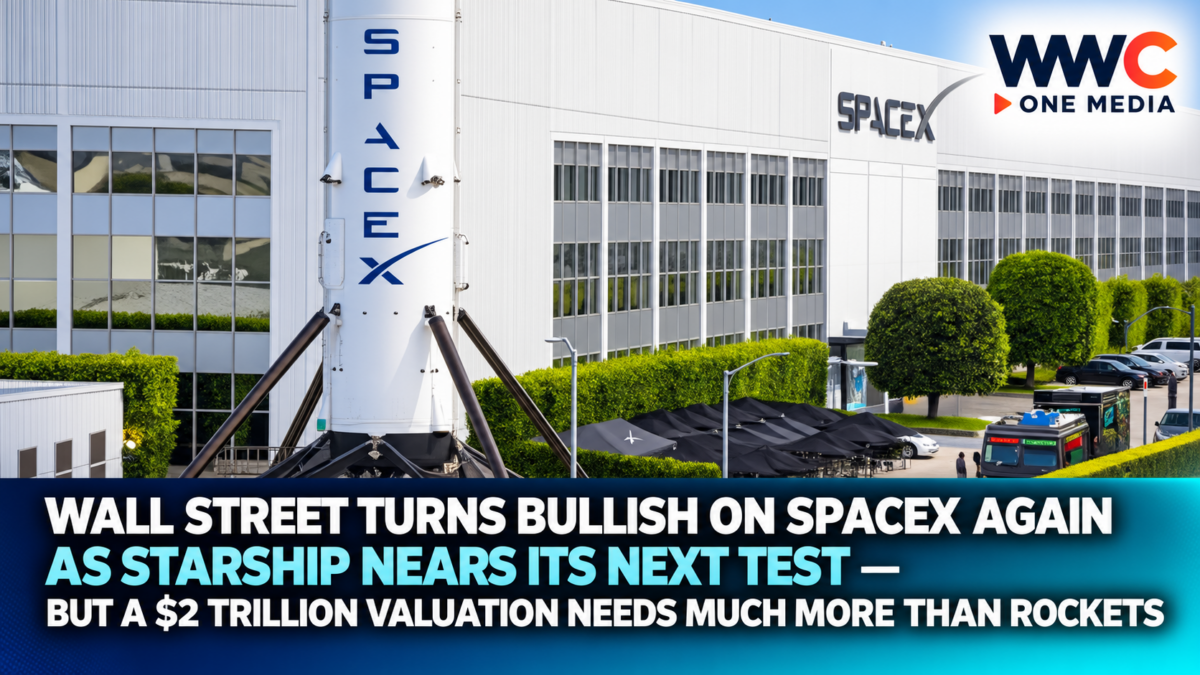
NEW YORK — Wall Street is warming up to SpaceX again after months of volatility, with analysts arguing Elon Musk’s rocket company could be substantially undervalued ahead of another crucial Starship test flight—but the bullish case increasingly depends on much more than launching satellites.
SpaceX shares surged 7.6% on Monday to $171.09, their highest level since shortly after the company’s blockbuster June IPO.
The stock is now roughly 27% above its $135 IPO price, although it remains below some of the highs reached soon after its market debut.
The latest rally was fueled partly by Morgan Stanley analyst Adam Jonas, one of Wall Street’s most aggressive SpaceX bulls.
Jonas reiterated an Overweight rating and $300 price target, arguing that investors may have only a short window to accumulate shares before several major technological catalysts arrive.
At Monday’s closing price, that target implies roughly 75% potential upside.
But the real investment debate is no longer simply whether SpaceX can launch more rockets than everyone else.
The bigger question is whether it can transform Starship, Starlink and its emerging AI business into enough revenue and profit to justify a valuation already approaching the scale of the world’s biggest technology companies.
Morgan Stanley calls SpaceX “cheap”—despite its enormous valuation
Calling a company valued at roughly $2 trillion cheap sounds counterintuitive.
Morgan Stanley’s argument is based on expected growth rather than SpaceX’s current absolute valuation.
Jonas estimates SpaceX trades at roughly 30 times projected 2028 operating profit, almost double the median multiple for large technology companies.
But when that valuation is adjusted for SpaceX’s expected growth rate, Morgan Stanley says the stock looks comparatively inexpensive.
That distinction is central to the bull case.
Investors are not paying only for today’s Falcon launches and Starlink subscriptions.
They are paying for what SpaceX could become if it successfully combines:
Starship;
Starlink broadband;
satellite-to-phone connectivity;
government and military services;
orbital AI computing;
and future commercial space infrastructure.
That is an extraordinarily ambitious collection of businesses.
It is also why estimating what SpaceX is worth requires investors to make assumptions about industries that barely exist today.
Starship Flight 14 changed the narrative
SpaceX gave bulls an important piece of evidence on September 28.
During Starship’s 14th test flight, the enormous rocket reached orbit for the first time and successfully deployed 26 Starlink V3 satellites.
That was Starship’s first meaningful commercial payload deployment and marked an important transition from experimental test vehicle toward potentially operational launch system.
Starship did not complete everything SpaceX hoped.
One engine shut down prematurely, shortening the planned mission.
The spacecraft remained in orbit for roughly three hours rather than the intended 10, and SpaceX is still investigating propulsion problems.
Those issues matter.
But reaching orbit and deploying operational Starlink hardware represented a significant advance from earlier flights that ended before completing major objectives.
For investors, the milestone reduced at least some of the technological uncertainty surrounding the program.
Flight 15 could be even more important
Wall Street’s attention is now shifting to Starship Flight 15, expected later in October or possibly early November, subject to testing, regulatory approval and launch readiness.
Morgan Stanley believes the coming flight could become another major catalyst for the stock.
One of the most important objectives expected in coming Starship missions is demonstrating increasingly ambitious recovery techniques.
SpaceX ultimately wants both the giant Super Heavy booster and the Starship upper stage to become rapidly reusable.
That is the economic breakthrough Musk has promised for years.
Falcon 9 already demonstrated that reusing rockets can dramatically lower launch costs.
Starship is designed to take the idea much further.
The real prize is not reaching orbit—it is full reusability
Starship is the largest and most powerful launch system SpaceX has ever developed.
It is designed to carry more than 100 metric tons to low-Earth orbit, compared with roughly 22.8 metric tons for Falcon 9 and 63.8 metric tons for Falcon Heavy.
But carrying a huge payload alone is not what makes the system revolutionary.
SpaceX wants to recover the booster and spacecraft, refuel them and fly them again rapidly.
If that works reliably, the cost of putting each kilogram into orbit could fall dramatically.
That would change the economics of:
satellite deployment;
lunar missions;
Mars missions;
space stations;
military launches;
and potentially orbital data centers.
Morgan Stanley believes that is where much of SpaceX’s long-term value lies.
But it has not been fully demonstrated yet.
Wall Street is becoming much more bullish
Morgan Stanley is not alone.
Recent analyst initiations and updates have become increasingly positive.
TD Cowen initiated SpaceX with a Buy rating and $200 target.
CLSA began coverage with an Outperform rating and $250 target.
Macquarie maintained an Outperform rating with a $250 target.
Deutsche Bank retained a Buy rating and $235 target.
Across 32 analysts tracked by Benzinga, 26 carried Buy or Strong Buy recommendations, five rated the shares Hold and only one had a Sell rating.
The average price target was around $226, implying roughly 32% upside from Monday’s close.
Those estimates vary substantially.
And price targets are opinions—not guarantees.
But they show how dramatically sentiment has shifted since the summer.
SpaceX stock had fallen more than 30% from its early peak
The renewed optimism follows a painful period for investors.
After its enormous June IPO, SpaceX shares initially surged.
But the stock later fell below its $135 offer price and at one stage dropped more than 30% from its post-listing peak.
The decline reflected several concerns:
Starship development risk;
heavy capital spending;
AI-related losses;
possible insider selling;
and questions about whether investors had valued the company too aggressively during one of history’s most hyped public offerings.
That correction is important context.
Wall Street is not suddenly discovering SpaceX.
Analysts are becoming more bullish after the stock went through a significant valuation reset.
The IPO itself was unprecedented
SpaceX went public in June through the largest U.S. initial public offering ever.
The company sold roughly 555.6 million shares at $135 each, raising $75 billion and valuing SpaceX at approximately $1.77 trillion.
That dwarfed previous U.S. IPO records and even exceeded Saudi Aramco’s original offering in terms of money raised.
Shares opened at $150 on their first trading day.
The deal instantly placed SpaceX among the world’s most valuable publicly traded companies.
But the valuation came with enormous expectations.
SpaceX had generated $18.67 billion in revenue in 2025, yet posted a roughly $4.94 billion net loss, largely because enormous spending on AI infrastructure and Starship development overwhelmed profits generated elsewhere in the business.
That is why investors cannot evaluate SpaceX like an ordinary aerospace manufacturer.
Starlink remains the financial foundation
The most mature part of SpaceX’s business is Starlink.
The satellite broadband network accounted for roughly 60% of SpaceX’s 2025 revenue and had around 10.3 million users served by a constellation of roughly 9,600 satellites at the time of the IPO.
Starlink has transformed SpaceX’s financial profile.
Traditional rocket launches can produce substantial revenue, but launches are episodic.
Starlink generates recurring subscription income.
Residential customers pay monthly.
Businesses pay.
Airlines and ships pay.
Governments and militaries purchase connectivity.
That recurring revenue provides SpaceX with something most launch companies never had:
a massive customer-facing subscription business.
Starship could make Starlink dramatically more powerful
This is another reason Flight 14 mattered.
The 26 Starlink V3 satellites carried by Starship were not merely demonstration payloads.
SpaceX says the new generation has roughly 10 times the data capacity of previous versions.
Starship can also carry far more satellites per launch than Falcon 9.
That creates a potentially powerful economic loop:
Starship lowers the cost of deploying Starlink satellites.
More powerful satellites increase network capacity.
More capacity allows Starlink to serve more customers.
More customers generate more cash.
That cash helps fund more Starships.
This vertical integration is one of the strongest parts of the SpaceX investment thesis.
The next frontier may be AI in orbit
But Morgan Stanley’s most aggressive valuation assumptions increasingly involve artificial intelligence.
Jonas argues SpaceX’s emerging AI businesses are not being fully reflected in the stock price.
He sees substantial future value in both enterprise and consumer AI applications.
Musk has also discussed placing computing infrastructure and AI hardware in space.
The idea is that solar-powered orbital data centers could eventually use enormous amounts of energy without requiring the same terrestrial grid connections, land or cooling systems as conventional facilities.
That sounds futuristic.
It is.
But SpaceX has already begun moving in that direction.
Recent launches included AI computing hardware, and Morgan Stanley sees future orbital AI products as an important potential catalyst.
SpaceX’s AI business is still far less proven than its rocket business
This is where investors should be especially careful.
SpaceX has demonstrated extraordinary launch dominance.
Starlink already generates significant revenue.
AI is a different story.
At the time of SpaceX’s IPO, Reuters noted that its AI operation trailed major rivals such as OpenAI and Anthropic in adoption.
Ramp spending data showed xAI services being used by roughly 5% of businesses in its sample, far below the shares paying for OpenAI or Anthropic products.
That means a large portion of the future AI value embedded in bullish SpaceX estimates remains speculative.
The technology may succeed enormously.
But the commercial evidence is much weaker today than the evidence supporting Starlink.
Musk has now renamed the AI operation again
Over the weekend, Musk said the company’s AI unit would be renamed from SpaceXAI to SpaceXSI, short for “super intelligence.”
The name change itself does not alter SpaceX’s economics.
But it highlights how tightly the company’s investment narrative is becoming linked to artificial intelligence.
SpaceX is increasingly being valued not simply as:
a rocket company,
or even a satellite company,
but as a combined aerospace, communications and AI platform.
That dramatically expands the theoretical addressable market.
It also dramatically expands execution risk.
Some analysts imagine a $12 trillion SpaceX
The most aggressive Wall Street forecasts go far beyond Morgan Stanley’s $300 target.
Citi analysts have discussed a long-term scenario in which SpaceX could eventually be worth around $12.2 trillion, or roughly $900 per share, if Starship, Starlink and future businesses achieve extremely ambitious revenue assumptions.
That is not Citi saying SpaceX is worth $12 trillion today.
It is a highly bullish long-range scenario.
The estimate assumes the company develops businesses at scales that do not currently exist.
It therefore illustrates both the extraordinary optimism surrounding SpaceX and the enormous uncertainty embedded in its valuation.
A trillion-dollar future revenue estimate only matters if SpaceX can actually execute.
NASA needs Starship too
Commercial investors are not the only people watching Starship.
NASA has selected a version of Starship as a lunar lander for its Artemis program.
But the timetable remains challenging.
Reuters reported this week that Artemis III remains targeted for 2027, although NASA astronauts acknowledged that schedules could change depending partly on the progress of SpaceX and Blue Origin lander systems.
Starship still needs to demonstrate several difficult technologies relevant to lunar missions, including:
reliable propulsion;
orbital refueling;
spacecraft rendezvous;
long-duration operations;
and eventually lunar landing and ascent.
The September engine failure showed that significant technical challenges remain.
That makes every test flight more than a spectacle.
NASA’s own lunar timeline partly depends on them.
SpaceX is preparing Florida for much heavier launch activity
Another sign of the company’s ambition emerged October 5.
A SpaceX subsidiary requested regulatory approval to construct a 32.4-mile natural-gas pipeline in Florida to support operations around Cape Canaveral.
The proposal is aimed at ensuring a reliable fuel supply for future launch operations.
Infrastructure investments like this matter because SpaceX ultimately wants Starship launches to become frequent—not rare.
Flying a rocket once every several months cannot create airline-like launch economics.
SpaceX needs a system capable of launching repeatedly and quickly.
That requires launchpads, fuel production, pipelines, ground equipment and regulatory infrastructure capable of supporting extremely high cadence.
The company already dominates conventional launches
SpaceX begins that effort from a position no competitor currently matches.
At the time of its IPO, SpaceX said its rockets had carried more than four-fifths of all mass launched into orbit globally over the previous three years.
Falcon 9’s partial reusability transformed the launch market.
Competitors including Blue Origin, Rocket Lab and traditional aerospace groups are working aggressively to close that gap.
But SpaceX has a major advantage:
it already operates a high-frequency launch network.
Starship does not need to build an entire launch culture from zero.
It can potentially scale within an organization already accustomed to reusing rockets.
That does not mean Starship success is guaranteed
Starship development has been spectacular precisely because SpaceX deliberately accepts failures during testing.
Vehicles have exploded.
Engines have malfunctioned.
Flights have ended early.
Hardware has been destroyed.
That iterative approach helped SpaceX develop Falcon rockets rapidly.
But public-market investors may react differently to dramatic test failures than private investors did.
Each Starship flight can now become a major stock-market event.
A successful recovery could send shares sharply higher.
A major failure—especially one suggesting a systemic engine or vehicle problem—could do the opposite.
That volatility comes with the territory.
The valuation already assumes extraordinary success
SpaceX’s biggest investment risk is therefore not necessarily that the company fails.
The company can remain extraordinarily successful and still disappoint investors.
At the IPO price, Reuters estimated SpaceX traded at about 94 times trailing sales.
That is an extreme multiple for any business.
Investors are effectively assuming dramatic future revenue growth and eventual profitability.
If SpaceX merely remains the world’s dominant rocket company and operates a successful broadband business, that may not be enough to justify the most bullish valuations.
The market increasingly expects something much bigger.
A successful Flight 15 could change launch economics—but not overnight
That is why Wall Street is so focused on the next Starship milestones.
A successful test could demonstrate that SpaceX is moving closer to full reusability.
That would strengthen the long-term argument for dramatically lower launch costs.
It could make heavier Starlink constellations economically practical.
It could improve confidence in NASA lunar missions.
And it could make orbital AI infrastructure look slightly less futuristic.
But one successful flight would still not prove that Starship can operate repeatedly and profitably.
SpaceX needs reliability.
Cadence.
Rapid refurbishment.
And eventually full vehicle recovery.
The investment thesis depends on all of them.
Wall Street is buying the possibility of a new economic platform
This is what makes SpaceX different from most companies.
Investors are not merely trying to estimate how many rockets it will launch next year.
They are trying to place a value on the possibility that cheaper access to space creates entirely new industries.
Satellite broadband already demonstrated one example.
Orbital AI could become another.
Lunar logistics could become another.
Space manufacturing could follow.
Musk ultimately talks about Mars.
Each layer adds potential value.
Each also adds another assumption.
The next few flights could determine how seriously investors take those assumptions
Morgan Stanley believes the market is currently underestimating SpaceX’s growth opportunities.
Other analysts are becoming more positive.
The stock has finally climbed back above its IPO price.
Starship has reached orbit.
And the next round of testing is approaching.
That creates a powerful setup for investors who believe Starship is on the verge of transitioning from experimental spacecraft into an operational platform.
But SpaceX’s roughly $2-trillion valuation means the company is already being judged against some of the greatest businesses ever created.
Starship does not simply need to fly.
It eventually needs to fly cheaply, repeatedly and reliably enough to transform SpaceX’s economics.
That is why Wall Street’s renewed optimism carries such an enormous caveat.
Wall Street Turns Bullish on SpaceX Again as Starship Nears Its Next Test — But a $2 Trillion Valuation Needs Much More Than Rockets
NEW YORK — Wall Street is warming up to SpaceX again after months of volatility, with analysts arguing Elon Musk’s rocket company could be substantially undervalued ahead of another crucial Starship test flight—but the bullish case increasingly depends on much more than launching satellites.
SpaceX shares surged 7.6% on Monday to $171.09, their highest level since shortly after the company’s blockbuster June IPO.
The stock is now roughly 27% above its $135 IPO price, although it remains below some of the highs reached soon after its market debut.
The latest rally was fueled partly by Morgan Stanley analyst Adam Jonas, one of Wall Street’s most aggressive SpaceX bulls.
Jonas reiterated an Overweight rating and $300 price target, arguing that investors may have only a short window to accumulate shares before several major technological catalysts arrive.
At Monday’s closing price, that target implies roughly 75% potential upside.
But the real investment debate is no longer simply whether SpaceX can launch more rockets than everyone else.
The bigger question is whether it can transform Starship, Starlink and its emerging AI business into enough revenue and profit to justify a valuation already approaching the scale of the world’s biggest technology companies.
Morgan Stanley calls SpaceX “cheap”—despite its enormous valuation
Calling a company valued at roughly $2 trillion cheap sounds counterintuitive.
Morgan Stanley’s argument is based on expected growth rather than SpaceX’s current absolute valuation.
Jonas estimates SpaceX trades at roughly 30 times projected 2028 operating profit, almost double the median multiple for large technology companies.
But when that valuation is adjusted for SpaceX’s expected growth rate, Morgan Stanley says the stock looks comparatively inexpensive.
That distinction is central to the bull case.
Investors are not paying only for today’s Falcon launches and Starlink subscriptions.
They are paying for what SpaceX could become if it successfully combines:
Starship;
Starlink broadband;
satellite-to-phone connectivity;
government and military services;
orbital AI computing;
and future commercial space infrastructure.
That is an extraordinarily ambitious collection of businesses.
It is also why estimating what SpaceX is worth requires investors to make assumptions about industries that barely exist today.
Starship Flight 14 changed the narrative
SpaceX gave bulls an important piece of evidence on September 28.
During Starship’s 14th test flight, the enormous rocket reached orbit for the first time and successfully deployed 26 Starlink V3 satellites.
That was Starship’s first meaningful commercial payload deployment and marked an important transition from experimental test vehicle toward potentially operational launch system.
Starship did not complete everything SpaceX hoped.
One engine shut down prematurely, shortening the planned mission.
The spacecraft remained in orbit for roughly three hours rather than the intended 10, and SpaceX is still investigating propulsion problems.
Those issues matter.
But reaching orbit and deploying operational Starlink hardware represented a significant advance from earlier flights that ended before completing major objectives.
For investors, the milestone reduced at least some of the technological uncertainty surrounding the program.
Flight 15 could be even more important
Wall Street’s attention is now shifting to Starship Flight 15, expected later in October or possibly early November, subject to testing, regulatory approval and launch readiness.
Morgan Stanley believes the coming flight could become another major catalyst for the stock.
One of the most important objectives expected in coming Starship missions is demonstrating increasingly ambitious recovery techniques.
SpaceX ultimately wants both the giant Super Heavy booster and the Starship upper stage to become rapidly reusable.
That is the economic breakthrough Musk has promised for years.
Falcon 9 already demonstrated that reusing rockets can dramatically lower launch costs.
Starship is designed to take the idea much further.
The real prize is not reaching orbit—it is full reusability
Starship is the largest and most powerful launch system SpaceX has ever developed.
It is designed to carry more than 100 metric tons to low-Earth orbit, compared with roughly 22.8 metric tons for Falcon 9 and 63.8 metric tons for Falcon Heavy.
But carrying a huge payload alone is not what makes the system revolutionary.
SpaceX wants to recover the booster and spacecraft, refuel them and fly them again rapidly.
If that works reliably, the cost of putting each kilogram into orbit could fall dramatically.
That would change the economics of:
satellite deployment;
lunar missions;
Mars missions;
space stations;
military launches;
and potentially orbital data centers.
Morgan Stanley believes that is where much of SpaceX’s long-term value lies.
But it has not been fully demonstrated yet.
Wall Street is becoming much more bullish
Morgan Stanley is not alone.
Recent analyst initiations and updates have become increasingly positive.
TD Cowen initiated SpaceX with a Buy rating and $200 target.
CLSA began coverage with an Outperform rating and $250 target.
Macquarie maintained an Outperform rating with a $250 target.
Deutsche Bank retained a Buy rating and $235 target.
Across 32 analysts tracked by Benzinga, 26 carried Buy or Strong Buy recommendations, five rated the shares Hold and only one had a Sell rating.
The average price target was around $226, implying roughly 32% upside from Monday’s close.
Those estimates vary substantially.
And price targets are opinions—not guarantees.
But they show how dramatically sentiment has shifted since the summer.
SpaceX stock had fallen more than 30% from its early peak
The renewed optimism follows a painful period for investors.
After its enormous June IPO, SpaceX shares initially surged.
But the stock later fell below its $135 offer price and at one stage dropped more than 30% from its post-listing peak.
The decline reflected several concerns:
Starship development risk;
heavy capital spending;
AI-related losses;
possible insider selling;
and questions about whether investors had valued the company too aggressively during one of history’s most hyped public offerings.
That correction is important context.
Wall Street is not suddenly discovering SpaceX.
Analysts are becoming more bullish after the stock went through a significant valuation reset.
The IPO itself was unprecedented
SpaceX went public in June through the largest U.S. initial public offering ever.
The company sold roughly 555.6 million shares at $135 each, raising $75 billion and valuing SpaceX at approximately $1.77 trillion.
That dwarfed previous U.S. IPO records and even exceeded Saudi Aramco’s original offering in terms of money raised.
Shares opened at $150 on their first trading day.
The deal instantly placed SpaceX among the world’s most valuable publicly traded companies.
But the valuation came with enormous expectations.
SpaceX had generated $18.67 billion in revenue in 2025, yet posted a roughly $4.94 billion net loss, largely because enormous spending on AI infrastructure and Starship development overwhelmed profits generated elsewhere in the business.
That is why investors cannot evaluate SpaceX like an ordinary aerospace manufacturer.
Starlink remains the financial foundation
The most mature part of SpaceX’s business is Starlink.
The satellite broadband network accounted for roughly 60% of SpaceX’s 2025 revenue and had around 10.3 million users served by a constellation of roughly 9,600 satellites at the time of the IPO.
Starlink has transformed SpaceX’s financial profile.
Traditional rocket launches can produce substantial revenue, but launches are episodic.
Starlink generates recurring subscription income.
Residential customers pay monthly.
Businesses pay.
Airlines and ships pay.
Governments and militaries purchase connectivity.
That recurring revenue provides SpaceX with something most launch companies never had:
a massive customer-facing subscription business.
Starship could make Starlink dramatically more powerful
This is another reason Flight 14 mattered.
The 26 Starlink V3 satellites carried by Starship were not merely demonstration payloads.
SpaceX says the new generation has roughly 10 times the data capacity of previous versions.
Starship can also carry far more satellites per launch than Falcon 9.
That creates a potentially powerful economic loop:
Starship lowers the cost of deploying Starlink satellites.
More powerful satellites increase network capacity.
More capacity allows Starlink to serve more customers.
More customers generate more cash.
That cash helps fund more Starships.
This vertical integration is one of the strongest parts of the SpaceX investment thesis.
The next frontier may be AI in orbit
But Morgan Stanley’s most aggressive valuation assumptions increasingly involve artificial intelligence.
Jonas argues SpaceX’s emerging AI businesses are not being fully reflected in the stock price.
He sees substantial future value in both enterprise and consumer AI applications.
Musk has also discussed placing computing infrastructure and AI hardware in space.
The idea is that solar-powered orbital data centers could eventually use enormous amounts of energy without requiring the same terrestrial grid connections, land or cooling systems as conventional facilities.
That sounds futuristic.
It is.
But SpaceX has already begun moving in that direction.
Recent launches included AI computing hardware, and Morgan Stanley sees future orbital AI products as an important potential catalyst.
SpaceX’s AI business is still far less proven than its rocket business
This is where investors should be especially careful.
SpaceX has demonstrated extraordinary launch dominance.
Starlink already generates significant revenue.
AI is a different story.
At the time of SpaceX’s IPO, Reuters noted that its AI operation trailed major rivals such as OpenAI and Anthropic in adoption.
Ramp spending data showed xAI services being used by roughly 5% of businesses in its sample, far below the shares paying for OpenAI or Anthropic products.
That means a large portion of the future AI value embedded in bullish SpaceX estimates remains speculative.
The technology may succeed enormously.
But the commercial evidence is much weaker today than the evidence supporting Starlink.
Musk has now renamed the AI operation again
Over the weekend, Musk said the company’s AI unit would be renamed from SpaceXAI to SpaceXSI, short for “super intelligence.”
The name change itself does not alter SpaceX’s economics.
But it highlights how tightly the company’s investment narrative is becoming linked to artificial intelligence.
SpaceX is increasingly being valued not simply as:
a rocket company,
or even a satellite company,
but as a combined aerospace, communications and AI platform.
That dramatically expands the theoretical addressable market.
It also dramatically expands execution risk.
Some analysts imagine a $12 trillion SpaceX
The most aggressive Wall Street forecasts go far beyond Morgan Stanley’s $300 target.
Citi analysts have discussed a long-term scenario in which SpaceX could eventually be worth around $12.2 trillion, or roughly $900 per share, if Starship, Starlink and future businesses achieve extremely ambitious revenue assumptions.
That is not Citi saying SpaceX is worth $12 trillion today.
It is a highly bullish long-range scenario.
The estimate assumes the company develops businesses at scales that do not currently exist.
It therefore illustrates both the extraordinary optimism surrounding SpaceX and the enormous uncertainty embedded in its valuation.
A trillion-dollar future revenue estimate only matters if SpaceX can actually execute.
NASA needs Starship too
Commercial investors are not the only people watching Starship.
NASA has selected a version of Starship as a lunar lander for its Artemis program.
But the timetable remains challenging.
Reuters reported this week that Artemis III remains targeted for 2027, although NASA astronauts acknowledged that schedules could change depending partly on the progress of SpaceX and Blue Origin lander systems.
Starship still needs to demonstrate several difficult technologies relevant to lunar missions, including:
reliable propulsion;
orbital refueling;
spacecraft rendezvous;
long-duration operations;
and eventually lunar landing and ascent.
The September engine failure showed that significant technical challenges remain.
That makes every test flight more than a spectacle.
NASA’s own lunar timeline partly depends on them.
SpaceX is preparing Florida for much heavier launch activity
Another sign of the company’s ambition emerged October 5.
A SpaceX subsidiary requested regulatory approval to construct a 32.4-mile natural-gas pipeline in Florida to support operations around Cape Canaveral.
The proposal is aimed at ensuring a reliable fuel supply for future launch operations.
Infrastructure investments like this matter because SpaceX ultimately wants Starship launches to become frequent—not rare.
Flying a rocket once every several months cannot create airline-like launch economics.
SpaceX needs a system capable of launching repeatedly and quickly.
That requires launchpads, fuel production, pipelines, ground equipment and regulatory infrastructure capable of supporting extremely high cadence.
The company already dominates conventional launches
SpaceX begins that effort from a position no competitor currently matches.
At the time of its IPO, SpaceX said its rockets had carried more than four-fifths of all mass launched into orbit globally over the previous three years.
Falcon 9’s partial reusability transformed the launch market.
Competitors including Blue Origin, Rocket Lab and traditional aerospace groups are working aggressively to close that gap.
But SpaceX has a major advantage:
it already operates a high-frequency launch network.
Starship does not need to build an entire launch culture from zero.
It can potentially scale within an organization already accustomed to reusing rockets.
That does not mean Starship success is guaranteed
Starship development has been spectacular precisely because SpaceX deliberately accepts failures during testing.
Vehicles have exploded.
Engines have malfunctioned.
Flights have ended early.
Hardware has been destroyed.
That iterative approach helped SpaceX develop Falcon rockets rapidly.
But public-market investors may react differently to dramatic test failures than private investors did.
Each Starship flight can now become a major stock-market event.
A successful recovery could send shares sharply higher.
A major failure—especially one suggesting a systemic engine or vehicle problem—could do the opposite.
That volatility comes with the territory.
The valuation already assumes extraordinary success
SpaceX’s biggest investment risk is therefore not necessarily that the company fails.
The company can remain extraordinarily successful and still disappoint investors.
At the IPO price, Reuters estimated SpaceX traded at about 94 times trailing sales.
That is an extreme multiple for any business.
Investors are effectively assuming dramatic future revenue growth and eventual profitability.
If SpaceX merely remains the world’s dominant rocket company and operates a successful broadband business, that may not be enough to justify the most bullish valuations.
The market increasingly expects something much bigger.
A successful Flight 15 could change launch economics—but not overnight
That is why Wall Street is so focused on the next Starship milestones.
A successful test could demonstrate that SpaceX is moving closer to full reusability.
That would strengthen the long-term argument for dramatically lower launch costs.
It could make heavier Starlink constellations economically practical.
It could improve confidence in NASA lunar missions.
And it could make orbital AI infrastructure look slightly less futuristic.
But one successful flight would still not prove that Starship can operate repeatedly and profitably.
SpaceX needs reliability.
Cadence.
Rapid refurbishment.
And eventually full vehicle recovery.
The investment thesis depends on all of them.
Wall Street is buying the possibility of a new economic platform
This is what makes SpaceX different from most companies.
Investors are not merely trying to estimate how many rockets it will launch next year.
They are trying to place a value on the possibility that cheaper access to space creates entirely new industries.
Satellite broadband already demonstrated one example.
Orbital AI could become another.
Lunar logistics could become another.
Space manufacturing could follow.
Musk ultimately talks about Mars.
Each layer adds potential value.
Each also adds another assumption.
The next few flights could determine how seriously investors take those assumptions
Morgan Stanley believes the market is currently underestimating SpaceX’s growth opportunities.
Other analysts are becoming more positive.
The stock has finally climbed back above its IPO price.
Starship has reached orbit.
And the next round of testing is approaching.
That creates a powerful setup for investors who believe Starship is on the verge of transitioning from experimental spacecraft into an operational platform.
But SpaceX’s roughly $2-trillion valuation means the company is already being judged against some of the greatest businesses ever created.
Starship does not simply need to fly.
It eventually needs to fly cheaply, repeatedly and reliably enough to transform SpaceX’s economics.
That is why Wall Street’s renewed optimism carries such an enormous caveat.
The next Starship flight could push the stock higher—but proving SpaceX deserves its trillion-dollar ambitions will take far more than one successful launch.The next Starship flight could push the stock higher—but proving SpaceX deserves its trillion-dollar ambitions will take far more than one successful launch.