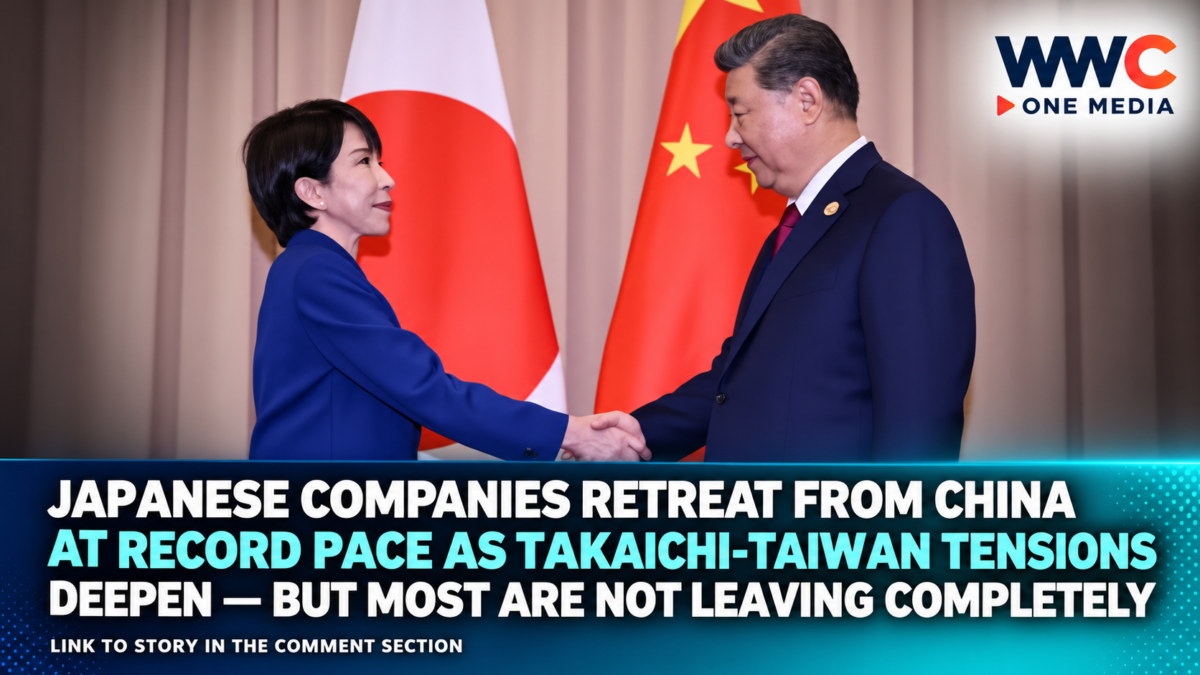
TOKYO — Japanese companies are cutting their exposure to China at the fastest pace in years, as a slowing Chinese economy, intense competition, U.S. tariffs and worsening political tensions over Taiwan push corporate Japan to rethink one of its most important overseas markets.
The number of Japanese companies operating in mainland China fell to 10,118 as of June 2026, the lowest level recorded since Teikoku Databank began tracking the figure in 2010.
That represents a 22.4% decline from 13,034 companies in 2024 and a drop of nearly 30% from the 2012 peak of 14,394.
Between the 2024 and 2026 surveys, Teikoku identified 4,137 companies that withdrew, closed operations or could no longer be confirmed, while only 1,221 new Japanese entrants were recorded.
The result was a net decline of 2,916 companies in just two years.
But calling this a wholesale Japanese exit from China would be misleading.
Many companies are not abandoning the country entirely.
Instead, they are reducing dependence, consolidating factories, moving selected production elsewhere and adopting a broader “China+1” strategy.
And the political confrontation between Tokyo and Beijing is making that shift harder to reverse.
Takaichi’s Taiwan comments made an already difficult relationship worse
Japan-China ties deteriorated sharply after Prime Minister Sanae Takaichi said in late 2025 that a Chinese attack on Taiwan could potentially create a “survival-threatening situation” for Japan.
Under Japanese security law, such a situation could allow Tokyo to exercise collective self-defense alongside the United States under specific conditions.
Takaichi later distanced herself from interpretations suggesting Japan had automatically committed to military intervention.
But Beijing reacted furiously.
China accused Tokyo of interfering in its internal affairs and portrayed Takaichi’s comments as evidence that Japan was shifting away from its previous Taiwan policy.
Taiwan is self-governed, but Beijing claims the island as Chinese territory and has not renounced the use of force to bring it under its control.
Japan, meanwhile, sits geographically close to Taiwan and hosts major U.S. military bases that could become strategically important in any conflict.
That makes the Taiwan question far more than diplomatic rhetoric for Japanese businesses.
It is becoming an economic-security issue.
Japanese firms say China tensions are now one of their biggest risks
The deterioration in political relations has moved directly into corporate boardrooms.
A Reuters corporate survey found that Japanese companies ranked strained relations with China among their top concerns for 2026, alongside uncertainty surrounding U.S. trade policy.
That concern is understandable.
China is one of Japan’s largest trading partners and has spent decades serving as both a production base and enormous consumer market for Japanese companies.
Automakers.
Electronics companies.
Machinery manufacturers.
Retailers.
Chemical producers.
Consumer brands.
All have built extensive supply chains there.
Political tension therefore creates a difficult dilemma.
Leaving China can be costly.
Staying can also become more risky.
Rare-earth pressure showed how quickly politics can hit industry
One of the strongest warnings came from critical minerals.
Reuters reported in July that Japanese companies were increasingly concerned about shortages of rare earths and other critical materials as China restricted supplies.
These materials are essential in products ranging from electric vehicles and electronics to military equipment.
China dominates the processing of many critical minerals, giving Beijing substantial influence over global industrial supply chains.
For Japan—a major producer of automobiles, robotics, electronics and advanced machinery—such dependence is a strategic vulnerability.
That helps explain why Tokyo is deepening economic-security partnerships with countries including Australia.
Japan and Australia launched a new finance dialogue in October focused partly on critical minerals, energy security and resilient supply chains.
Japanese companies are increasingly making the same calculation.
The cheapest supply chain is not necessarily the safest one.
China’s economy itself is also part of the problem
Geopolitics alone does not explain the retreat.
China’s economic slowdown has weakened the business case for some Japanese companies.
Teikoku Databank said deteriorating business conditions and weaker demand were among the reasons firms were reducing, relocating or shutting operations.
China’s property downturn has weighed on consumption.
Domestic companies have become more competitive.
Labor and operating costs have increased compared with the era when China was primarily viewed as a low-cost manufacturing base.
For some Japanese firms, the economics simply no longer look as attractive.
Chinese companies are beating Japanese firms on their own turf
Competition may be one of the biggest long-term pressures.
JETRO found that 74.5% of Japanese companies operating in China identified Chinese companies as their biggest competitors.
In manufacturing, the share exceeded 80%.
Japanese companies traditionally competed on quality, technology and reliability.
But Chinese firms have rapidly improved in those areas while often retaining a pricing advantage.
That is particularly visible in sectors such as:
electric vehicles,
consumer electronics,
industrial equipment,
batteries,
solar technology,
and digital services.
Japanese companies increasingly find themselves competing not just with multinational rivals in China but with highly capable local firms that understand the market better and can move faster.
Expansion appetite has fallen to a record low
JETRO’s latest survey provides another warning sign.
Only 21.3% of Japanese companies in China said they planned to expand their businesses over the next one to two years.
That was the lowest share since comparable records began.
By comparison, 64.3% planned to maintain their existing scale, while 14.4% said they expected to shrink operations, relocate or withdraw.
That distinction is crucial.
The largest group is not leaving.
It is staying put.
This means China remains too large and commercially important for most Japanese corporations to simply walk away from.
But companies are clearly becoming far less enthusiastic about putting more capital into the country.
Profitability has actually improved for some Japanese companies
There is another reason the “Japan abandons China” narrative needs caution.
Japanese firms that remain in China are not universally losing money.
JETRO said 63.2% of Japanese companies surveyed in China expected to be profitable in 2025, up from 58.4% in the previous survey.
The broader Asia survey also found profitability in China improved for the first time in four years, helped partly by stronger demand in selected sectors, improved production efficiency and lower labor costs in some businesses.
That creates an unusual situation.
Companies can still make money in China while simultaneously deciding not to expand there.
Profitability and strategic confidence are no longer the same thing.
Most Japanese firms still want to stay
JETRO’s data may be the strongest evidence against the idea of a total corporate flight.
When companies planning to expand or maintain their Chinese operations are combined, they account for 85.6% of respondents.
In other words, the overwhelming majority still expect to operate in China.
The shift is more subtle.
Companies are avoiding concentration.
New investment is becoming harder to justify.
And when they need extra manufacturing capacity, they increasingly look elsewhere first.
India could be one of the biggest winners
India has become one of the clearest alternatives.
JETRO’s Asia survey found Japanese corporate enthusiasm for expansion remains particularly strong there, largely because of growing domestic demand.
India offers several advantages:
a population of more than 1.4 billion;
a rapidly expanding middle class;
government incentives for manufacturing;
growing infrastructure;
and a strategic relationship with Japan.
For Japanese companies, India is not necessarily a direct replacement for China.
Its infrastructure, supplier networks and business environment remain different.
But it can serve as an increasingly important second growth market.
That is why analysts increasingly argue that China’s loss could become India’s gain as Japanese capital looks for alternatives.
Southeast Asia is another major beneficiary
Vietnam, Thailand and other Southeast Asian economies have been attracting Japanese manufacturing for decades.
The China-risk debate is accelerating that trend.
Japanese companies can place production in Southeast Asia while remaining close to Chinese suppliers and major Asian consumer markets.
Vietnam has become particularly important for electronics, components, machinery and consumer-goods manufacturing.
Thailand remains deeply integrated into Japan’s automotive supply chain.
Companies are therefore increasingly constructing regional networks rather than relying overwhelmingly on China.
The strategy is not:
China or Southeast Asia.
It is increasingly:
China plus Southeast Asia.
U.S. tariffs are accelerating the restructuring
Washington is adding another layer of pressure.
Teikoku Databank said more than 60% of Japanese companies in China that responded to its trade survey said U.S. tariff negotiations were affecting their overseas operations.
Among manufacturers, the figure reached 64.8%.
The reason is straightforward.
A Japanese company can manufacture a product in China.
But if that product is then exported to the United States, tariffs may destroy its price competitiveness.
That changes where companies want to manufacture.
JETRO’s North American survey found Japanese companies were increasingly shifting suppliers away from China toward:
the United States,
Japan,
and ASEAN countries.
The global supply chain is therefore being reshaped by two different tensions at once:
Washington versus Beijing;
and Tokyo versus Beijing.
Security concerns also matter to Japanese employees
Businesses also have to consider whether employees feel safe.
High-profile violent incidents involving Japanese citizens in China over recent years have heightened anxiety.
They include the fatal stabbing of a Japanese schoolboy in Shenzhen in 2024, an event that deeply shocked Japanese expatriate communities and intensified debate about anti-Japanese sentiment.
Companies deciding whether to send executives and families to China now evaluate security alongside traditional factors such as salaries, rent and operating costs.
This is difficult to quantify.
But executives repeatedly cite employee willingness to relocate as a factor when evaluating overseas operations.
If talented managers refuse China assignments, maintaining large local operations becomes harder.
History makes China-Japan relations uniquely sensitive
Japan and China share one of Asia’s most complicated political relationships.
China continues to place heavy emphasis on Japan’s invasion and occupation during the first half of the 20th century.
Beijing frequently invokes that history during modern diplomatic disputes.
Tokyo and Beijing also disagree over islands in the East China Sea, military activity, Taiwan and regional security.
Takaichi’s Taiwan remarks therefore landed on top of decades of unresolved historical and strategic tensions.
Chinese Defense Minister Dong Jun recently warned against the resurgence of what he called regressive historical trends, remarks widely interpreted as criticism of Japan.
The political relationship can therefore deteriorate extremely quickly.
Businesses know it.
Taiwan is now inseparable from Japan’s corporate risk planning
Japanese executives increasingly have to consider a scenario few corporate strategy departments seriously discussed 15 years ago:
what happens if there is a military crisis around Taiwan?
Japan’s southwestern islands sit close to Taiwan.
The United States has major bases in Japan.
Japanese shipping routes pass through nearby waters.
Taiwan is central to advanced semiconductor production.
China is Japan’s major trading partner.
A military conflict could therefore hit Japanese businesses simultaneously through:
trade disruption;
shipping interruptions;
sanctions;
factory shutdowns;
financial-market turmoil;
and supply-chain shortages.
This does not mean companies expect war.
U.S. officials currently assess a Chinese invasion of Taiwan as unlikely before 2028 despite Beijing’s military modernization goals.
But corporate risk managers no longer have the luxury of ignoring the possibility.
Japan is building alternatives before a crisis happens
Tokyo’s broader economic-security strategy reflects the same concern.
Japan has been investing in:
domestic semiconductor production;
alternative rare-earth suppliers;
battery supply chains;
strategic stockpiles;
defense manufacturing;
and partnerships with Australia, India, the United States and Southeast Asia.
The objective is not necessarily to isolate China.
It is to make sure China cannot become an economic single point of failure.
Corporate Japan is doing much the same thing.
China is still impossible to replace completely
There is a major problem with diversification.
China remains extraordinarily difficult to replicate.
Its advantages include:
massive industrial clusters;
world-class ports;
extensive rail and road infrastructure;
deep supplier networks;
skilled manufacturing workers;
a huge domestic market;
and rapidly growing technology companies.
Moving a factory is possible.
Moving an entire supplier ecosystem is much harder.
That is why many Japanese companies will keep significant Chinese operations even while expanding elsewhere.
China may lose some factories.
It is unlikely to disappear from corporate Japan’s supply chain.
Medium-term sentiment may already be stabilizing
There is another sign that the retreat could eventually become less dramatic.
A more recent JETRO survey of Japanese firms in Shandong found that 31.6% expected to expand their Chinese businesses from 2027 onward, up sharply from 19.7% in the earlier survey.
Only 1.8% of manufacturers in that sample expected to relocate or withdraw.
The survey is regional and should not be treated as representative of every Japanese company in China.
But it suggests the picture is not simply worsening in one direction.
Companies may be cautious today while still believing China offers long-term opportunities.
Beijing also has a strong reason to stop the exodus
China does not want Japanese investment to disappear.
Foreign businesses provide:
capital;
jobs;
technology;
tax revenue;
export activity;
and links to global markets.
Beijing has repeatedly said China remains open to foreign investment and has introduced measures aimed at improving conditions for overseas companies.
But investor confidence cannot be restored by policy announcements alone.
Companies need predictable regulation.
Stable diplomatic relations.
Reliable access to critical materials.
Protection for employees.
And confidence that geopolitical disputes will not suddenly disrupt their businesses.
That is where the China-Japan relationship currently looks most fragile.
The real story is “de-risking,” not decoupling
The number is dramatic.
More than 4,000 Japanese companies disappeared from Teikoku Databank’s China tally in two years, while the overall corporate presence dropped to its lowest level on record.
But the deeper story is not that Japan Inc. is packing up and leaving China.
It is that Japanese executives no longer want to bet everything on China.
They are keeping profitable operations.
Cutting weaker ones.
Sending new investment toward India and Southeast Asia.
Building alternative supply chains.
Stockpiling strategic materials.
And preparing for geopolitical shocks that once looked remote.
Takaichi’s Taiwan remarks did not create this shift.
China’s slowing economy, rising costs, Chinese competition and U.S. trade pressure were already pushing Japanese companies in this direction.
But the diplomatic confrontation over Taiwan may have transformed diversification from a long-term strategy into a much more urgent corporate priority.
And that could be the bigger change.
For decades, Japanese companies asked how much money they could make by expanding in China.
Increasingly, the question is becoming:
How much risk can they afford by staying too dependent on it?