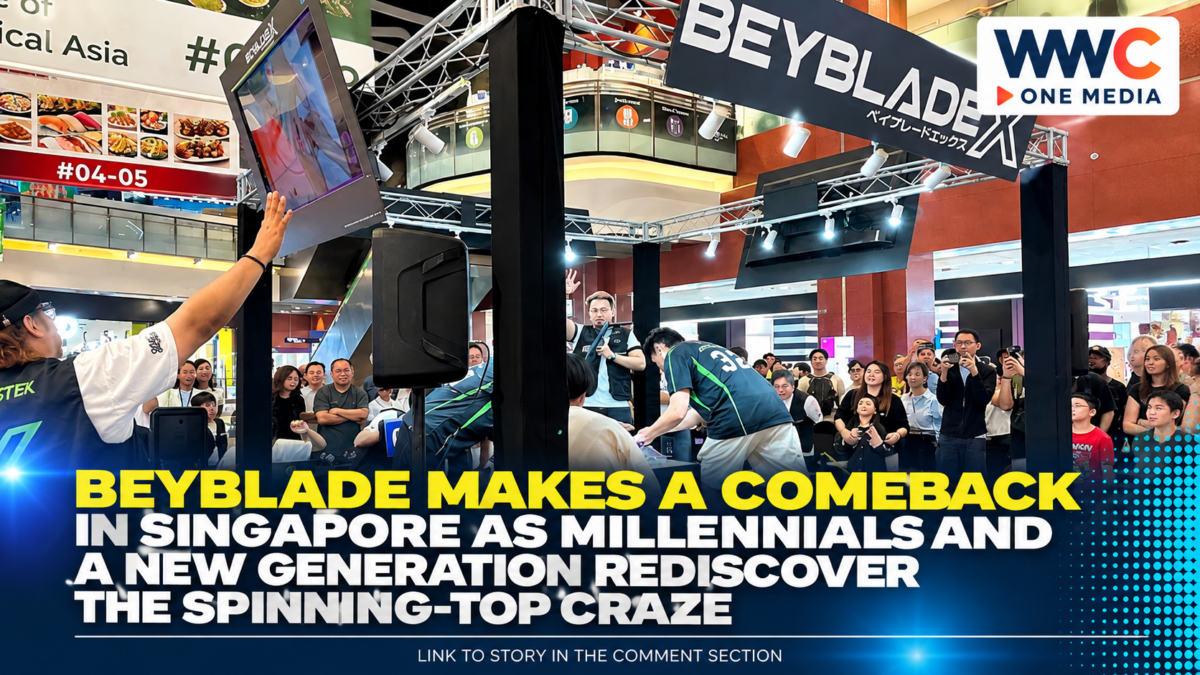
More than two decades after Beyblade became a childhood obsession for many Singaporeans, the spinning-top toy franchise is making a noticeable comeback, bringing together millennials who remember the original craze and a younger generation discovering the hobby for the first time.
For many Singaporeans who grew up in the early 2000s, Beyblade was closely tied to childhood memories of anime, school recess and afternoons spent battling friends. The sight and sound of spinning tops crashing into one another inside a plastic Beystadium became a familiar part of growing up alongside other popular franchises such as Pokémon, Power Rangers and Digimon.
Beyblade was more than something to watch on television. Children could recreate the battles themselves, launching their tops into an arena and competing to knock out their opponents or outlast them. Players could also customise their tops using different components, adding a strategic element to what initially appeared to be a simple toy.
The franchise itself dates back to 1999 and was inspired in part by beigoma, a traditional Japanese spinning-top game. The concept of battling spinning tops is also found in other Asian cultures, including the traditional Malay gasing. Beyblade expanded that basic idea into a multimedia franchise supported by manga, anime, toys and collectible parts.
The original Beyblade generation ran from 1999 to 2004, but the franchise continued through several iterations. The newest generation, Beyblade X, launched in 2023 and has helped introduce the hobby to a fresh group of players while giving older fans another reason to return.
That new generation has helped change the perception of Beyblade from a childhood toy into a more organised hobby. Singapore now has an active community where players of different ages meet for casual battles, gatherings and formal competitions.
One recent gathering at a hobby store in Bukit Merah provided a glimpse of how broad the community has become. Players included young children, teenagers and adults, with some parents participating alongside their children. For millennials who remember playing Beyblade in primary school, the sight of families sharing the hobby has added another dimension to its revival.
The competitive scene has also become significantly more developed than the informal battles many older fans remember. Beyblade X tournaments form part of an international competition pathway, with high-level events leading toward regional and global competitions. Singapore’s recent G1 tournament at Bugis+ drew a mixed crowd and featured separate categories that brought together competitors from different age groups.
The contrast between generations was particularly noticeable at the tournament. One winner in the Open category was an adult who could have grown up with the original Beyblade craze, while the winner of the Regular category was young enough to still be in primary school. The competition therefore showed how the hobby has managed to connect people who encountered Beyblade at completely different points in their lives.
Singapore’s tournaments are also connected to a wider international competitive circuit. Winners from the local qualifying events can advance through regional competitions, with the 2026 GP Final scheduled to take place in Bangkok in December.
The revival is not entirely driven by nostalgia. The newer Beyblade X generation has brought updated designs and a fresh competitive environment, allowing returning players to start again without necessarily having to master years of previous-generation strategies and developments. This has helped make the hobby accessible to both experienced fans and newcomers.
Older players have also remained an important part of the community. Singapore’s Beyblade scene has previously included adult hobbyists in their 20s and 30s, with some continuing to participate in competitions and informal gatherings. The community has increasingly included parents and children playing together, extending the franchise beyond its original target audience.
Another factor behind Beyblade’s appeal is its physical nature. Unlike many modern forms of entertainment that take place on phones, computers or consoles, the basic Beyblade experience requires players to physically launch their tops and watch the battle unfold in front of them. That creates a social activity where participants can gather around the same arena and interact directly.
For millennials, the comeback also offers a direct connection to childhood. Older fans who once collected Beyblades alongside Game Boy consoles, PlayStation 2 games and Pokémon cards can now revisit the hobby while sharing it with their own children or younger players. What was once simply an after-school pastime has evolved into a multigenerational community.
The revival illustrates how older analogue hobbies can find new life when they are combined with updated products, organised communities and competitive events. Beyblade may have begun as a children’s toy, but its latest resurgence in Singapore shows that its appeal can extend well beyond childhood.
For those who grew up shouting “Let it rip” in the 2000s, the comeback offers a familiar dose of nostalgia. For younger players, however, Beyblade X represents something different: a competitive, hands-on hobby that does not require a screen and provides a reason to gather, play and compete in person.