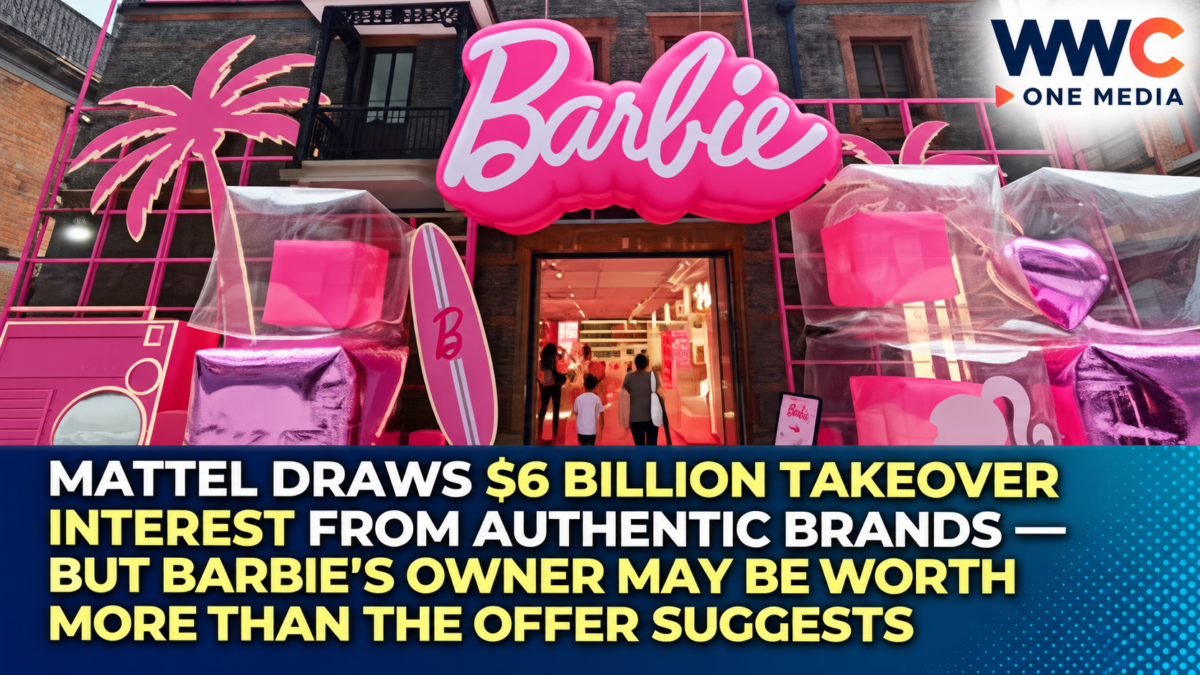
LOS ANGELES — Mattel, the company behind Barbie, Hot Wheels, Fisher-Price and American Girl, has attracted takeover interest from Authentic Brands Group in a potential deal that could value the toy giant at more than $6 billion — setting up one of the most closely watched consumer-brand deals of 2026.
Authentic Brands Group has approached Mattel about a possible acquisition and has discussed a price of more than $20 per share, according to Reuters and The Wall Street Journal.
That would value Mattel at roughly $6 billion or more, a substantial premium to the company’s market capitalization of approximately $3.6 billion before news of the approach emerged.
Investors immediately reacted.
Mattel shares surged roughly 18% on October 1 to close at $15.04, after falling sharply earlier in the year.
But investors should not mistake takeover interest for a completed deal.
There is currently no formal sale process, Mattel has not publicly confirmed that it is willing to sell, and neither Mattel nor Authentic Brands has commented publicly on the reported discussions.
Authentic Brands Could Offer More Than $20 a Share
The potential price is the biggest reason investors paid attention.
Authentic Brands is reportedly considering paying above $20 per Mattel share.
That would represent a large premium to Mattel’s pre-report trading price.
Mattel had closed at just $12.66 on September 30, meaning a $20-plus bid would imply a premium of well over 50% from that level.
Even after the takeover report sent shares higher, the stock remained below the potential price under discussion.
That gap reflects uncertainty.
Markets are effectively saying there is a meaningful possibility of a deal — but nowhere near enough certainty to price the shares at the proposed takeover level.
Why Authentic Brands Would Want Mattel
The strategic logic is easy to understand.
Authentic Brands Group specializes in acquiring recognizable brands and making money from them through licensing, partnerships, retail distribution, media and consumer products.
Its portfolio has included brands such as:
Reebok
Brooks Brothers
Sports Illustrated
Forever 21
Nautica
Juicy Couture
and intellectual-property rights associated with celebrities including Elvis Presley, Marilyn Monroe, Muhammad Ali and Shaquille O’Neal.
Authentic has built its business around the idea that a famous brand can generate money far beyond the product category where it originally became successful.
That philosophy fits Mattel almost perfectly.
Mattel does not simply own toy brands.
It owns cultural franchises with enormous licensing potential.
Barbie Is More Than a Doll Now
The most obvious example is Barbie.
Mattel’s 2023 “Barbie” film grossed more than $1 billion worldwide and became one of the most successful movies of the year.
The film demonstrated something Mattel had been trying to prove for years:
its brands could potentially become major entertainment franchises rather than remain limited to toy shelves.
Under outgoing CEO Ynon Kreiz, Mattel increasingly described itself as an intellectual-property company rather than simply a toy manufacturer.
Kreiz launched Mattel Films and pushed the company toward movies, television, games, digital content and licensing.
That strategy made Mattel’s brand portfolio much more interesting to a company like Authentic Brands.
The Big Question: Is $6 Billion Enough?
Some investors believe Mattel’s brands may be worth significantly more than the value currently assigned to the company by the stock market.
Financial Times reporting cited UBS estimates suggesting Mattel’s intellectual-property portfolio could theoretically be worth around $22 to $39 per share, depending on assumptions about monetization.
That range is important.
If Authentic ultimately offers only slightly more than $20 per share, some shareholders could argue that the buyer is acquiring Barbie, Hot Wheels, Fisher-Price and Mattel’s other franchises too cheaply.
Of course, theoretical IP value is not the same as actual cash flow.
That is Mattel’s current problem.
The company owns extraordinary brands.
It has struggled to convert all of them into consistently strong financial performance.
Mattel’s Stock Had Fallen More Than 30%
Before the takeover news, Wall Street had become increasingly frustrated with Mattel.
The stock had fallen by more than 30% during 2026 before rallying on the takeover report.
That decline reflected a combination of weak toy demand, tariffs, margin pressure and investor skepticism about how quickly Mattel could turn entertainment projects into meaningful earnings.
The company’s recent results illustrate the challenge.
Mattel generated $1.12 billion in second-quarter revenue, slightly above analyst expectations.
But adjusted profit came in at only 1 cent per share, below the 4 cents expected by analysts, as higher tariff-related expenses squeezed margins.
Mattel maintained its annual forecast, but the results reinforced investor concerns about profitability.
Tariffs Have Become a Serious Problem
Mattel relies heavily on global manufacturing.
That leaves it exposed when tariffs increase the cost of importing toys into the United States.
The company has tried to offset those costs through pricing, manufacturing changes and supply-chain adjustments.
But those strategies have limits.
Parents may accept modest price increases.
They may resist paying significantly more for discretionary products such as toys — particularly when household budgets are already under pressure.
That creates a difficult equation.
Mattel needs to protect margins without pushing consumers away.
The takeover approach arrives while management is still trying to solve that problem.
One Major Investor Was Already Calling for a Sale
Authentic Brands’ interest did not emerge in a vacuum.
In May, Southeastern Asset Management, which owned more than 4% of Mattel, publicly urged the company to explore strategic alternatives.
The investor argued Mattel could potentially create more value by:
going private,
selling to another toy company,
or being acquired by a major media company.
Southeastern specifically suggested a possible deal with rival Hasbro, although analysts have questioned whether regulatory issues and financing challenges would make such a combination realistic.
The investor’s argument was essentially that Mattel’s brands were more valuable than the public stock market was recognizing.
The Authentic Brands approach now gives that argument additional credibility.
Private Ownership Could Change Mattel’s Strategy
Southeastern also argued that Mattel might operate better as a private company.
Public companies face constant pressure to deliver predictable quarterly earnings.
Mattel’s business is inherently seasonal.
Toy sales depend heavily on Christmas.
Movie projects can take years before generating revenue.
Large brand-development investments can reduce profits long before investors see results.
A private owner may be more willing to tolerate that volatility.
Authentic Brands could also potentially separate ownership of the brands from parts of Mattel’s manufacturing and operating structure.
That is consistent with Authentic’s asset-light business model.
Mattel’s CEO Is Leaving at the Worst — or Best — Possible Time
The takeover interest comes during a major leadership transition.
Mattel announced on September 30 that longtime CEO Ynon Kreiz is leaving the company.
Kreiz will become co-CEO of the newly enlarged Paramount-Warner Bros. Discovery media group alongside David Ellison.
His departure is significant because he was the architect of Mattel’s entertainment transformation.
He joined Mattel in 2018 when the company was struggling.
Under his leadership, Mattel cut more than $1.5 billion in costs, stabilized the business and pushed brands such as Barbie into entertainment.
His replacement will be Roger Lynch, the former Condé Nast CEO and longtime Mattel board member.
That means Lynch could take control of Mattel almost immediately while facing one of the biggest strategic decisions in the company’s history.
The CEO Change Could Complicate a Deal
Leadership transitions are rarely ideal moments for takeover negotiations.
A new chief executive normally wants time to review strategy, meet investors and establish priorities.
Instead, Lynch may inherit a company already facing pressure to decide whether to remain independent.
That could complicate discussions.
On the other hand, it could make a sale easier.
A board facing:
a falling share price,
activist pressure,
tariff headwinds,
a CEO departure,
and an outside bidder
may be more willing to consider alternatives than it would under normal circumstances.
Authentic Brands Has Been Expanding Aggressively
Authentic itself has been increasingly active.
The company recently bought Dockers from Levi Strauss and has been expanding into entertainment, hospitality and youth-oriented consumer businesses.
That makes Mattel a logical — although enormous — next step.
Authentic’s model is built around owning recognizable names and licensing those names to operating partners.
Mattel could give it one of the strongest collections of family entertainment brands in the world.
Barbie alone spans:
toys,
films,
fashion,
cosmetics,
video games,
theme-park attractions,
consumer products,
and licensing.
Hot Wheels has similar potential.
Fisher-Price brings preschool products.
American Girl gives Authentic another lifestyle brand.
Masters of the Universe adds a franchise aimed at older fans.
The portfolio could theoretically support decades of licensing revenue.
Hot Wheels May Be Mattel’s Next Big Entertainment Test
Barbie proved that Mattel can create a blockbuster.
But investors want to know whether it can repeat the formula.
Mattel has been developing films and entertainment projects around numerous properties, including Hot Wheels, Masters of the Universe, Polly Pocket and Matchbox.
The long-term valuation of the company depends partly on whether these brands can become recurring media franchises.
One successful movie is encouraging.
A portfolio of successful franchises would fundamentally change Mattel’s economics.
That is likely one of the biggest attractions for a potential buyer.
But Barbie Also Revealed the Problem
The Barbie film generated enormous global attention.
Yet Mattel’s stock has still struggled.
That shows why owning great intellectual property is not enough.
The challenge is extracting consistent economic value from it.
Film studios.
Licensing partners.
Retailers.
Talent.
Distributors.
All take shares of the revenue.
Mattel has to structure deals that allow the company to capture enough of the upside.
That is where a buyer like Authentic Brands might believe it can do better.
Its entire business is built around commercializing brand rights across multiple categories.
Could Hasbro Enter the Picture?
Southeastern previously suggested rival toy giant Hasbro as another possible buyer.
A Mattel-Hasbro combination would unite some of the world’s most recognizable toy franchises.
Mattel owns Barbie and Hot Wheels.
Hasbro controls brands including Monopoly, Nerf, Transformers, My Little Pony and Dungeons & Dragons.
Such a combination would create an enormous toy and entertainment business.
But regulators could scrutinize a merger between two of the industry’s largest traditional competitors.
That makes Authentic Brands potentially less complicated strategically.
Authentic is primarily a brand-management and licensing company rather than Mattel’s direct toy competitor.
A Media Buyer Could Also Make Sense
Another possibility raised by investors is acquisition by a media company.
The logic is obvious.
Mattel owns franchises.
Media companies need franchises.
Disney built much of its modern empire around Marvel, Pixar and Star Wars.
Universal has expanded aggressively around brands such as Minions, Jurassic World and Nintendo-related attractions.
Warner Bros. relies on DC Comics, Harry Potter and other franchises.
Owning Barbie and Hot Wheels could provide a media company with decades of film, television, consumer-product and theme-park possibilities.
Ironically, Kreiz himself is now leaving Mattel to help run one of the biggest media companies in the world.
Authentic May See What Public Investors Don’t
This may be the central takeover argument.
Public investors tend to evaluate Mattel based on:
quarterly toy sales,
profit margins,
holiday demand,
tariffs,
and earnings forecasts.
Authentic may evaluate it differently.
It may ask:
How much could Barbie generate over 20 years?
How many Hot Wheels films, games and licensing deals are possible?
Can American Girl expand internationally?
Can Fisher-Price become a broader preschool entertainment business?
Can Mattel’s brands be licensed without carrying the full operating costs of manufacturing products?
That creates potentially very different valuations.
Shares Jumped — But They Are Still Below the Rumored Offer
Mattel’s stock closed at $15.04 after the takeover report, still far below the more-than-$20 level being discussed.
That discount tells investors something important.
Wall Street does not yet view the acquisition as highly probable.
If investors believed a $20-plus transaction was nearly certain, shares would normally trade much closer to the proposed price.
Instead, the market is factoring in the possibility that:
Mattel refuses to sell,
Authentic walks away,
financing becomes difficult,
another bidder emerges,
or negotiations never progress beyond preliminary interest.
The takeover premium therefore represents opportunity — and considerable risk.
The Board Now Has a Difficult Decision
Mattel’s directors have competing responsibilities.
A $6 billion-plus offer could deliver shareholders an immediate premium.
But selling too cheaply could sacrifice the long-term value of some of the world’s most recognizable consumer brands.
Rejecting an offer is also risky.
If Mattel remains independent and earnings continue struggling, the stock could fall again.
If management successfully transforms Barbie, Hot Wheels and other properties into global entertainment franchises, shareholders might eventually receive far more than $20 per share.
That is the strategic dilemma.
Take a substantial premium now.
Or bet that Mattel can create greater value itself.
The Real Prize Isn’t the Toys — It’s the Brands
The possible Authentic Brands takeover ultimately shows how the toy industry itself is changing.
Physical toys remain important.
But the most valuable asset may increasingly be the intellectual property printed on the box.
Barbie is no longer simply a doll.
Hot Wheels is no longer simply a miniature car.
They are platforms for movies, games, clothing, licensing, attractions and digital experiences.
Authentic Brands understands that model extremely well.
And that may explain why a company known for acquiring brands such as Reebok, Sports Illustrated and Brooks Brothers is now looking at one of the most valuable collections of childhood brands ever assembled.
The unanswered question is whether Mattel’s board believes more than $6 billion is enough to hand those brands over.
Because if Barbie, Hot Wheels and Mattel’s other properties successfully become the entertainment franchises management has spent years promising, the buyer may ultimately be getting far more than a toy company.