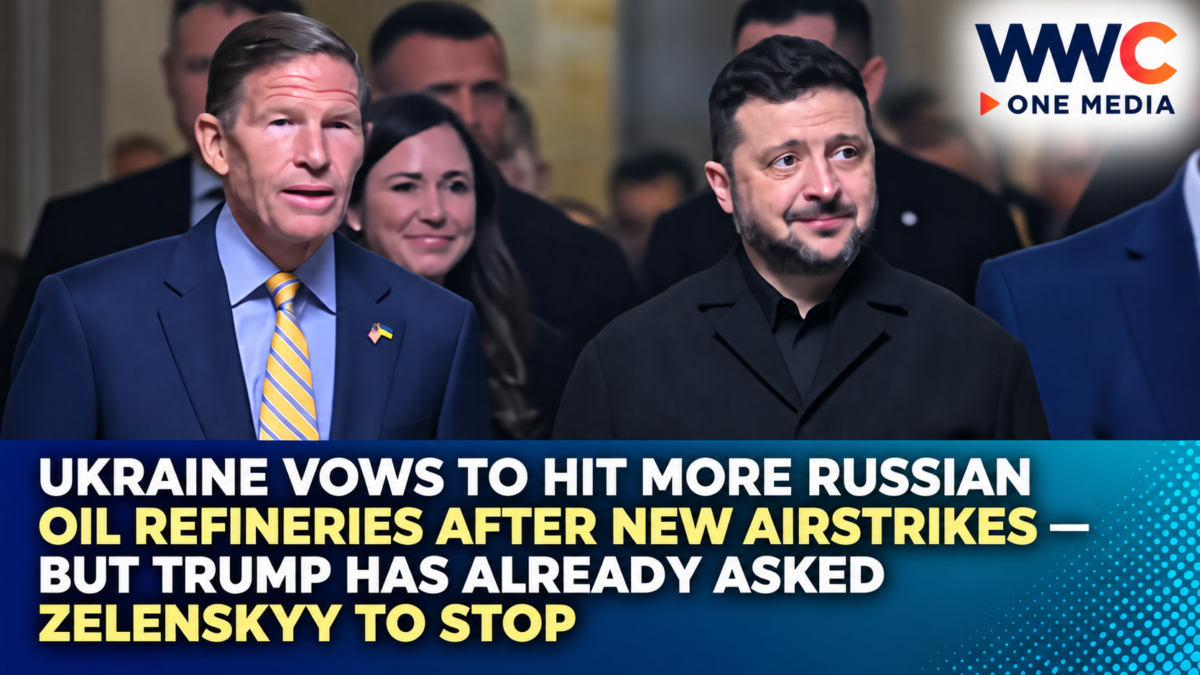
KYIV — Ukrainian President Volodymyr Zelenskyy says his military will intensify strikes on Russian oil refineries in retaliation for what Kyiv describes as a new Kremlin strategy aimed at crippling Ukrainian cities, energy networks and civilian infrastructure ahead of winter.
Speaking in an interview with Reuters, Zelenskyy said Ukrainian intelligence had obtained documents indicating that Russian President Vladimir Putin had authorized a broader air-strike strategy targeting infrastructure including energy systems, logistics networks, roads, schools and hospitals in an effort to pressure civilians to leave Kyiv and other cities.
Zelenskyy said Ukraine would respond by focusing particularly on Russia’s energy sector.
His argument is straightforward:
Russian refineries help finance and fuel Moscow’s war effort.
So if Russia attacks Ukrainian energy infrastructure, Kyiv will increasingly attack the Russian facilities generating revenue and fuel for the war.
But Zelenskyy also drew an important distinction.
He said Ukraine would not deliberately copy what Kyiv accuses Moscow of doing by indiscriminately attacking civilian targets.
Instead, the emphasis would remain on oil refineries and other facilities Ukraine considers part of Russia’s war economy.
Russia Is Expanding Its Assault on Kyiv
The announcement comes as Russia intensifies missile and drone attacks against the Ukrainian capital.
On October 3, Russian strikes damaged Kyiv’s Northern Bridge across the Dnipro River, forcing traffic to be suspended after the road surface and trolleybus infrastructure were damaged.
That followed earlier strikes affecting the Southern Bridge and other major crossings, causing major disruption for a city of roughly three million people.
AP reported that recent Russian attacks killed at least six people across Ukraine, while strikes in and around Kyiv continued targeting infrastructure essential to daily life.
Russia says it is striking military and logistical targets and describes the attacks as retaliation for Ukrainian strikes inside Russia.
Ukraine says the campaign has expanded far beyond military facilities and is increasingly designed to make civilian life in major cities unsustainable.
Both sides deny intentionally targeting civilians.
Zelenskyy Says Moscow Has a ‘New Doctrine’
According to Zelenskyy, Russia’s latest campaign represents more than another wave of bombardment.
He described it as a deliberate “new doctrine” aimed at applying pressure directly to the population.
Ukrainian intelligence, he said, had seen documents authorizing attacks across a wider range of infrastructure before winter.
The goal, according to Kyiv’s interpretation, is to disrupt electricity, transport, schools, hospitals and communications severely enough that civilians begin leaving major cities.
The claim could not be independently verified from the intelligence documents themselves.
But recent attack patterns are consistent with a broader campaign against infrastructure.
AP reported that Russian strikes have hit bridges and Ukraine’s electricity network while Moscow deploys increasingly sophisticated jet-powered drones designed to penetrate Ukrainian air defenses.
Kyiv Is Preparing for Another Brutal Winter
Ukraine has experienced repeated winter campaigns against its energy grid since Russia’s full-scale invasion began.
But officials say the current threat could be particularly severe.
Ukrainian authorities have warned that Russia has accumulated hundreds of ballistic missiles while increasing production and deployment of faster drone systems.
The Guardian reported that Russian attacks this year have already inflicted roughly $10 billion in economic damage, while every hour of nationwide business disruption caused by air-raid alerts can cost the Ukrainian economy an estimated $45 million.
That means the infrastructure war is not only military.
It is increasingly economic.
Disrupting power, transportation and telecommunications can reduce industrial output, weaken tax revenue and force the Ukrainian government to spend billions repairing infrastructure instead of financing other parts of the war effort.
Ukraine’s Answer: Hit the Source of Russia’s Revenue
For Kyiv, Russian oil infrastructure has become one of the most attractive targets.
Russia relies heavily on energy exports to generate government revenue.
Oil products also directly supply the military.
Ukraine therefore argues that refineries are legitimate military-economic targets rather than civilian infrastructure.
Zelenskyy told Reuters that refineries are especially important because they generate money that helps Russia finance the war.
Ukraine has dramatically expanded its long-range drone campaign during 2026.
Targets have included refineries, oil depots and other energy facilities hundreds — and sometimes more than 1,000 kilometers — inside Russian territory.
The increasing range of Ukrainian drones has changed the strategic equation.
Facilities once thought safely beyond the battlefield are now exposed.
Ukraine’s Refinery Campaign Is Already Hurting Russia
The strikes are no longer symbolic.
They are affecting actual fuel supply.
Reuters reported in September that Ukrainian attacks had reduced Russian refinery output and contributed to gasoline shortages across several regions.
Russia subsequently extended restrictions on diesel exports as the government attempted to stabilize domestic supply.
Financial Times reporting said Russian diesel shipments had fallen sharply during 2026 and that attacks on refining capacity had contributed to fuel rationing and domestic shortages.
Ukraine claims it has disabled a very large share of Russian refining capacity at different points during the campaign, although estimates vary and facilities can often return to partial operation after repairs.
The precise percentage of capacity unavailable at any given moment therefore remains difficult to confirm independently.
What is clear is that the attacks have imposed real costs.
Russia has had to repair plants, adjust fuel exports and prioritize domestic supply.
Russia Was Once a Major Diesel Exporter
That matters far beyond Russia.
Before the latest disruptions, Russia was one of the world’s largest exporters of diesel and other refined petroleum products.
When Russian refining capacity falls, fewer barrels reach international markets.
That tightens global supplies.
And because diesel powers trucks, farming equipment, ships, trains and heavy industry, shortages can rapidly affect inflation throughout the wider economy.
Reuters reported that global diesel markets were already under severe strain this year because of disruptions in both Russia and the Middle East.
The result has been sharply higher fuel prices.
That is where Ukraine’s military strategy collides directly with American politics.
Trump Has Already Told Zelenskyy to Stop
On September 13, President Donald Trump publicly urged Zelenskyy to halt strikes on Russian diesel-producing facilities.
Trump argued that attacks on Russian refineries were contributing to a global diesel shortage and higher fuel prices.
At the time, the U.S. national average diesel price had climbed above $6 per gallon.
Trump said Ukraine had other targets available and should stop attacking Russian diesel infrastructure because of the impact on global markets.
The Kremlin welcomed his comments.
Ukraine, however, continued the refinery campaign.
And Zelenskyy’s latest statement indicates Kyiv may now intensify it.
That creates a potential source of tension between Washington and Kyiv.
Trump’s Political Problem Is Diesel
Fuel prices are politically sensitive in the United States.
Diesel is especially important because it indirectly affects the cost of nearly everything transported by truck.
Higher diesel prices can feed into:
food prices,
retail goods,
construction costs,
shipping,
agriculture,
and manufacturing.
By late September, Trump was even considering restrictions on U.S. diesel exports in an effort to ease domestic prices.
Reuters reported that U.S. diesel inventories were unusually low while exports had risen substantially because foreign buyers were searching for replacement supplies after disruptions elsewhere.
That puts Washington in a difficult position.
The United States supports Ukraine militarily.
But one of Ukraine’s most effective pressure campaigns against Russia is also contributing to tight global fuel markets.
Ukraine Sees the Calculation Differently
From Kyiv’s perspective, asking Ukraine to spare Russian refineries creates its own contradiction.
Russia continues striking Ukraine’s power plants, transport networks and other energy infrastructure.
Ukraine therefore argues it should be allowed to impose comparable economic pressure on Russia’s war machine.
The difference, Zelenskyy says, is targeting.
Kyiv says it is focusing on facilities that directly support Russian military operations and government finances rather than trying to terrorize civilian populations.
Whether Washington accepts that distinction could become increasingly important.
Especially if global diesel prices keep rising.
Moscow Says Its Strikes Will Continue
Russia has shown no indication it intends to scale back its own campaign.
On October 3, the Russian Foreign Ministry said Moscow would continue what it described as targeted retaliatory strikes against Kyiv and other Ukrainian cities.
It also urged foreign nationals and diplomatic personnel to leave Ukraine, warning of escalating danger.
Russian President Vladimir Putin has similarly warned that Ukraine will continue to “pay a price” for attacks inside Russia.
That rhetoric suggests the current escalation could become self-reinforcing.
Russia hits Ukrainian infrastructure.
Ukraine hits Russian refineries.
Russia expands air attacks.
Ukraine expands refinery strikes.
Each side describes the next escalation as retaliation for the previous one.
Peace Talks Are Still Going Nowhere
The intensifying infrastructure war comes even as the Trump administration tries to restart negotiations.
Reuters reported that Washington has been seeking another round of talks, potentially involving technical-level discussions in the United Arab Emirates.
But Zelenskyy said he had seen no serious indication that Putin was prepared to negotiate a meaningful ceasefire.
One major obstacle remains the Donbas.
Russia insists it must control the entire eastern region as part of any settlement.
Ukraine refuses to surrender territory that Russian forces have not captured.
Zelenskyy said Ukraine’s current counteroffensive, Operation Vivaldi, had recovered roughly 140 square kilometers in the Donbas region.
Those battlefield movements remain limited compared with the size of the front, but they matter politically because Russia has portrayed full control of Donbas as inevitable.
Ukraine Is Building Longer-Range Weapons
Ukraine is also trying to reduce its dependence on Western long-range weapons.
Kyiv has expanded domestic drone production and deployed its own ballistic-missile systems.
AP reported that Ukraine recently used its domestically developed FP-7 ballistic missile, while development continues on longer-range systems.
That matters because domestically produced weapons give Kyiv more freedom to select targets.
Western governments have historically imposed conditions on how some supplied weapons can be used inside Russia.
Homegrown systems are not subject to the same external restrictions.
The stronger Ukraine’s domestic long-range arsenal becomes, the harder it will be for outside partners to control the refinery campaign simply by restricting weapons.
Russian Refineries Are Strategically Vulnerable
Oil infrastructure presents an unusual military target.
Refineries are large.
They cannot move.
Their locations are publicly known.
And many contain highly specialized equipment that can take weeks or months to replace.
A drone costing a fraction of the target’s value can potentially damage processing units worth millions of dollars.
That makes refinery attacks an example of asymmetric warfare.
Ukraine cannot match Russia barrel for barrel in energy production.
But it does not need to.
It only needs to make Russian refining more expensive, unreliable and difficult to operate.
But the Strategy Has Global Consequences
The strategic logic is obvious.
The economic consequences are more complicated.
Every Russian refinery taken offline can reduce fuel available to both Moscow and global markets.
Russia responded this year by restricting diesel exports to protect domestic consumers.
That sends the shortage abroad.
Europe is particularly vulnerable because it imports large quantities of diesel.
Financial Times reporting said British diesel prices were approaching record levels amid disruptions from both Russia and the Middle East.
So one drone strike hundreds of kilometers inside Russia can eventually affect fuel prices thousands of kilometers away.
That is why Washington is paying attention.
The Energy War Is Becoming a Global Inflation Story
Russia and Ukraine are no longer fighting only over territory.
They are fighting over energy infrastructure.
And energy connects the battlefield directly to the global economy.
Russian missile attacks can damage Ukraine’s electricity system.
Ukrainian drones can disrupt Russian refineries.
Russian export restrictions can tighten global diesel supply.
Higher diesel prices can increase transportation and food costs internationally.
The war therefore increasingly has an economic transmission mechanism that reaches consumers far beyond Eastern Europe.
That creates a dangerous feedback loop.
The more effective Ukraine becomes at hurting Russia economically, the more pressure Kyiv may face from countries experiencing higher fuel prices.
Zelenskyy Is Signaling He Will Not Back Down
That may be the most important message from his latest remarks.
Despite Trump’s request to stop striking Russian diesel infrastructure, Zelenskyy is publicly saying Ukraine intends to do more.
The rationale is retaliation.
If Moscow tries to destroy Ukraine’s energy and civilian infrastructure, Kyiv will strike the sector it believes is most important to financing Russia’s war.
For Ukraine, that means oil.
For Russia, it means Ukraine’s cities and infrastructure could face even more attacks in response.
And for the rest of the world, it means one of the most consequential parts of the war may increasingly be fought not only on the battlefield — but inside refineries, power grids and global fuel markets.
The next question is whether Washington can convince Kyiv to restrain a strategy Ukraine considers effective.
Because Zelenskyy is now signaling something very different:
if Russia expands its attacks on Ukraine’s energy system, Russian refineries may become an even bigger target — regardless of what happens to global diesel prices.