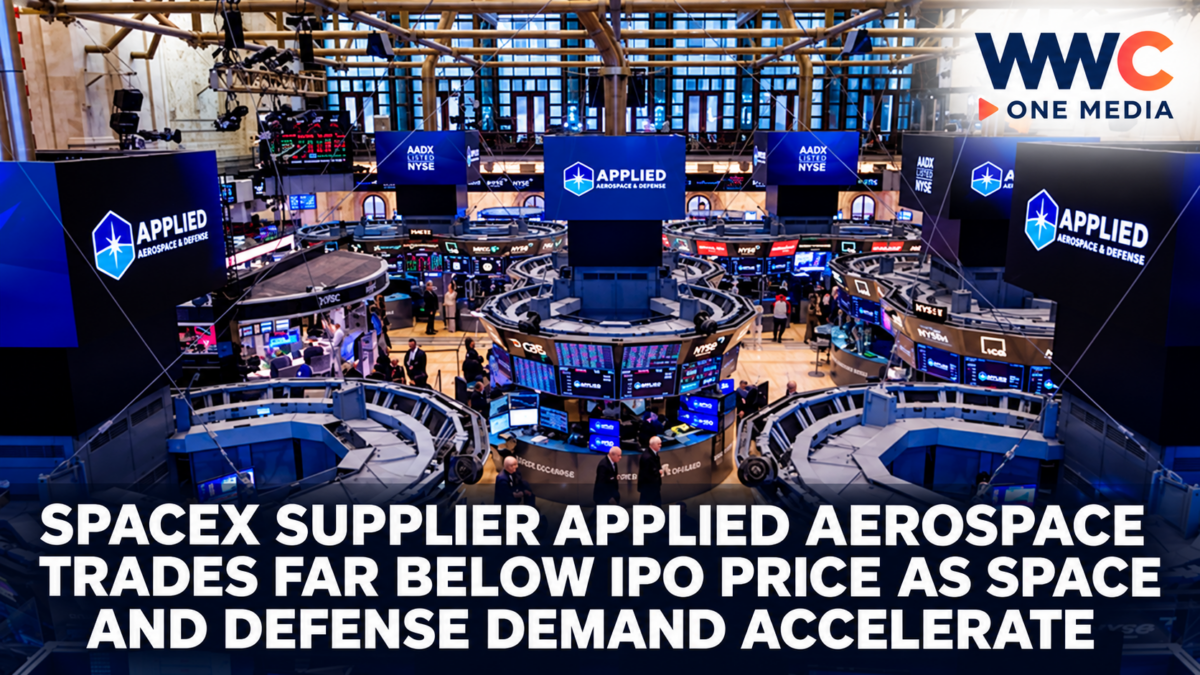
NEW YORK — A little-known aerospace manufacturer supplying hardware for SpaceX rockets and next-generation military aircraft is emerging as one of Wall Street’s more unusual ways to gain exposure to both the commercial space boom and the global defense buildup — even as its shares trade nearly 40% below their June IPO price.
Applied Aerospace & Defense, ticker:
AADX,
made its public-market debut only four months ago.
The company priced its IPO at:
$20 per share.
Its shares opened above that level and briefly traded as high as:
$24.24.
But by October 2, the stock closed at:
$12.63.
That was an approximately:
8% one-day gain
but still roughly:
37% below the IPO price.
The falling share price might suggest a struggling business.
The operating numbers tell a more complicated story.
Applied just reported:
Record revenue
Record adjusted EBITDA
More than $1.1 billion of backlog
and rapidly growing demand from some of the most important aerospace and defense programs in the United States.
The disconnect is why the company is suddenly attracting more attention.
APPLIED AEROSPACE IS DEEP INSIDE THE SUPPLY CHAIN
Applied Aerospace & Defense does not build an entire rocket.
It does not manufacture a complete fighter aircraft.
And it does not operate a satellite constellation.
Instead, it produces highly engineered components and subsystems that go inside those platforms.
Its products include equipment for:
Launch vehicles
Satellites
Military aircraft
Helicopters
Missiles
Precision-strike systems
and
Radar and communications systems.
That makes Applied what investors sometimes call a:
“picks-and-shovels” aerospace business.
Rather than betting everything on one rocket, aircraft or weapons platform, it supplies specialized hardware used across multiple programs.
SPACEX IS ONE OF ITS MOST IMPORTANT CUSTOMERS
The SpaceX relationship is the most eye-catching part of the story.
Applied Aerospace supplies components supporting:
Falcon 9.
Management says it has meaningful content tied to the launch program.
Falcon 9 has become the workhorse of the global commercial launch industry.
SpaceX uses the rocket for:
Starlink missions
NASA flights
Commercial satellites
National-security launches
and
Crewed missions.
The extraordinary launch frequency creates recurring demand for suppliers embedded inside the program.
APPLIED MAKES HARDWARE USED IN FALCON 9 LANDINGS
Among Applied’s SpaceX-related products are structures connected to Falcon 9’s reusable landing system.
Industry reporting says the company supplies components including:
Payload-deployment structures
and
Aluminum honeycomb crush components used in landing assemblies.
Some of those components require replacement after missions.
That distinction is important.
A reusable rocket does not necessarily mean every component is reused indefinitely.
Parts exposed to severe mechanical stress may need inspection, refurbishment or replacement.
That can create repeat demand for qualified suppliers.
SPACEX LAUNCH FREQUENCY IS THE BIG OPPORTUNITY
The economics become particularly interesting when launch cadence rises.
SpaceX has been launching Falcon 9 rockets at extraordinary frequency.
Every additional mission can create demand across a broad supply chain involving:
Structures
Propulsion components
Payload systems
Landing equipment
and
Ground-support hardware.
Applied does not disclose exactly how much revenue it earns from each Falcon 9 launch.
But management explicitly cited higher volumes on launch-vehicle programs as one reason its Space and Launch Systems business surged in Q2.
SPACE REVENUE JUMPED 58.5%
Applied’s Space and Launch Systems revenue reached:
$38.8 million
in the second quarter.
That was an increase of:
58.5% year over year.
Management attributed the growth to higher volumes supporting:
Launch vehicles
and
Satellite-production programs.
It specifically highlighted demand connected to:
SpaceX Falcon 9
and
Blue Origin New Glenn.
That means the company is benefiting from more than one major launch provider.
BLUE ORIGIN IS ANOTHER IMPORTANT CUSTOMER
Jeff Bezos’ Blue Origin is also ramping its heavy-lift:
New Glenn
rocket.
Applied supplies reusable landing-system hardware for that platform as well.
New Glenn is strategically important because it is expected to compete in:
Commercial satellite launches
U.S. national-security missions
NASA work
and potentially
Large constellation deployments.
If Blue Origin can significantly increase launch frequency, Applied could benefit from another growing production program alongside SpaceX.
BUT STARSHIP COULD BE THE MUCH BIGGER PRIZE
SpaceX’s next-generation Starship system could eventually dwarf Falcon 9 in scale.
Starship is being developed for missions involving:
Starlink deployment
Moon landings
Mars
Heavy commercial payloads
and potentially
Orbital logistics.
Applied has not announced a major Starship production contract.
That distinction is important.
But management says it is already working with SpaceX on a range of opportunities related to Starship.
President and Chief Strategy Officer Chris Rogers told investors that Applied views its relationship as being with:
SpaceX itself
rather than simply one rocket program.
MANAGEMENT SAYS THE RELATIONSHIP GOES BEYOND FALCON 9
That could become strategically important.
A supplier deeply qualified inside SpaceX may have an advantage when competing for future programs.
Spaceflight hardware has to meet extraordinary standards for:
Reliability
Weight
Material performance
Precision
and
Manufacturing consistency.
Changing suppliers can require expensive qualification work.
So existing relationships can create meaningful switching barriers.
That does not guarantee Applied will win major Starship work.
But it gives the company a seat at the table.
SPACE IS NOT EVEN APPLIED’S LARGEST BUSINESS
This is one of the most important things investors can miss.
Applied Aerospace is not primarily a SpaceX supplier.
Its biggest business is:
Defense Aviation and Airborne Systems.
That segment generated:
$78.9 million
in Q2 revenue.
Space and Launch Systems generated:
$38.8 million.
The remaining:
$49.6 million
came from C5ISR and Precision Strike Systems.
So the company’s growth thesis is broader than commercial space.
DEFENSE AVIATION GENERATED ALMOST HALF OF Q2 SALES
The Defense Aviation and Airborne Systems business supports:
Military aircraft
Helicopters
Next-generation autonomous aircraft
and
Aftermarket sustainment.
Revenue increased approximately:
4.8%
year over year during the second quarter.
Management said next-generation development programs are now beginning to transition toward production.
That transition can be financially significant.
Development work may involve relatively small quantities.
Full production can require hundreds or thousands of components.
ANDURIL’S FURY DRONE IS ONE OF THOSE PROGRAMS
One of Applied’s most interesting defense relationships is with:
Anduril Industries.
Anduril is developing the:
Fury
autonomous combat aircraft.
Fury is part of the U.S. Air Force’s Collaborative Combat Aircraft program.
The concept involves relatively low-cost unmanned aircraft flying alongside crewed fighters.
These aircraft could perform missions involving:
Reconnaissance
Electronic warfare
Weapons deployment
and
Decoy operations.
Applied supplies structural hardware for the Fury platform.
APPLIED HAS BEEN WORKING WITH ANDURIL SINCE 2025
The company began supporting Anduril’s Fury program during:
2025.
Its content reportedly includes components related to:
Fuselage structures
Wings
Horizontal tails
and
Landing gear assemblies.
That gives Applied exposure to one of the Pentagon’s most closely watched next-generation aviation programs.
The U.S. Air Force is considering procurement of more than:
150 Collaborative Combat Aircraft
through fiscal 2031.
Actual procurement could change.
But if the program moves toward large-scale production, suppliers already embedded in the platform could benefit substantially.
BELL’S MV-75 IS ANOTHER GROWTH PROGRAM
Applied also supports Bell’s:
MV-75
tiltrotor program.
The aircraft was previously known as the V-280 Valor.
It is being developed for the U.S. Army’s Future Long Range Assault Aircraft program.
The MV-75 is intended eventually to replace parts of the Army’s aging helicopter fleet.
Military aircraft programs can last for decades.
Once a supplier is qualified and embedded, it may generate revenue through:
Production
Maintenance
Repair
and
Aftermarket sustainment.
That long lifecycle is one of the attractions of aerospace manufacturing.
APPLIED ALSO SELLS INTO MISSILE AND PRECISION-STRIKE PROGRAMS
Its third major segment is:
C5ISR and Precision Strike Systems.
C5ISR refers to:
Command
Control
Communications
Computers
Cyber
Intelligence
Surveillance
and
Reconnaissance.
Applied also produces components used in missile and precision-strike systems.
This business generated:
$49.6 million
of Q2 revenue.
That was roughly:
$13.7 million higher
than the prior year.
MISSILE DEMAND HAS BECOME A MAJOR DEFENSE THEME
Global conflicts have exposed how quickly modern militaries can burn through missile inventories.
The United States and allied governments are increasing investment in:
Air-defense interceptors
Long-range strike weapons
Rocket motors
Missile bodies
and
Precision-guided weapons.
Applied manufactures specialized structures and components used in those systems.
This gives the company exposure to an entirely different demand driver from commercial space.
A slowdown in launch activity would not necessarily mean a slowdown in missile demand.
That diversification is important.
Q2 REVENUE HIT A RECORD $167.3 MILLION
The company’s latest results were strong.
Second-quarter revenue reached:
$167.3 million.
That represented:
47.4% year-over-year growth.
For the first six months of 2026, revenue totaled:
$301.7 million.
That was up:
34.4%.
Part of the increase came from acquisitions.
But organic growth across existing programs also contributed meaningfully.
THE HEADLINE $154 MILLION LOSS LOOKS TERRIBLE
Applied reported a Q2 net loss of:
$154 million.
On the surface, that appears alarming.
But most of the loss was connected to the company’s June IPO.
Applied incurred major:
Share-based compensation
and
Transaction-related expenses.
Those charges distorted the GAAP bottom line.
That is why investors also look at adjusted operating metrics.
ADJUSTED EBITDA HIT A RECORD $36.4 MILLION
Adjusted EBITDA reached:
$36.4 million
in Q2.
That was up:
38.5% year over year.
The figure excludes certain expenses management considers unusual or nonoperating.
Adjusted EBITDA should not replace GAAP net income.
But in this case it helps explain why the $154 million statutory loss does not necessarily reflect the underlying economics of normal manufacturing operations.
BACKLOG HAS CLIMBED ABOVE $1.1 BILLION
Another important number is:
$1.1 billion.
That is Applied’s reported contract backlog.
Backlog represents work the company expects to perform under existing contracts.
It can provide:
Revenue visibility
and
Production planning confidence.
For a company generating hundreds of millions of dollars in annual sales, a backlog above $1 billion is substantial.
But backlog is not the same thing as immediate revenue.
Contracts must still be:
Funded
Produced
Delivered
and
Recognized.
Execution matters.
THE COMPANY ALSO HAS A MULTIBILLION-DOLLAR PIPELINE
Investment managers tracking Applied have cited a weighted opportunity pipeline of roughly:
$3.8 billion.
That represents programs the company may be positioned to win rather than contracts already guaranteed.
The difference between:
Backlog
and
Pipeline
is crucial.
Backlog is much more concrete.
Pipeline represents potential future business.
If even part of that pipeline converts into contracts, however, it could support years of growth.
87% OF REVENUE COMES FROM SOLE- OR SINGLE-SOURCE POSITIONS
Applied has one of the more striking statistics in the aerospace supply chain.
Approximately:
87% of its 2025 revenue
came from:
sole-source or single-source awards.
That means for many parts and systems, Applied is either the only qualified supplier or one of a very limited number.
This can create a strong competitive moat.
Replacing a supplier for flight-critical aerospace hardware may require:
Engineering redesign
New tooling
Material qualification
Flight testing
and
Government approval.
Customers often prefer not to do that unless absolutely necessary.
THOSE CONTRACTS CREATE STICKINESS
Applied says its average customer relationship spans approximately:
39 years.
That is unusual in many industries.
In aerospace and defense, however, platforms can remain in service for decades.
A helicopter might fly for:
30 years.
A fighter aircraft may remain operational even longer.
A missile program can go through repeated production cycles.
A launch vehicle can fly hundreds of missions.
Suppliers that remain qualified can benefit for years.
BUT CUSTOMER CONCENTRATION IS A REAL RISK
The same structure creates risk.
Applied disclosed that its:
top three customers generated 59% of 2025 revenue.
That is significant concentration.
If one major customer:
reduces production
changes suppliers
cancels a program
or
brings manufacturing in-house,
Applied could feel the impact quickly.
The SpaceX relationship therefore works both ways.
Rapid Falcon 9 launches can lift sales.
But dependency on major customers increases downside risk if programs change.
“SOLE SOURCE” DOES NOT MEAN “NO RISK”
It is easy to interpret sole-source contracts as guaranteed revenue.
They are not.
A company can still lose work through:
Poor quality
Late deliveries
Contract renegotiation
Platform cancellation
or
Customer insourcing.
A sole-source position can create strong switching costs.
But it also raises the importance of flawless execution.
When a customer depends heavily on one supplier, missed deliveries can become extremely serious.
THE COMPANY HAS AROUND 40% EXCESS CAPACITY
One potentially important growth advantage is manufacturing headroom.
CNBC reported that Applied currently has roughly:
40% excess production capacity.
That means the company may be able to increase output substantially without immediately building entirely new factories.
In manufacturing, that can be powerful.
If demand grows while fixed infrastructure is already in place, more revenue can flow through the same manufacturing base.
That can improve margins.
But only if the demand actually materializes.
THE IPO DRAMATICALLY IMPROVED THE BALANCE SHEET
Applied raised approximately:
$683 million gross
through its June IPO.
After fees and expenses, net proceeds were approximately:
$635.6 million.
Much of that money was used to repay debt.
That reduced pro forma leverage to roughly:
2.5 to 2.7 times adjusted EBITDA,
depending on the measurement date.
A stronger balance sheet gives the company more flexibility to fund:
Capacity expansion
Equipment
Acquisitions
and
Working capital.
THE STOCK MARKET HAS NOT REWARDED THAT PROGRESS
Despite the growth, Applied shares remain depressed.
The stock priced at:
$20
in June.
It closed October 2 at:
$12.63.
That leaves the company with a market capitalization around:
$2.2 billion.
The decline is striking because the business has reported rapid revenue growth since listing.
But newly public companies often face investor skepticism.
Wall Street wants several quarters of evidence before assigning premium valuations.
THE STOCK ACTUALLY JUMPED 8% ON OCTOBER 2
There was one encouraging market signal.
AADX gained approximately:
8%
on October 2.
The stock moved from roughly:
$11.69
to
$12.63.
That still leaves it far below the IPO price.
But it shows investors may be beginning to reconsider the company after months of weakness.
A single day’s rally, however, does not establish a sustained trend.
CASH CONVERSION IS ONE NUMBER INVESTORS SHOULD WATCH
Revenue growth alone is not enough.
Applied manufactures complex aerospace systems that can take long periods to complete.
That creates:
Work-in-progress assets
and
Unbilled receivables.
CNBC highlighted that unbilled receivables recently rose to roughly:
34% of trailing sales
from around:
28%.
That means Applied may recognize revenue before it receives cash under certain long-term contract structures.
There is nothing inherently unusual about this in aerospace.
But investors will want to see that recognized revenue eventually converts into cash collections.
THAT IS WHY FREE CASH FLOW MATTERS
A manufacturer can report:
Growing sales
and
Strong adjusted EBITDA
while still consuming cash.
Working-capital demands can become large when production expands rapidly.
Applied must purchase:
Materials
Labor
Machinery
and
Inventory
before some customers pay.
That makes cash flow one of the most important metrics to monitor as the company scales.
THE SPACE ECONOMY IS ENTERING A DIFFERENT PHASE
For years, the commercial-space narrative focused on rocket startups.
Now the industry is entering a manufacturing phase.
More rockets are launching.
More satellites are being produced.
Constellations require replacement spacecraft.
National-security space spending is increasing.
And next-generation vehicles such as Starship and New Glenn require huge industrial supply chains.
That can benefit less glamorous companies making:
Structures
Composite materials
Landing hardware
Payload systems
and
Precision components.
Applied sits directly in that layer.
THE DEFENSE INDUSTRY HAS THE SAME SUPPLY-CHAIN PROBLEM
The Pentagon faces a related challenge.
Years of underinvestment left portions of the U.S. defense industrial base with limited manufacturing capacity.
Recent conflicts have highlighted shortages involving:
Missiles
Rocket motors
Aircraft components
and
Munitions.
Governments increasingly want suppliers capable of scaling production quickly.
That creates opportunities for mid-tier manufacturers such as Applied.
It also explains why aerospace-sector mergers and acquisitions have accelerated.
AEROSPACE DEALMAKING IS BOOMING
Reuters reported that aerospace deal activity has accelerated in 2026 as production improves and buyers compete for specialized manufacturing capacity.
Through August, roughly:
154 commercial aerospace deals
had been announced with a combined value near:
$14 billion.
Large aerospace companies and private-equity firms are particularly interested in suppliers with:
Skilled labor
Specialized processes
Qualified facilities
and
Available manufacturing capacity.
Those are many of the attributes Applied itself emphasizes.
APPLIED WAS CREATED THROUGH CONSOLIDATION
The current Applied Aerospace & Defense company itself was assembled through acquisitions and combinations.
Private-equity firm:
Greenbriar Equity Group
combined businesses including Applied Aerospace and PCX Aerosystems.
The strategy was to build a larger, more diversified supplier capable of serving both:
Next-generation platforms
and
Long-established aerospace programs.
That model is increasingly common.
Large customers want suppliers with enough scale to ramp production without sacrificing precision.
SPACE AND DEFENSE CREATE DIFFERENT GROWTH CYCLES
This is perhaps Applied’s most compelling strategic characteristic.
Commercial space and defense do not necessarily move together.
Space demand can be driven by:
Satellite constellations
Launch economics
and
Commercial investment.
Defense demand can be driven by:
Government budgets
Geopolitical conflict
Military modernization
and
Weapons replenishment.
A downturn in one market may therefore be offset by strength in another.
Management explicitly describes the two as:
long-term and relatively uncorrelated demand drivers.
BUT GOVERNMENT SPENDING STILL MATTERS ENORMOUSLY
Applied remains heavily exposed to U.S. defense and government programs.
That means revenue can be affected by:
Defense budgets
Procurement delays
Continuing resolutions
Program cancellations
and
Changes in military priorities.
A major aircraft or weapons program can take years to develop.
Political changes can alter schedules or funding.
Backlog provides visibility.
It does not eliminate government-budget risk.
SPACEX ITSELF IS STILL A PRIVATE COMPANY
One reason AADX is attracting attention is access.
Investors generally cannot buy publicly traded SpaceX shares.
SpaceX remains privately held.
That has pushed some public-market investors toward companies with exposure to its supply chain.
But buying a supplier is not the same thing as owning SpaceX.
Applied’s value depends on:
Its own margins
Its own execution
Its other customers
and
Its balance sheet.
The SpaceX relationship is an important growth driver—not a guarantee that AADX will track SpaceX’s success one-for-one.
THE BIGGER STORY: SPACE MAY GET THE HEADLINES, BUT DEFENSE MAKES THIS A MUCH BROADER BET
Applied Aerospace & Defense has an easy headline:
“SpaceX supplier.”
But that description misses much of the company.
Yes, it supports Falcon 9.
Yes, it is talking with SpaceX about Starship-related opportunities.
And yes, rising launch cadence helped Space and Launch Systems revenue jump almost:
59%.
But its largest Q2 business was still military aviation.
It is also supplying next-generation programs involving:
Anduril
Bell
Blue Origin
and major defense customers.
Its backlog exceeds:
$1.1 billion.
Its Q2 revenue rose:
47%.
And roughly:
87% of historical revenue
came from sole- or single-source positions that can be difficult for competitors to displace.
Yet the stock remains far below its IPO price.
That disconnect is why Applied is becoming interesting to Wall Street.
The bullish case is straightforward:
more rockets,
more missiles,
more autonomous aircraft,
and more defense manufacturing could generate years of demand.
But the risks are equally clear:
customer concentration,
working-capital needs,
government-program dependence,
and the challenge of turning rapid revenue growth into reliable cash flow.
Applied Aerospace already has a front-row seat to SpaceX’s launch boom and the Pentagon’s next generation of weapons — but the real question is whether that privileged position can finally translate into the kind of earnings and cash generation Wall Street expected when the shares were sold at $20.