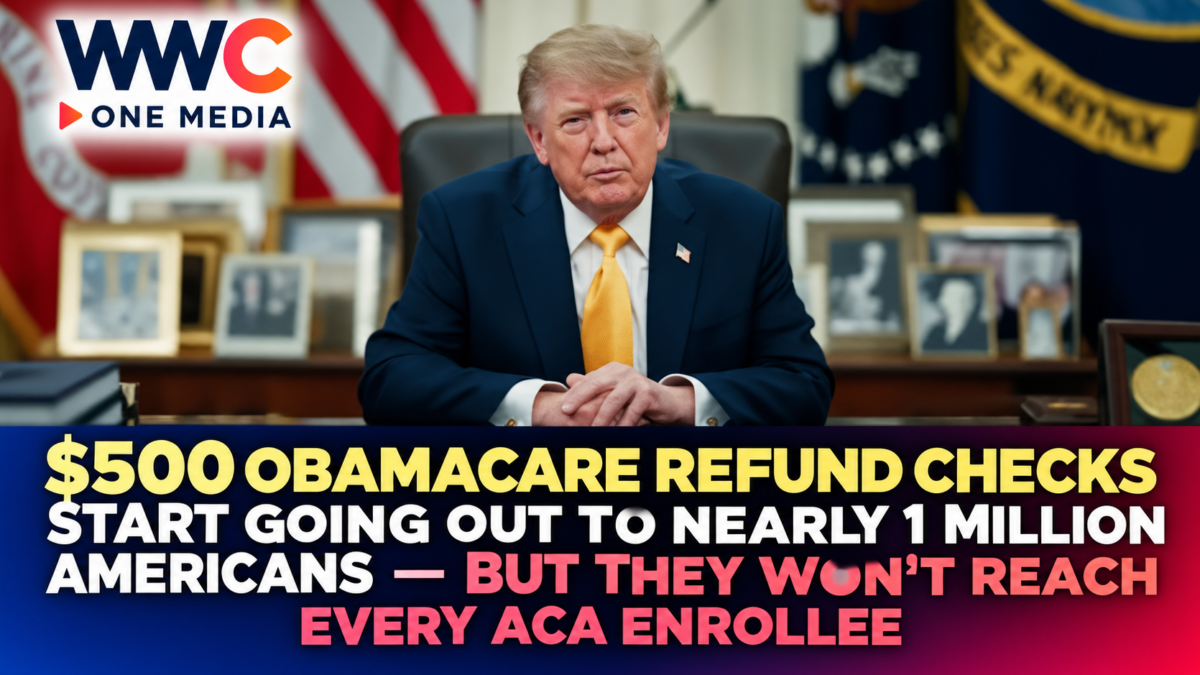
WASHINGTON — More than 950,000 Americans are beginning to receive unexpected $500 payments tied to the Affordable Care Act, as the Trump administration returns hundreds of millions of dollars collected through fees used to operate HealthCare.gov.
The Treasury Department began sending the payments on September 30, 2026, targeting people in 30 states who purchased ACA health insurance through the federal Marketplace and generally paid the full cost of their coverage without federal premium subsidies.
The payments are worth:
$500 per eligible person.
That means some households with more than one eligible family member could receive:
$1,000
$1,500
or potentially more.
And unlike many government benefit programs, eligible consumers do not need to submit a new application.
The administration says recipients have already been identified using federal Marketplace records.
But the payments come with several important limitations.
Not every Obamacare enrollee qualifies.
Residents of states operating their own ACA marketplaces generally will not receive them.
And the $500 refunds are separate from the traditional insurance-company rebates that some Americans receive under another provision of the Affordable Care Act.
MORE THAN 950,000 PEOPLE ARE GETTING $500
The Trump administration says more than:
950,000 Americans
will receive the one-time payment.
Recipients live across:
30 states
that use HealthCare.gov for their Affordable Care Act Marketplace operations.
The White House originally announced the program on September 10.
Payments started being released on:
September 30.
Some recipients will receive:
Paper checks
while others may receive:
Direct deposits.
Eligible households with multiple qualifying people can receive more than one $500 payment.
YOU DO NOT NEED TO APPLY
One of the most important practical details is that there is:
no application process.
The government says it already knows who qualifies based on Marketplace records.
Consumers should therefore be cautious if anyone contacts them claiming they must:
Pay a fee
Submit bank details
Provide a Social Security number
or
Click a link
to claim the money.
Legitimate recipients should receive the payment automatically.
That also makes the program an obvious target for potential scams.
WHY IS THE GOVERNMENT SENDING THE MONEY?
The payments come from fees associated with operating the federal Affordable Care Act Marketplace.
Insurance companies selling policies through HealthCare.gov pay what are known as:
user fees.
These fees are calculated as a percentage of premiums.
Insurers generally factor operating expenses—including government Marketplace fees—into the prices they charge customers.
The Trump administration says previous user-fee collections generated more money than was necessary to operate HealthCare.gov.
The administration therefore argues that consumers who effectively helped finance those excess collections should receive money back.
The White House has labeled the program:
“Working Families Obamacare Refunds.”
THE WHITE HOUSE CALLS THE MONEY AN OVERCHARGE
The administration says the previous Biden administration collected user fees at levels that produced a significant surplus.
President Donald Trump argues that the extra funds should be returned to the people whose premiums helped finance the system.
But the term:
“overcharge”
reflects the Trump administration’s characterization.
Health-policy analysts note that HealthCare.gov user fees historically finance the operation and administration of the federal Marketplace, and determining exactly how much of any fee was economically borne by an individual enrollee is more complicated than simply tracing a specific dollar from one person’s premium into the federal Treasury.
The practical result, however, is straightforward:
the administration decided to return a portion of the accumulated funds directly to consumers.
THESE ARE NOT NORMAL ACA INSURANCE REBATES
This is one of the easiest parts of the story to misunderstand.
The $500 federal payments are not the same thing as the Affordable Care Act’s annual:
Medical Loss Ratio rebates.
Under the ACA, insurers in the individual and small-group markets generally must spend at least:
80% of premium revenue
on medical claims and quality-improvement activities.
Large-group insurers generally must spend at least:
85%.
If an insurer spends too little and keeps too much for administration, marketing or profit, it may have to return money to customers.
Those payments are known as:
MLR rebates.
The new $500 federal checks are separate.
AMERICANS MAY ACTUALLY RECEIVE BOTH
Because the two programs are unrelated, an eligible consumer could theoretically receive:
a $500 federal ACA refund
and
an insurer MLR rebate.
KFF estimated health insurers will issue approximately:
$759 million
in MLR rebates during 2026.
Those rebates are calculated using insurers’ financial performance over:
2023
2024
and
2025.
They may arrive as:
Checks
Bank reimbursements
or
Credits toward future premiums.
So consumers should carefully read any correspondence accompanying a payment to understand why they received it.
WHO QUALIFIES FOR THE $500 REFUND?
The new federal program primarily targets people who:
Purchased coverage through HealthCare.gov
and
Paid the full premium without federal premium assistance.
Many recipients had incomes above:
400% of the federal poverty level.
For 2026, that threshold is around:
$62,600 for one person.
For a family of four, the comparable amount is roughly:
$128,000 to $132,000, depending on the poverty guideline and eligibility year being referenced.
Some recipients with lower incomes may also qualify depending on their Marketplace history and whether they received premium assistance.
The government has already determined the eligible group.
WHY HIGHER-INCOME ACA CUSTOMERS ARE A MAJOR PART OF THE PROGRAM
The answer goes back to the expiration of enhanced Obamacare subsidies.
During the pandemic era, Congress temporarily expanded ACA premium tax credits.
The enhanced subsidies:
Increased assistance for lower- and middle-income households
and
Removed the old 400%-of-poverty income cutoff.
That meant some middle-income households that previously earned too much to qualify for help suddenly became eligible for premium subsidies.
The expanded credits were extended through:
2025.
But they expired at the end of that year.
THE “SUBSIDY CLIFF” CAME BACK IN 2026
Once the enhanced subsidies expired, the Affordable Care Act’s traditional subsidy structure returned.
For some households, earning slightly above the eligibility cutoff meant losing federal premium assistance entirely.
That phenomenon is commonly called the:
“subsidy cliff.”
KFF found people just above that threshold were disproportionately likely to abandon Marketplace coverage in 2026.
Those households could face premiums costing thousands of dollars more per year.
The $500 refund therefore arrives at a moment when some of these consumers are paying substantially more for health insurance.
ACA PREMIUM PAYMENTS JUMPED 58%
KFF found that average monthly Marketplace premium payments, after tax credits, increased from approximately:
$113 in 2025
to
$178 in 2026.
That is a:
58% increase.
The increase was even larger for some people who lost enhanced federal subsidies entirely.
Consumers responded in several ways.
Some:
Changed plans
Moved to cheaper coverage
Accepted higher deductibles
or
Dropped insurance altogether.
DEDUCTIBLES ALSO JUMPED
Premiums were not the only expense increasing.
KFF estimated the average Marketplace deductible rose about:
37%
in 2026.
That was an increase of more than:
$1,000 per person.
The average deductible climbed from approximately:
$2,759
to
$3,786.
One reason was that many consumers shifted toward cheaper:
Bronze plans.
Bronze plans usually offer lower monthly premiums.
But they often require patients to pay significantly more out of pocket before insurance coverage fully kicks in.
ENROLLMENT DROPPED BY ABOUT 3 MILLION PEOPLE
The higher costs also affected enrollment.
KFF’s analysis of CMS data found February effectuated Marketplace enrollment fell from:
21.8 million people in 2025
to
19.2 million in 2026.
That represents roughly:
2.6 million fewer people
or a decline of about:
12%.
Other federal estimates put the broader decline near:
3 million people.
It was the first major enrollment reversal after years of rapid ACA Marketplace growth.
ALMOST EVERY STATE LOST ACA ENROLLEES
KFF found Marketplace enrollment declined in nearly every state.
The exception was:
New Mexico.
New Mexico replaced the expired federal enhanced subsidies with state-funded assistance.
States operating their own marketplaces generally experienced smaller enrollment declines than states relying on the federal platform.
That suggests state-level financial assistance helped cushion the impact of the federal subsidy expiration.
WHICH STATES ARE GETTING THE $500 CHECKS?
The federal refund program applies to eligible consumers in 30 states connected to the federal HealthCare.gov platform.
They include:
Alabama
Alaska
Arizona
Arkansas
Delaware
Florida
Hawaii
Indiana
Iowa
Kansas
Louisiana
Michigan
Mississippi
Missouri
Montana
Nebraska
New Hampshire
North Carolina
North Dakota
Ohio
Oklahoma
Oregon
South Carolina
South Dakota
Tennessee
Texas
Utah
West Virginia
Wisconsin
and
Wyoming.
People using independent state-operated ACA exchanges are generally outside this particular refund program.
TEXAS HAS THE MOST RECIPIENTS
Texas is expected to receive the largest number of payments.
Reports indicate roughly:
140,000 Texas residents
are eligible.
That would represent about:
$70 million
in payments to Texas alone.
Florida and Ohio are also among the states with large recipient populations.
The distribution broadly reflects where significant numbers of unsubsidized HealthCare.gov customers live.
THE PROGRAM COULD COST ABOUT $475 MILLION
If approximately:
950,000 people
each receive:
$500,
the total payments would equal roughly:
$475 million.
That money is coming from funds associated with Marketplace user-fee collections.
The White House says returning the money to consumers is preferable to leaving excess revenue with the government.
Critics of the administration’s approach argue those funds could alternatively have been used to help address broader Marketplace affordability or administrative needs.
USER FEES ARE A SMALL PERCENTAGE OF PREMIUMS
HealthCare.gov does not operate for free.
CMS charges insurers participating in the federally facilitated Marketplace a percentage of premiums.
For the 2026 benefit year, the federal Marketplace user-fee rate was:
2.5% of monthly premiums.
State-based marketplaces using the federal platform were charged:
2.0%.
CMS uses these fees to finance functions including:
Marketplace technology
Eligibility systems
Consumer assistance
Enrollment infrastructure
and other operational costs.
THE GOVERNMENT CAN CHANGE THE FEE OVER TIME
Marketplace user-fee rates are not permanently fixed.
CMS reviews and adjusts them.
The agency’s calculations depend partly on:
Enrollment
Expected program costs
and
Marketplace operations.
That means a fee appropriate during one enrollment environment may generate too much or too little revenue if participation changes substantially.
The Trump administration’s position is that previous collections exceeded what was necessary.
THE TIMING HAS BECOME POLITICALLY CONTROVERSIAL
The checks began arriving roughly five weeks before the:
November 2026 U.S. midterm elections.
Reuters reported that many of the largest payments are flowing into politically competitive states.
Democratic critics have questioned the timing and described the refund program as politically motivated.
The Trump administration says the purpose is straightforward:
to return excess federal Marketplace fee revenue to consumers who paid full-price premiums.
Research on direct government payments suggests they may attract attention from voters, although determining whether they materially change voting behavior is difficult.
The payments themselves are already authorized and being distributed regardless of that political debate.
THE $500 CHECK DOES NOT RESTORE THE EXPIRED SUBSIDIES
This distinction is particularly important.
A person receiving $500 is not automatically receiving restored enhanced ACA premium tax credits.
Those were a separate policy.
For some households, expiration of the enhanced credits increased annual health-insurance costs by:
Thousands of dollars.
A one-time $500 payment may offset part of that increase.
But it does not recreate the subsidy structure that existed through 2025.
That is why supporters and critics frame the program differently.
A FAMILY COULD RECEIVE MORE THAN $500
The payment is calculated per eligible person rather than strictly per household.
Suppose two spouses are both identified as eligible.
The household could receive:
$1,000.
If additional qualifying family members exist, the total could be higher.
The administration says some families therefore will receive multiple payments.
Recipients should examine government correspondence carefully before assuming an unexpected deposit is an error.
THERE MAY BE TAX QUESTIONS
Recipients may also need to consider whether their specific payment has tax consequences.
The answer can depend partly on how the original health-insurance premiums were treated for tax purposes.
For someone who paid premiums entirely using after-tax dollars and did not claim a deduction, a refunded amount may be treated differently from a reimbursement connected to previously deducted expenses.
Self-employed consumers or others who deducted health-insurance premiums may face different circumstances.
Because individual tax situations vary, recipients with substantial deductions or unusual circumstances may need professional tax guidance.
WATCH OUT FOR SCAMS
Any government check program creates opportunities for fraud.
Consumers should be suspicious of messages saying:
“Click here to claim your $500.”
or
“Pay a processing fee before your refund can be released.”
The federal program does not require an application.
The government already identified eligible recipients.
No legitimate administrator should require someone to send money before receiving the refund.
Recipients should rely on official government correspondence rather than unsolicited calls, texts or social-media messages.
A SEPARATE ACA FRAUD CRACKDOWN IS ALSO UNDERWAY
The refunds arrive while CMS is conducting a broader review of fraud and unauthorized enrollment in the federal Marketplace.
In September, CMS said it had canceled approximately:
315,000 unauthorized enrollments
covering more than:
760,000 individuals.
The agency estimated that could prevent approximately:
$2.2 billion
in federal premium subsidies from being improperly paid.
Another roughly:
400,000 enrollments
were under review.
CMS says many cases involved unauthorized broker activity.
THAT CRACKDOWN COULD HAVE AN UNINTENDED PREMIUM EFFECT
There is another complication.
Reuters reported that many allegedly fraudulent or unauthorized enrollees used relatively little health care.
If large numbers of healthier people are removed from insurance pools, the remaining population can become:
Older
Sicker
or
More expensive to insure.
That could eventually push insurer costs—and therefore future premiums—higher.
Insurers have already filed for a median ACA premium increase of approximately:
15% for 2027.
Those rates are largely locked in, but analysts say enrollment changes could influence pricing in later years.
HEALTH INSURANCE AFFORDABILITY REMAINS THE BIGGER ISSUE
The $500 checks will be meaningful for many households.
But they arrive against a much larger cost backdrop.
Consumers face:
Higher premiums
Higher deductibles
Prescription-drug costs
and
Out-of-pocket medical expenses.
KFF surveys found many Marketplace customers worry about whether they can afford:
Hospital care
Routine doctor visits
and
Prescription medicines.
More than four in 10 returning Marketplace enrollees surveyed said higher insurance costs had made basic household expenses such as groceries, utilities or rent harder to afford.
THE BIGGER STORY: $500 IS REAL MONEY — BUT THE ACA AFFORDABILITY FIGHT IS MUCH BIGGER
More than 950,000 Americans are now receiving something unusual from Washington:
a $500 Obamacare refund.
No application is required.
Some families will receive multiple payments.
And nearly half a billion dollars could ultimately flow back to eligible households across 30 states.
For recipients, that is genuine financial relief.
But the payment arrives after a difficult year for the Affordable Care Act Marketplace.
Enhanced subsidies expired.
Average premium payments rose:
58%.
Average deductibles increased:
37%.
And roughly:
2.6 million fewer people
had effectuated Marketplace coverage in February compared with a year earlier.
That puts the new checks into perspective.
The administration says it is returning surplus Marketplace fees that should never have remained with the government.
Critics say $500 does not address the much larger affordability pressures many ACA customers now face.
Both debates will continue.
But for households opening their mailboxes or checking their bank accounts, the immediate question is much simpler:
Is that unexpected $500 payment legitimate—and are you one of the nearly one million Americans who qualified automatically?