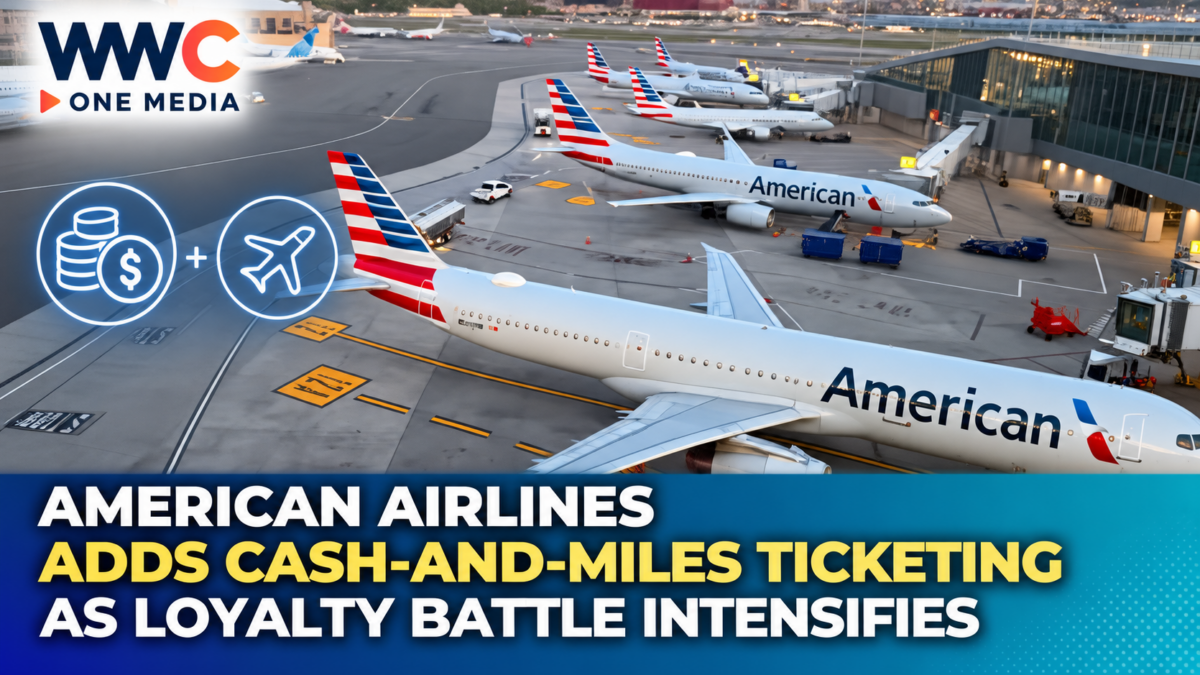
FORT WORTH — American Airlines is giving AAdvantage members a new way to pay for flights, allowing travelers to combine cash and frequent-flyer miles on the same ticket instead of choosing between paying entirely with money or redeeming a traditional award.
The feature will begin rolling out in the coming weeks on aa.com and the American Airlines app, giving eligible travelers a slider at checkout that lets them choose how much of the fare they want to cover with miles and how much they want to pay in cash.
For travelers sitting on smaller mileage balances, that could make AAdvantage miles easier to use.
But there is an important catch.
American has not published a fixed redemption rate showing exactly how much value each mile will provide.
That means the new flexibility does not automatically mean better value.
HOW THE NEW CASH-AND-MILES OPTION WORKS
American says members will first search for a flight using a normal cash fare.
After choosing the flight and reaching checkout, eligible users will see available combinations of:
Cash
and
AAdvantage miles.
A slider will allow the traveler to change the mix.
As more miles are applied, the cash portion will fall.
The final price updates automatically before payment is completed.
That creates a very different experience from the traditional award-booking model.
Instead of searching separately for an award seat priced entirely in miles, travelers can start with a normal cash fare and use miles to reduce the amount they owe.
THE FIRST ROLLOUT IS LIMITED
The initial launch is narrower than the headline may suggest.
American’s own AAdvantage program page says the feature will initially be available for:
U.S.-based AAdvantage members
booking
domestic U.S. flights operated by American Airlines
while excluding:
Alaska
and
Hawaii.
American says more routes will be added later.
So international flights and some domestic destinations will not necessarily be included immediately.
WHY THIS COULD HELP PEOPLE WITH SMALL MILEAGE BALANCES
One of the biggest frustrations in airline loyalty programs is having miles but not enough for the award a traveler actually wants.
A member might have:
8,000 miles
12,000 miles
or
18,000 miles
while a desired award requires significantly more.
Those miles can sit unused for years.
Cash-and-miles booking gives those balances a purpose.
Instead of waiting to earn enough miles for a full award ticket, a traveler may be able to immediately use the existing balance to lower the cash cost of a trip.
That can make the loyalty program feel more useful to occasional travelers—not just elite members and frequent credit-card users.
BUT AMERICAN HAS NOT SAID WHAT EACH MILE WILL BE WORTH
This is the most important unanswered question.
American has not published a fixed exchange rate for cash-and-miles redemptions.
That is significant because redemption value determines whether the feature is actually a good deal.
For example, imagine a traveler can use:
10,000 miles to reduce a ticket by $100.
That would equal roughly:
1 cent per mile.
If the same 10,000 miles could otherwise be used for an award giving $150 or $200 in value, using cash and miles would be less attractive.
Travel analysts therefore warn that convenience and value are two different things.
The option may make miles easier to spend without necessarily making them more valuable.
TRADITIONAL AWARD TICKETS MAY STILL BE BETTER
American uses dynamic pricing for many AAdvantage awards.
That means the number of miles required can change depending on:
Destination
Travel date
Demand
Cabin
and
Available inventory.
Sometimes those award prices can provide strong value.
At other times they can be expensive.
Travelers using the new system should therefore compare at least three numbers:
The normal cash fare
The normal full-mile award price
and
The cash-and-miles combination.
Without comparing all three, a customer may unknowingly redeem miles at a poor rate.
THIS ISN’T A NEW IDEA IN THE AIRLINE INDUSTRY
American is catching up with rivals that already offer versions of mixed payment.
Delta has long offered Miles + Cash on selected award bookings.
It also offers Pay with Miles for eligible Delta SkyMiles American Express cardholders.
Under Delta’s Pay with Miles system, eligible customers generally receive up to $50 off a ticket for every 5,000 miles redeemed.
That creates a relatively transparent benchmark of approximately:
1 cent per mile.
Delta’s broader Miles + Cash product works differently and is treated as an award ticket.
United has also offered a Money + Miles option that lets MileagePlus members combine the two currencies on eligible bookings.
American is therefore moving toward a flexibility model already familiar to many travelers.
AMERICAN’S DIFFERENCE COULD BE HOW SIMPLE IT FEELS
The airline is positioning the feature as a checkout tool rather than forcing customers to think entirely in award-ticket terms.
Members search normally.
They choose the fare they want.
Then they decide whether miles should reduce the price.
That simplicity could be strategically important.
Airline loyalty programs have become increasingly complicated.
Travelers often need to understand:
Award charts
Dynamic pricing
Transfer partners
Elite status
Credit-card bonuses
and
Fare restrictions.
A simple slider could make mileage redemption much more intuitive for the average passenger.
THE MOVE IS PART OF A MUCH BIGGER AADVANTAGE EXPANSION
American has spent 2026 broadening the ways customers can use AAdvantage miles.
The airline has already added or announced redemptions for:
Retail gift cards
Sporting events
Subscriptions
and other experiences.
Members reaching certain Loyalty Point thresholds can also select benefits including New York Times subscriptions and inflight food-and-beverage coupons.
American has kept its AAdvantage elite-status qualification thresholds unchanged for a third consecutive year.
That stability is notable at a time when loyalty programs across the industry have frequently changed qualification requirements.
LOYALTY PROGRAMS HAVE BECOME HUGE BUSINESSES
The cash-and-miles launch matters because airline loyalty programs are no longer side benefits.
They are major financial assets.
Airlines earn enormous amounts of money by selling miles to:
Credit-card issuers
Hotels
Retail partners
and
Other businesses.
Banks purchase miles and award them to customers when they spend on co-branded cards.
The airline receives cash immediately.
The passenger receives miles that may eventually be redeemed for travel.
This model has made loyalty programs some of the most valuable pieces of major U.S. airlines.
THE CREDIT-CARD BUSINESS MAKES MILES MORE IMPORTANT THAN EVER
American has a major co-branded credit-card relationship with Citi.
Customers can earn AAdvantage miles through:
Flights
Credit-card spending
Hotels
Car rentals
Shopping portals
and
Partner transactions.
Every additional redemption option can make those miles appear more useful.
And the more useful the currency feels, the more incentive customers have to:
use an American-branded credit card,
remain inside the AAdvantage ecosystem,
and choose American for future flights.
That is why seemingly small loyalty changes can carry major financial implications.
AIRLINES WANT MEMBERS TO ACTUALLY USE THEIR MILES
Large unused mileage balances create a complicated situation for airlines.
On one hand, miles that expire or never get redeemed can be financially beneficial.
On the other hand, a loyalty currency becomes less attractive if customers think it is too difficult to use.
The ideal balance is to make miles feel valuable enough that customers continue earning them while maintaining enough pricing flexibility to protect airline economics.
Cash-and-miles redemptions can help.
They create more opportunities for customers to spend their balances without requiring the airline to offer a low-priced full award seat.
AMERICAN IS ALSO PUSHING FREE WI-FI THROUGH AADVANTAGE
Loyalty is becoming central to the onboard experience as well.
American began rolling out free high-speed Wi-Fi for AAdvantage members in 2026, with AT&T sponsoring the service.
The airline says free connectivity will ultimately reach its entire narrowbody and dual-class regional fleet.
By linking free Wi-Fi to AAdvantage membership, American gains another reason for occasional passengers to create an account.
Once enrolled, those travelers become part of the airline’s broader customer-data and marketing ecosystem.
THE INDUSTRY IS TURNING LOYALTY INTO A COMPLETE DIGITAL ECOSYSTEM
The traditional frequent-flyer model was simple:
fly,
earn miles,
redeem them for another flight.
That model has changed dramatically.
Modern airline loyalty programs now include:
Credit cards
Hotels
Rental cars
Shopping
Dining
Subscriptions
Sports experiences
and
Digital services.
Airlines want customers earning and redeeming points even when they are not flying.
That increases engagement and generates more revenue from partners.
American’s cash-and-miles feature fits directly into that strategy.
IT COULD ALSO ENCOURAGE MORE PAID BOOKINGS
There is another financial advantage for American.
A traveler looking at a $400 ticket may hesitate because the cash price feels too high.
If American allows that customer to apply miles and reduce the payment to $250 or $300, the traveler may complete a booking that otherwise would not have happened.
That can increase conversion.
From the airline’s perspective, the transaction also still includes real cash revenue rather than being funded completely through an award redemption.
That makes mixed payments potentially attractive to both sides.
FLEXIBILITY CAN BE ESPECIALLY USEFUL DURING EXPENSIVE TRAVEL PERIODS
Cash-and-miles options may become especially appealing during:
Thanksgiving
Christmas
Spring break
and
Summer holidays.
Award pricing can become extremely high during peak demand.
A traveler might not want to use 60,000 or 80,000 miles on a domestic flight.
But using 15,000 or 20,000 miles to reduce an expensive cash ticket could still feel worthwhile.
Again, however, the actual value depends on the conversion rate American offers.
DYNAMIC PRICING MAKES THE CALCULATION MORE COMPLICATED
AAdvantage awards no longer behave like a simple fixed-price currency.
The airline can adjust mileage prices based on demand.
Cash fares also change constantly.
That means a cash-and-miles offer that looks attractive today may be less attractive tomorrow.
Consumers may need to think of miles almost like another payment currency whose exchange rate changes depending on the transaction.
That gives travelers flexibility.
But it also makes loyalty programs harder to evaluate.
SOME TRAVELERS WILL STILL SAVE MILES FOR PREMIUM CABINS
Experienced points collectors frequently use airline miles for long-haul premium travel because those awards can sometimes provide substantially higher value.
Business-class tickets that cost thousands of dollars can occasionally be booked for far fewer miles than a simple one-cent-per-mile cash offset would imply.
For those travelers, applying miles toward a routine $250 domestic economy ticket may not make sense.
They may prefer to preserve the balance for:
International business class
Partner awards
or
Other high-value redemptions.
Cash and miles therefore may appeal most strongly to customers who value simplicity rather than maximizing every mile.
THE FEATURE COULD MAKE AADVANTAGE MORE COMPETITIVE WITH DELTA AND UNITED
All three major U.S. network airlines increasingly compete not just on routes or ticket prices but on loyalty-program convenience.
A traveler deciding between American, Delta and United may compare:
Credit-card benefits
Upgrade rules
Airport lounges
Status benefits
and
How easy miles are to redeem.
United and Delta already offer mixed-payment options in different forms.
American adding one removes a competitive gap.
That matters especially for occasional travelers who may not care about the technical differences between airline currencies.
AMERICAN IS TRYING TO MAKE LOYALTY LESS ALL-OR-NOTHING
That may be the most important strategic change.
Traditional award programs often force customers into an all-or-nothing decision.
Either:
pay the full fare
or
use enough miles for the entire award.
American is now creating a middle ground.
A member with only a modest mileage balance can still receive immediate value.
That could make the program psychologically more rewarding.
Instead of seeing 9,000 miles sitting unused in an account, a customer sees those miles reducing the cost of the next trip.
BUT VALUE TRANSPARENCY WILL MATTER
American will eventually face pressure from frequent flyers to make redemption value clearer.
Travelers want to know what they are receiving in exchange for their points.
If cash-and-miles pricing consistently provides weak value, sophisticated customers may avoid it.
If the airline offers competitive value, it could become one of the easiest ways to redeem AAdvantage miles.
The feature’s success will therefore depend less on the existence of the slider and more on the numbers behind it.
THE BIGGER STORY: AIRLINE MILES ARE BECOMING MONEY
For decades, frequent-flyer miles were treated primarily as rewards.
Increasingly, airlines are turning them into something closer to a digital currency.
Customers can earn them through daily spending.
They can use them for travel, retail and experiences.
And now American is letting members directly combine them with dollars at checkout.
That gives travelers more flexibility.
It also gives the airline another powerful way to keep customers inside the AAdvantage ecosystem.
But there is one question every member should ask before moving that new slider:
How much cash is American actually giving you for every mile you spend?
Until the airline makes that value transparent—or the feature goes live widely enough for travelers to measure it—the new system may be easier to use, but not automatically the best way to use your miles.