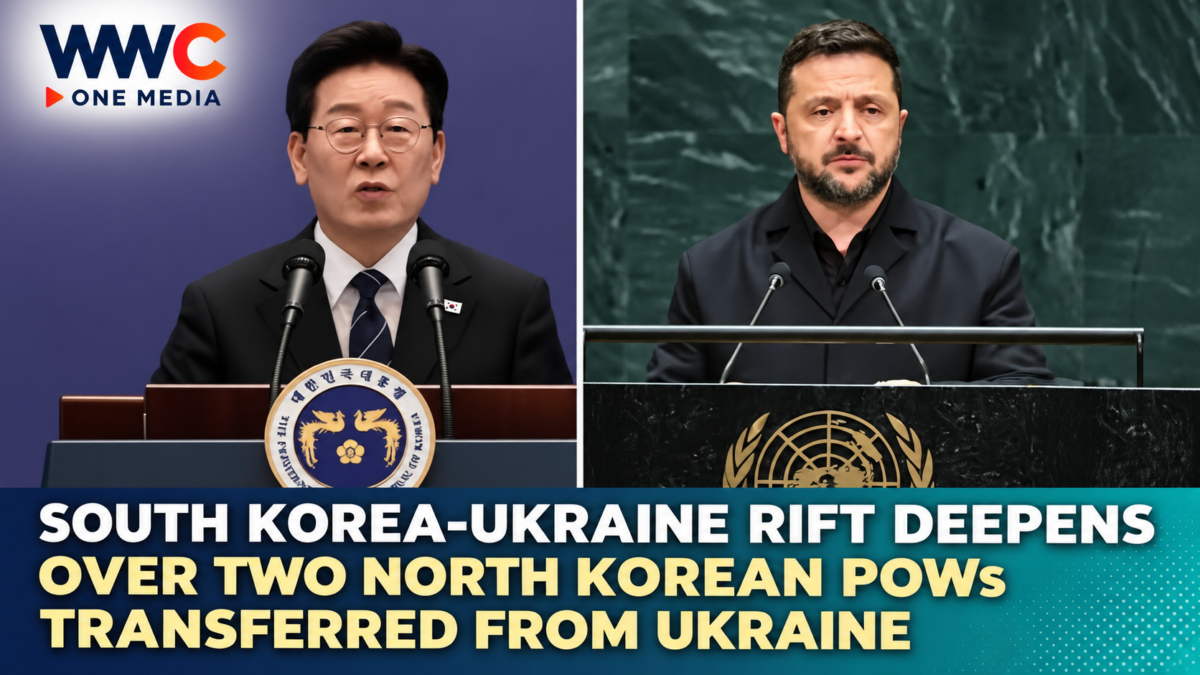
SEOUL/KYIV — A secretive prisoner transfer involving two North Korean soldiers captured while fighting for Russia has erupted into an unusually sharp diplomatic dispute between South Korea and Ukraine, with President Lee Jae Myung warning Kyiv of possible “additional measures” unless it acknowledges what Seoul says was a confidentiality agreement and issues an apology.
The two North Korean soldiers were captured by Ukrainian forces in Russia’s Kursk region in January 2025 after Pyongyang deployed troops to support Moscow’s war effort.
Both men were later transferred to South Korea after expressing a desire to resettle there rather than return to North Korea, according to international reporting.
The transfer itself had initially been kept quiet.
That changed on September 23, when Ukrainian President Volodymyr Zelenskyy revealed during a speech at the United Nations General Assembly that Ukraine had sent the two prisoners to South Korea.
That public disclosure has now become the center of a widening dispute.
SEOUL SAYS THE TRANSFER WAS SUPPOSED TO REMAIN SECRET
South Korean President Lee Jae Myung says Seoul and Kyiv had agreed not to publicly disclose the transfer.
Lee argued that secrecy was necessary because revealing the prisoners’ identities and circumstances could create diplomatic and security risks and potentially endanger people connected to them in North Korea.
South Korea says it now has written documents showing that confidentiality was part of the arrangement.
The presidential office has demanded both clarification and an apology from Ukraine.
Ukraine disputes that account.
Kyiv has denied that a formal non-disclosure agreement existed and has described the escalating disagreement as a diplomatic misunderstanding.
That leaves the two governments openly contradicting each other over what was agreed before the prisoners were transferred.
LEE WARNS OF “ADDITIONAL MEASURES”
The dispute escalated on October 2 when Lee warned that South Korea could take unspecified “additional measures” if Ukraine continued to reject Seoul’s account and failed to apologize.
Lee said Ukraine’s denial effectively suggested that his account of the confidentiality arrangement was untrue.
The South Korean government has not publicly specified what those measures could involve.
Seoul has been an important non-lethal supporter of Ukraine since Russia’s full-scale invasion, providing humanitarian and financial assistance while stopping short of directly supplying lethal weapons.
Any reduction in support would therefore add another complication to Ukraine’s relations with one of Asia’s most important U.S. allies.
WHY WERE THE TWO NORTH KOREANS FIGHTING IN UKRAINE?
The soldiers were part of a much larger North Korean military deployment supporting Russia.
North Korea began sending soldiers to Russia in 2024 as military cooperation between Pyongyang and Moscow deepened.
Estimates cited by Reuters indicate that roughly 14,000 to 15,000 North Korean troops have been deployed since then, particularly around Russia’s Kursk region.
North Korea has also supplied Russia with artillery ammunition, missiles and other military equipment.
Zelenskyy said in late September that more than 8,000 North Korean troops remained in Russia, while another 10,000 were being trained for potential deployment.
The two prisoners transferred to South Korea are therefore important not simply as individual defectors.
They potentially possess firsthand information about:
North Korean deployment procedures
Training
Command structures
Russian-North Korean battlefield cooperation
Military equipment
and
conditions faced by North Korean soldiers overseas.
THEY WERE CAPTURED ALIVE — WHICH WAS ITSELF UNUSUAL
Ukraine announced the capture of the two North Korean soldiers in January 2025.
Their survival was significant because Ukrainian officials had previously said some North Korean troops appeared to have been instructed to avoid capture.
One of the men was reportedly wounded when taken prisoner.
The two were among the first confirmed North Korean troops captured alive after Pyongyang directly entered the conflict on Russia’s side.
That made them potentially valuable sources of military intelligence for both Ukraine and South Korea.
BOTH MEN EVENTUALLY SAID THEY WANTED TO GO SOUTH
The prisoners initially became the subject of competing possibilities.
Ukraine considered whether they might eventually be used in a prisoner exchange involving Ukrainians held by Russia.
But returning them to North Korea carried another risk.
Pyongyang treats defection and surrender extremely seriously, and there were concerns the soldiers could face severe punishment if sent back.
By late 2025, both prisoners had reportedly expressed a desire to resettle in South Korea.
A South Korean activist said the men had written a letter stating that wish.
Seoul eventually agreed to accept them.
SOUTH KOREA TREATS NORTH KOREANS DIFFERENTLY FROM MOST FOREIGN POWS
The legal situation is unusual because South Korea’s Constitution considers the entire Korean Peninsula part of Korean territory.
North Koreans who enter South Korea and qualify for protection are generally treated as South Korean nationals rather than ordinary foreign refugees.
That legal framework made transfer to South Korea possible once the soldiers said they wanted to resettle there.
It also explains why Seoul became deeply involved in negotiations over their future.
WHY SEOUL WANTED SECRECY
South Korea’s concern was not limited to the personal safety of the prisoners.
President Lee’s administration is also trying to manage an increasingly difficult relationship with North Korea.
Pyongyang has abandoned its previous language of eventual reunification and now formally describes South Korea as a hostile state.
North Korean leader Kim Jong Un has simultaneously deepened military ties with Russia.
A highly publicized transfer of North Korean soldiers to Seoul could therefore be portrayed by Pyongyang as an organized defection operation.
That could complicate any future attempt by the Lee administration to restart communication with North Korea.
AP reported that South Korean officials and analysts see that diplomatic sensitivity as one reason Seoul reacted so strongly to Zelenskyy’s disclosure.
THE PRISONERS MAY ALSO HAVE FAMILIES STILL IN NORTH KOREA
Another concern involves relatives.
North Korea has a long history of imposing punishment on individuals accused of political disloyalty and, according to defectors and human-rights reporting, sometimes on their families.
Seoul therefore feared that public information about the prisoners could put people associated with them at risk.
That is one reason South Korean officials argue that confidentiality was not simply diplomatic preference.
They say it was also a humanitarian protection.
Ukraine has not publicly accepted Seoul’s claim that such an agreement existed.
ZELENSKYY MAY HAVE HAD A DIFFERENT STRATEGIC REASON
South Korea’s National Intelligence Service has reportedly assessed that Zelenskyy’s announcement may have been intended to highlight North Korea’s growing involvement in the war and encourage greater South Korean support for Ukraine.
That interpretation has not been independently confirmed as Zelenskyy’s motive.
But Ukraine has repeatedly emphasized North Korea’s involvement because Pyongyang’s troop deployments have transformed what began as a European conflict into one with deeper implications for Northeast Asian security.
For Kyiv, evidence that North Korean soldiers are directly fighting for Russia strengthens its argument that the war increasingly involves a wider coalition supporting Moscow.
SOUTH KOREA HAS RESISTED SENDING WEAPONS TO UKRAINE
The dispute also touches one of the most sensitive questions in Seoul’s Ukraine policy.
South Korea is a major arms producer and possesses large stocks of artillery ammunition compatible with Western systems.
Ukraine and some Western governments have repeatedly looked to Seoul as a potential source of military supplies.
But South Korea has largely maintained a policy of providing humanitarian, economic and non-lethal military assistance rather than directly supplying weapons to Ukraine.
Seoul’s domestic politics and its relationship with Russia and North Korea make direct weapons transfers particularly sensitive.
If South Korean officials believe Ukraine intentionally violated an agreement, it could make deeper military cooperation politically harder.
UKRAINE IS TRYING TO CONTAIN THE DAMAGE
Ukrainian Foreign Minister Andrii Sybiha has been in direct contact with South Korean Foreign Minister Cho Hyun as the two governments attempt to resolve the disagreement.
Sybiha has called the episode a misunderstanding and said Ukraine values its relationship with South Korea.
South Korean officials say the two sides are discussing possible language for a Ukrainian statement, including whether it would contain an apology.
That suggests both governments are still trying to prevent the dispute from becoming a broader rupture.
THE TWO COUNTRIES STILL NEED EACH OTHER
Despite the sharp rhetoric, Seoul and Kyiv have reasons to preserve cooperation.
Ukraine has direct battlefield experience observing how North Korean units operate alongside Russian forces.
That information is extremely valuable to South Korea as it studies Pyongyang’s evolving military capabilities.
Ukraine can provide intelligence on:
North Korean weapons performance
Troop tactics
combat experience
and
Russia-North Korea military integration.
South Korea, meanwhile, remains a technologically advanced economy, major arms manufacturer and important source of humanitarian and financial assistance.
Reuters reported that analysts believe prolonged deterioration in relations would therefore hurt both countries.
THE DISPUTE COMES AS NORTH KOREA-RUSSIA TIES DEEPEN
The prisoner controversy cannot be separated from the larger strategic relationship between Moscow and Pyongyang.
North Korea’s military support has given its soldiers rare exposure to modern battlefield conditions involving drones, artillery, electronic warfare and Western weapons systems.
In return, South Korean and Western officials have expressed concern that Russia could provide North Korea with advanced military technologies or other strategic benefits.
That exchange could strengthen Pyongyang’s military capabilities even after the Ukraine war eventually ends.
For Seoul, information obtained from captured North Korean troops may therefore have long-term security value.
TENSIONS ON THE KOREAN PENINSULA ARE RISING AT THE SAME TIME
The diplomatic clash with Ukraine is unfolding during another period of elevated tension between North and South Korea.
On October 2, North Korea launched a ballistic missile toward the sea from the area around Wonsan, according to South Korea’s military.
The launch came amid another dispute over mine explosions near the Demilitarized Zone.
South Korea accused North Korea of responsibility for a September 21 blast that injured South Korean personnel, while Kim Yo Jong, the sister of Kim Jong Un, rejected the accusation.
The simultaneous developments demonstrate why Seoul views anything involving North Korean defectors or captured soldiers as especially sensitive.
THE BIGGER STORY: TWO PRISONERS NOW SIT AT THE CENTER OF THREE COUNTRIES’ SECURITY INTERESTS
The case began with two wounded soldiers captured on a battlefield thousands of kilometers from Korea.
It has now become intertwined with:
Russia’s war in Ukraine
North Korea’s expanding military alliance with Moscow
South Korea’s attempt to manage relations with Pyongyang
and
Seoul’s support for Ukraine.
For Ukraine, the prisoners are evidence that North Korea is directly helping Russia wage war.
For South Korea, they are both potential intelligence sources and vulnerable individuals whose transfer had major diplomatic implications.
For North Korea, their defection could be portrayed as a politically embarrassing loss of military personnel sent abroad.
That explains why a disclosure of just two prisoners has produced an argument between governments.
The immediate question is whether Seoul and Kyiv can settle their disagreement over confidentiality.
But the larger story is harder to resolve:
North Korean soldiers are now gaining real combat experience in Europe—and South Korea is trying to understand what that could eventually mean much closer to home.