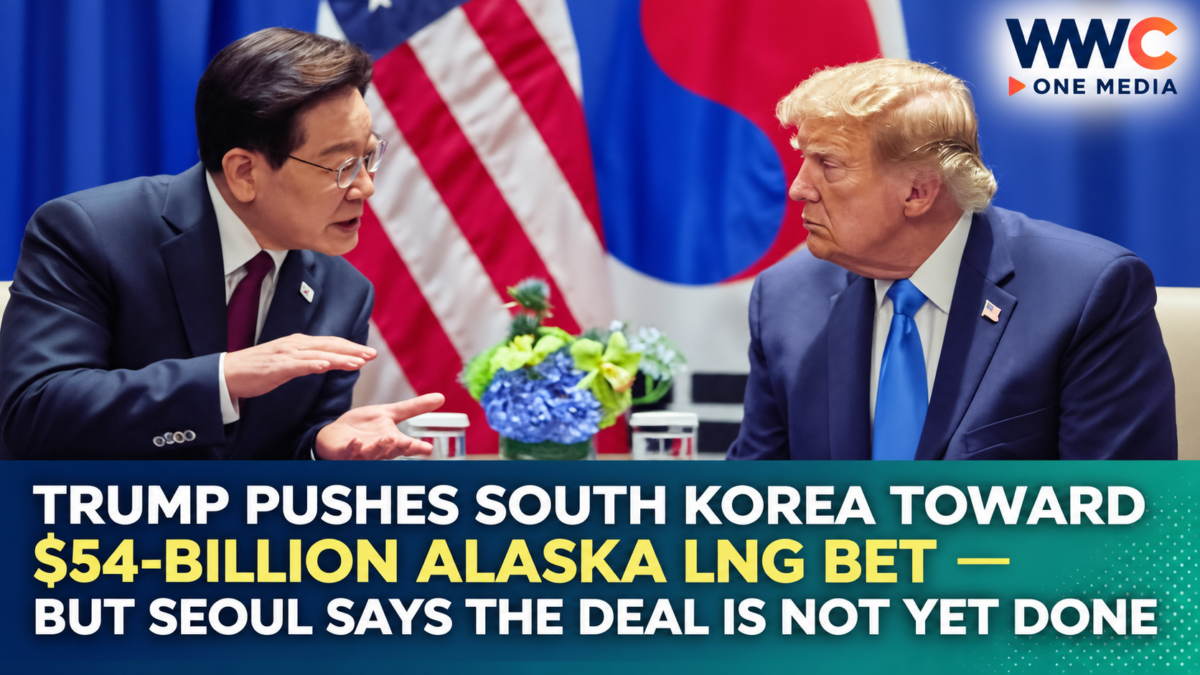
WASHINGTON/SEOUL — U.S. President Donald Trump is pushing South Korea to help finance one of America’s biggest proposed energy projects, a massive Alaska natural-gas pipeline and LNG export terminal potentially worth more than $50 billion — but Seoul is refusing to treat the investment as a done deal until the numbers make commercial sense.
The disagreement has exposed a widening gap between Washington’s public description of the project and South Korea’s more cautious position.
Trump and U.S. Commerce Secretary Howard Lutnick have presented approximately $54 billion in proposed South Korean participation in the Alaska LNG project as part of Seoul’s wider investment commitments to the United States.
South Korean officials, however, say the scale, structure and even the final decision to participate remain under review.
Industry Minister Kim Jung-kwan has repeatedly stressed that Seoul will participate only if the project can demonstrate commercial rationality and satisfy legal requirements.
That distinction could determine whether one of America’s longest-delayed energy megaprojects finally gets built.
TRUMP SAYS SOUTH KOREA WILL PUT BILLIONS INTO ALASKA LNG
The Alaska LNG project was among several large U.S. investments Trump highlighted this week under the economic framework negotiated with South Korea.
Washington has described South Korea’s broader U.S. investment package as totaling $350 billion, including:
$150 billion related to shipbuilding
and
$200 billion for strategic investments in U.S. industries and infrastructure.
The Alaska LNG proposal has emerged as one of the most prominent projects under that second category.
Lutnick said South Korean investment in the Alaska development could reach around $54 billion.
Trump has spoken about the project as though Korean participation were effectively agreed.
Seoul says otherwise.
SOUTH KOREA SAYS NOTHING HAS BEEN FINALIZED
South Korea’s Industry Ministry has said the country is still reviewing Alaska LNG.
An official told Korean media that neither a decision to invest nor the size of any potential investment had been determined.
Kim also said he protested to Lutnick after Washington publicly described the project in terms Seoul believed went beyond what the two sides had agreed.
According to Kim, figures discussed during negotiations had varied substantially, reinforcing Seoul’s view that the project’s economics and structure were not yet settled.
The disagreement is therefore not simply over whether South Korea supports closer energy cooperation with the United States.
It is over whether a project requiring tens of billions of dollars is commercially attractive enough to justify the risk.
TRUMP HAS NOW INCREASED THE PRESSURE
The dispute escalated further on October 3.
Trump told reporters that if South Korea does not agree to the Alaska LNG investment, he could “charge them more,” although he did not specify what additional charge he was referring to.
He also rejected suggestions that he had announced Seoul’s participation prematurely.
South Korea, meanwhile, has continued to say the project has not been finalized.
The latest exchange illustrates the political pressure surrounding what Seoul maintains should ultimately be a commercial investment decision.
WHAT EXACTLY IS ALASKA LNG?
The proposal is enormous.
Alaska LNG would transport natural gas from Alaska’s North Slope through a pipeline roughly 800 miles, or around 1,300 kilometers, long to Nikiski in southern Alaska.
There, the gas would be cooled into liquefied natural gas for export primarily to Asian markets.
The project would include:
North Slope gas infrastructure
A major gas-treatment facility
The long-distance pipeline
and
An LNG liquefaction and export terminal.
Planned LNG production could reach around 20 million metric tons annually.
The developer currently targets first exports around 2031.
THE COST COULD REACH $54.5 BILLION
This is where South Korea’s caution becomes easier to understand.
Current estimates put the total cost at approximately $44.5 billion to $54.5 billion.
That would make Alaska LNG considerably more expensive to build on a per-unit basis than many competing LNG projects on the U.S. Gulf Coast.
Reuters estimated that Alaska LNG could cost more than $2.7 billion for every million metric tons of annual LNG capacity.
Comparable recent Gulf Coast projects have generally cost around $1 billion per million tons of annual capacity.
That gap is one of the biggest concerns facing potential Korean investors.
The question is not whether Alaska has natural gas.
It clearly does.
The question is whether that gas can be brought to Asian customers cheaply enough to compete with alternative supplies.
WHY IS ALASKA LNG SO EXPENSIVE?
Geography is both Alaska LNG’s greatest advantage and its biggest problem.
The project must move gas from the remote North Slope through some of the most challenging terrain and weather conditions in North America.
The pipeline would cross hundreds of miles of Alaska before reaching the southern coast.
Construction costs could be affected by:
Extreme weather
Labor availability
Remote logistics
Steel and construction costs
and
The sheer length of the pipeline.
South Korea’s industry minister has specifically highlighted permitting and labor constraints among the issues that need to be addressed before the economics become convincing.
BUT ALASKA HAS ONE HUGE ADVANTAGE: ASIA IS CLOSE
Supporters argue that the project has something Gulf Coast LNG cannot easily replicate:
location.
Alaska sits much closer to major Northeast Asian LNG buyers including:
South Korea
Japan
Taiwan
and other Pacific markets.
That gives Alaska LNG shorter shipping routes and reduces exposure to maritime chokepoints used by cargoes coming from other producing regions.
Supporters argue those advantages could improve energy security and reduce shipping costs enough to offset some of the project’s higher construction expenses.
Analysts cited by Reuters, however, have questioned whether Asian buyers will be willing to pay enough of a premium for that security advantage to compensate for Alaska LNG’s much higher capital cost.
GLOBAL ENERGY DISRUPTIONS HAVE MADE SUPPLY SECURITY MORE IMPORTANT
The geopolitical argument has become stronger in 2026.
Energy markets have faced major disruption from the conflict involving Iran, increasing concerns about supplies moving through the Strait of Hormuz.
The strait historically handles close to one-fifth of global crude and LNG movements.
Despite the conflict, LNG traffic through Hormuz increased again in September, but shipping-security risks remain significant.
An LNG project on America’s Pacific coast would avoid Hormuz entirely.
It would also avoid the Panama Canal route normally associated with some U.S. Gulf Coast LNG shipments to Asia.
For countries heavily dependent on imported energy, geographic diversification has obvious strategic value.
But Seoul still has to determine how much that security is worth financially.
SOUTH KOREA ALREADY HAS A FOOT IN THE PROJECT
South Korean companies are not starting from zero.
POSCO International signed a preliminary agreement with Alaska LNG developer Glenfarne in 2025 involving the potential purchase of 1 million metric tons of LNG annually for 20 years.
The arrangement also contemplated POSCO supplying steel for the massive Alaska pipeline.
That gives South Korea a direct commercial connection to the project even before any broader government-backed investment is finalized.
But a long-term LNG purchase agreement is very different from committing tens of billions of dollars to finance infrastructure.
That is the much larger decision now under discussion.
JAPAN AND THAILAND HAVE ALSO SHOWN INTEREST
Alaska LNG has attracted other Asian buyers.
Japan’s JERA agreed to a long-term arrangement covering around 1 million tons of LNG annually, while Thailand’s PTT signed an agreement covering approximately 2 million tons a year over 20 years.
Those agreements strengthen the project’s commercial case.
But much of Alaska LNG’s customer pipeline remains preliminary rather than fully binding.
Glenfarne has indicated that the project has agreements covering roughly 13 million tons of annual LNG demand and needs additional commitments.
The developer is seeking binding contracts covering at least around 16 million tons annually to support financing.
That means billions of dollars in financing still depend on converting expressions of interest into firm, long-term purchase contracts.
THE PROJECT HAS BEEN TRYING TO GET BUILT FOR YEARS
Alaska LNG is not a new Trump-era concept.
Versions of the project have been discussed for decades.
Major energy companies including ExxonMobil, BP and ConocoPhillips were previously involved.
But several producers stepped away from earlier development efforts as costs rose and global LNG supply increased.
Alaska eventually took greater control of the project before private developer Glenfarne Group acquired a 75% stake.
The state-owned Alaska Gasline Development Corp. retains the remaining 25%.
That history helps explain why potential investors remain cautious.
The gas resource has never been the primary obstacle.
Financing and commercial competitiveness have been.
GLENFARNE HAS MADE PROGRESS ON GAS SUPPLY
There have nevertheless been significant developments.
In May 2026, Alaska LNG secured a 30-year natural-gas supply agreement with ConocoPhillips.
The agreement supports the project’s first phase and helps ensure sufficient North Slope gas supplies for Alaska customers.
Glenfarne also has supply arrangements involving other major producers.
That removes one piece of uncertainty.
But securing gas is not the same as financing and constructing the entire export project.
THE PROJECT COULD BE BUILT IN TWO STAGES
Glenfarne has structured Alaska LNG around two broad phases.
The first focuses primarily on getting North Slope gas into Alaska’s own domestic market through the pipeline.
A second phase would add the large LNG export facility at Nikiski, allowing shipments to Asian customers.
This phased strategy could reduce some early financing pressure and address declining local gas supplies in Alaska.
But the export phase is where much of the enormous project cost—and South Korea’s potential involvement—comes into play.
SOUTH KOREA’S BIGGER $350-BILLION U.S. COMMITMENT MATTERS
The Alaska debate is unfolding within a much larger U.S.–South Korean economic arrangement.
Seoul agreed to a $350-billion strategic investment package as part of a trade agreement with Washington that reduced tariffs on South Korean imports to the United States.
Of that amount, approximately:
$150 billion is associated with shipbuilding
while
$200 billion is intended for other strategic U.S. investments.
Projects under discussion have included:
Alaska LNG
A roughly 6-gigawatt gas-fired power project in Texas
and
Potential construction of eight nuclear reactors.
South Korea’s argument is that each project must still pass financial and legal review.
Washington’s recent public statements have portrayed several of them as considerably further along.
WHY SEOUL IS SO CAUTIOUS
South Korea has several reasons to examine Alaska LNG carefully.
1. THE PROJECT IS ENORMOUS
A $44.5-billion to $54.5-billion project creates substantial exposure if construction costs rise.
2. LNG PRICES CAN CHANGE DRAMATICALLY
The project would operate for decades.
Gas prices in 2031 or 2040 could look very different from those in 2026.
3. COMPETING LNG IS GETTING CHEAPER
New export plants are expanding along the U.S. Gulf Coast and Canada’s Pacific coast.
Canada in particular has a geographic advantage for Asian buyers without requiring Alaska LNG’s enormous North Slope pipeline.
4. MUCH OF THE CUSTOMER DEMAND ISN’T YET FULLY BINDING
Preliminary agreements help, but lenders and investors ultimately need firm contracts.
5. THE PIPELINE HAS TO CROSS ALASKA
That creates construction and cost risks substantially greater than those facing coastal LNG facilities located close to established gas infrastructure.
BUT SOUTH KOREA ALSO HAS REASONS TO WANT ALASKAN GAS
The other side of the equation is energy security.
South Korea relies heavily on imported fuels.
A long-term supply of U.S. LNG from Alaska could diversify its sources while shortening the physical journey between producer and customer.
An Alaska agreement could also deepen South Korea’s economic relationship with Washington at a time when investment, tariffs, shipbuilding, nuclear energy and semiconductor policy are increasingly intertwined.
POSCO’s potential role supplying pipeline steel also means participation could generate business for Korean industry instead of functioning solely as an energy purchase.
That combination explains why Seoul has continued evaluating the project rather than rejecting it.
$54 BILLION IS NOT YET A SOUTH KOREAN CHEQUE
The most important distinction in the current story is therefore between a political announcement and a finalized investment commitment.
Trump and Lutnick have publicly discussed more than $50 billion in Korean participation.
South Korea says it has not made that final commitment.
Reuters reported that Seoul considers the Alaska project subject to continuing commercial and legal evaluation.
So while the proposed $54-billion figure makes a dramatic headline, investors should not treat it as money already transferred or irrevocably committed to construction.
THE BIGGER STORY: ALASKA LNG HAS GAS, BUYERS AND POLITICAL SUPPORT — BUT IT STILL NEEDS THE NUMBERS TO WORK
For decades, Alaska has held enormous gas reserves without a commercially successful route for exporting them to Asia.
Trump has put presidential pressure behind changing that.
Glenfarne has brought in potential customers.
South Korean and Japanese companies have signed preliminary agreements.
And current geopolitical tensions make an LNG supply route outside major maritime chokepoints more attractive.
Yet the same fundamental question that has followed Alaska LNG for years remains unresolved:
Can an 800-mile pipeline and export terminal costing as much as $54.5 billion deliver LNG to Asia at a price competitive enough to justify the investment?
Washington is pushing Seoul for an answer.
South Korea’s answer, for now, is that it still needs to see the numbers.