MANILA, Philippines — The Philippines is intensifying its attack on some of the world’s most powerful short-lived climate pollutants, targeting methane, black carbon and hydrofluorocarbons as it tries to deliver on an ambitious commitment to cut and avoid greenhouse-gas emissions by 75%.
The government outlined the tougher measures during the Superpollutant Action Summit in New York, organized by the Climate and Clean Air Coalition on the sidelines of the 81st United Nations General Assembly.
The announcement comes weeks after the Philippines formally submitted its NDC 3.0 to the United Nations Framework Convention on Climate Change on September 8, 2026.
The strategy puts greater emphasis on pollutants that do not remain in the atmosphere as long as carbon dioxide but can trap enormous amounts of heat in the short term.
That means cutting them could produce climate benefits much faster.
WHAT ARE SUPERPOLLUTANTS?
The Philippines is focusing on three major categories:
Methane
Black carbon
and
Hydrofluorocarbons, or HFCs.
These are often grouped under the broader category of short-lived climate pollutants, or SLCPs.
Unlike carbon dioxide, which can remain in the atmosphere for centuries, several of these pollutants remain for much shorter periods.
But during that time, their warming effect can be extremely powerful.
Methane, for example, remains in the atmosphere for roughly 12 years but is responsible for about 30% of current global warming, according to climate research cited in recent Philippine methane initiatives.
That makes methane reduction one of the fastest available ways to slow near-term warming.
PHILIPPINES KEEPS 75% CLIMATE TARGET
The country’s updated climate commitment continues to center on a 75% reduction and avoidance of greenhouse-gas emissions against a business-as-usual pathway.
The target covers major sectors including:
Energy
Agriculture
Waste
Industrial processes
and
Transportation.
The Philippines’ earlier NDC divided the 75% commitment into only 2.71% unconditional action, with 72.29% dependent on international support.
That earlier framework underscores one of the central challenges that remains today: Manila says it cannot fully finance the transition on its own.
The government is continuing to seek climate finance, technology transfer and capacity-building support from wealthier countries and international institutions.
WHY METHANE IS NOW A MAJOR TARGET
Methane is particularly important for the Philippines because the country’s biggest sources are closely tied to agriculture and waste.
Recent Philippine methane assessments found that in 2020:
Agriculture accounted for roughly 55% to 60% of methane emissions
while
Waste accounted for about 35% to 40%.
Rice farming is the single largest source.
Other contributors include:
Livestock digestion
Animal manure
Wastewater
and
Solid waste disposal.
By comparison, energy, transport and industrial processes together accounted for less than 5% of national methane emissions in that assessment.
That means cutting methane in the Philippines is not mainly an oil-and-gas story.
It is largely a rice, livestock and waste-management story.
RICE FIELDS ARE AT THE CENTER OF THE PLAN
One of the government’s major measures is expanding alternate wetting and drying, or AWD, in rice production.
Traditional irrigated rice fields are often continuously flooded.
That creates oxygen-poor conditions in the soil where methane-producing microorganisms thrive.
AWD periodically allows rice paddies to dry before they are irrigated again.
That can reduce methane emissions while also saving water.
The government has identified AWD as one of the priority methane-reduction projects for the agriculture sector.
The Philippines is also pursuing an aspirational goal of cutting rice-sector methane emissions by 15% by 2030, while improving monitoring using technologies such as remote sensing.
LIVESTOCK COULD ALSO PRODUCE LESS METHANE
The agriculture strategy goes beyond rice.
Government measures also include:
Improved livestock feeding
Better manure management
and
Expanded use of biodigesters.
Biodigesters can capture methane from animal waste and convert it into usable biogas.
Instead of allowing methane to escape directly into the atmosphere, the gas can potentially be used as an energy source.
For farmers, this creates the possibility of turning waste into fuel while also reducing emissions.
LANDFILLS ARE ANOTHER MAJOR TARGET
The waste sector is also expected to carry a large part of the superpollutant-reduction effort.
Government plans include expanding:
Landfill gas capture
Methane flaring
Composting
Anaerobic digestion
and
Better separation of organic waste.
Organic waste becomes a major methane source when food scraps and other biodegradable material decompose without oxygen inside landfills.
Separating those materials and processing them through composting or controlled digestion can dramatically reduce emissions.
A Philippine strategy supported by the Climate and Clean Air Coalition estimated greenhouse-gas and black-carbon emissions from the municipal solid-waste sector at the equivalent of 5.43 million metric tons of carbon dioxide under its baseline assessment.
BLACK CARBON LINKS CLIMATE ACTION WITH CLEAN AIR
Black carbon is another key target.
It is produced through incomplete combustion and is commonly associated with:
Diesel engines
Open burning
Industrial combustion
and
Some household fuels.
Unlike conventional greenhouse gases, black carbon is a particle.
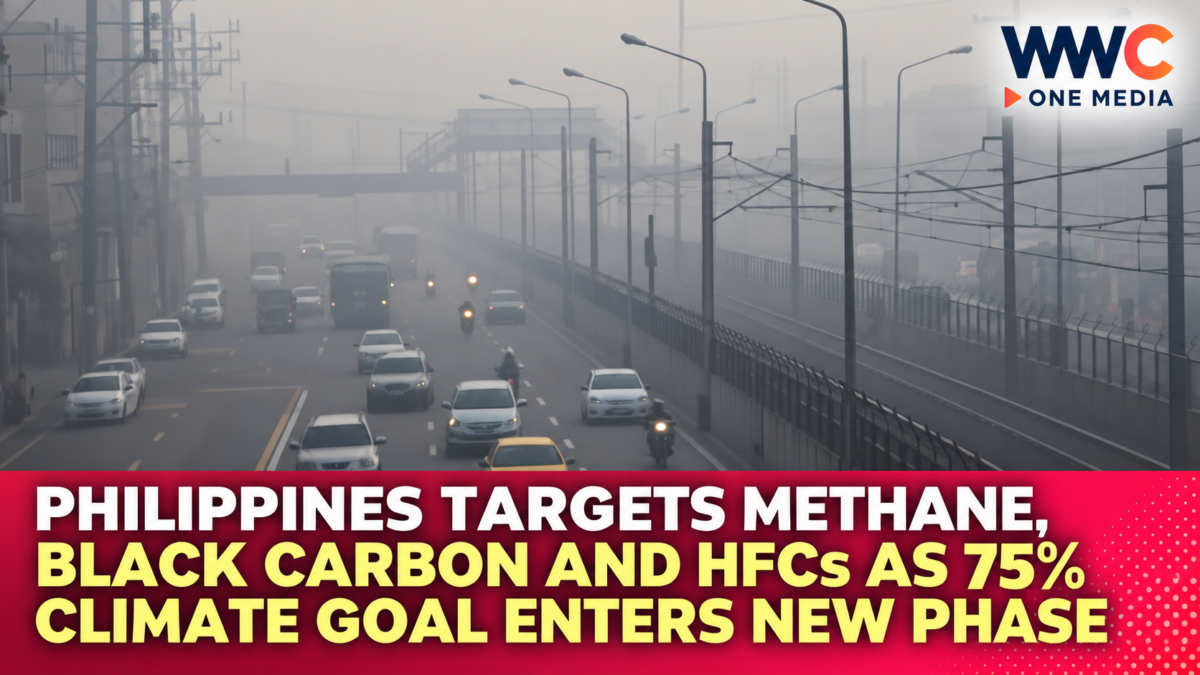
It contributes to warming while also worsening air quality and increasing health risks.
That means reducing black carbon can produce benefits almost immediately for people breathing polluted urban air.
The Philippine strategy includes tighter vehicle standards and cleaner transportation as part of the response.
EURO 5 AND EURO 6 VEHICLE STANDARDS ARE PART OF THE PLAN
Environment Assistant Secretary Daniel Darius Nicer said the Philippines is looking to stronger Euro 5 and Euro 6 vehicle-emission standards as part of its superpollutant strategy.
These standards impose tighter limits on pollutants produced by vehicle engines.
Government measures also include:
Electrification of public utility vehicles
and
Expansion of renewable energy.
That connects the superpollutant agenda with the country’s broader transportation modernization and clean-energy policies.
AIR CONDITIONERS AND REFRIGERATORS ARE PART OF THE CLIMATE STORY TOO
One of the less obvious targets is the refrigeration and air-conditioning industry.
Many cooling systems use hydrofluorocarbons, or HFCs.
HFCs do not destroy the ozone layer, but many have extremely high global-warming potential.
Some can trap hundreds or even thousands of times more heat than carbon dioxide on a molecule-for-molecule basis over standard climate-accounting periods.
The government plans to reduce those emissions by:
Shifting to refrigerants with lower global-warming potential
Improving refrigerant recovery
and
Safely handling and disposing of old cooling chemicals.
PHILIPPINES IS PREPARING FOR THE KIGALI TRANSITION
The policy is tied to the Kigali Amendment to the Montreal Protocol, which requires countries to gradually reduce the consumption of HFCs.
The Philippines is part of the group of developing countries that froze HFC consumption starting in 2024, with progressively deeper reductions scheduled over the following decades.
The transition matters enormously in a tropical country.
Air conditioning and refrigeration are essential to:
Homes
Hospitals
Food supply chains
Data centers
Shopping centers
and
Industrial facilities.
That means the Philippines cannot simply eliminate cooling.
It must replace high-warming refrigerants with safer alternatives while maintaining energy efficiency and affordability.
UNIDO IS HELPING PHILIPPINES PREPARE
The United Nations Industrial Development Organization and DENR launched another phase of Philippine cooling-sector work in August 2026.
The program is helping the country eliminate remaining HCFC refrigerants by 2030 while preparing for broader implementation of the Kigali HFC phase-down.
This means refrigeration contractors, equipment manufacturers, building owners and technicians will eventually have to adjust.
The climate transition is therefore also a workforce and industrial-policy issue.
Technicians need training.
Companies need different equipment.
And businesses may face capital costs when old systems are replaced.
THE PHILIPPINES IS ALSO TRYING TO MEASURE METHANE BETTER
You cannot credibly reduce emissions you cannot measure.
That has become another major focus.
Government agencies and climate partners convened in Quezon City in September to identify gaps in the Philippines’ methane measurement, reporting and verification system.
The work covers:
Agriculture
Waste
Energy
Transportation
and
Industrial processes.
Better measurement is particularly important because methane sources such as farms, landfills and wastewater facilities are spread across thousands of locations.
Reliable data will determine whether claimed reductions are actually happening.
WHY THIS MATTERS FOR CLIMATE FINANCE
Better measurement could also determine whether the Philippines can access international funding.
Climate-finance providers increasingly want verifiable evidence that projects are actually cutting emissions.
That is why DENR is seeking stronger localized systems for:
Monitoring
Reporting
and
Verification.
The government is also calling for more concessional and non-debt climate financing.
That distinction matters.
The Philippines is one of the world’s most climate-vulnerable countries and has repeatedly argued that adaptation and emissions reduction should not require vulnerable nations to take on excessive additional debt.
ARTICLE 6 CARBON MARKETS COULD ALSO PROVIDE MONEY
The Philippines is also exploring cooperation under Article 6 of the Paris Agreement.
Article 6 allows countries to cooperate in meeting climate targets, including through internationally transferred emissions reductions.
In practical terms, projects that cut methane or other emissions could potentially generate climate credits that attract foreign investment.
But such markets require credible accounting.
Without strong measurement systems, it becomes difficult to prove that a climate project produced genuine additional reductions.
That explains why carbon-market ambitions and methane monitoring are increasingly being developed together.
THE OLD CLIMATE PLAN ALREADY REQUIRED ABOUT $72 BILLION
The scale of the financial challenge is enormous.
The Philippines’ previous NDC Implementation Plan estimated that implementing its climate policies and measures would require roughly $72 billion, equivalent to trillions of pesos.
The largest estimated requirements were concentrated in:
Energy — about $36.5 billion
and
Transport — about $32.8 billion.
Agriculture, waste and industrial-process measures required smaller absolute amounts but can produce significant emissions reductions—especially when methane and HFCs are involved.
That is one reason superpollutants are attractive.
Some reductions can deliver relatively fast climate benefits without waiting decades for the entire energy system to transform.
AGRICULTURE ALONE ACCOUNTS FOR A LARGE SHARE OF PH EMISSIONS
The OECD estimates that agriculture contributes around 23% of Philippine greenhouse-gas emissions, with methane from rice cultivation and cattle among the major sources.
That creates a difficult policy balance.
Agriculture is both a contributor to climate change and one of the sectors most vulnerable to it.
Farmers already face:
Extreme heat
Typhoons
Flooding
Drought
Saltwater intrusion
and
Changing rainfall patterns.
Climate policies therefore need to cut emissions without hurting food security or farmer incomes.
That is why the government is emphasizing technologies such as water-saving irrigation and improved livestock feeding rather than simply restricting agricultural production.
SUPERPOLLUTANT CUTS COULD DELIVER FASTER BENEFITS THAN CO2 ALONE
Carbon dioxide remains the central driver of long-term climate change.
But reducing CO2 does not immediately remove the warming already locked into the atmosphere.
Short-lived climate pollutants work differently.
Because pollutants such as methane remain in the atmosphere for much shorter periods, aggressive reductions can slow the pace of warming more quickly.
Nicer said these measures can simultaneously produce benefits in:
Public health
Air quality
Food security
and
Near-term climate stabilization.
That makes superpollutant reduction one of the few climate strategies where people may feel some of the benefits relatively quickly.
BUT THE 75% TARGET STILL COMES WITH A MASSIVE CONDITION
The headline number is ambitious:
75% emissions reduction and avoidance.
But that figure should not be interpreted as a promise that the Philippines will finance and deliver the entire reduction independently.
Historically, most of the Philippine NDC has depended on outside assistance.
The earlier 2021 commitment made only 2.71% unconditional and 72.29% conditional on support from developed countries.
The country’s newest climate plan continues to emphasize the need for international support, particularly:
Climate finance
Technology transfer
Technical assistance
and
Capacity building.
That could ultimately determine how much of the target becomes reality.
THE BIGGER STORY: CLIMATE ACTION IS MOVING FROM POWER PLANTS TO RICE FIELDS, LANDFILLS AND AIR CONDITIONERS
Climate policy is often framed almost entirely around coal plants, renewable energy and electric vehicles.
The Philippines’ latest strategy shows how much broader the problem really is.
A flooded rice field can produce methane.
A landfill full of rotting food can produce methane.
A diesel vehicle can emit black carbon.
An aging air-conditioning unit can leak high-warming refrigerants.
Those sources may attract less attention than major power plants, but together they represent a substantial opportunity to slow warming.
That is why the Philippine climate strategy is increasingly moving beyond carbon dioxide alone.
The government is now trying to cut emissions from farms, garbage, vehicles and cooling systems at the same time.
The 75% target looks dramatic on paper.
But the real challenge begins with thousands of much smaller changes across the economy—and with finding the billions of dollars needed to make them happen.