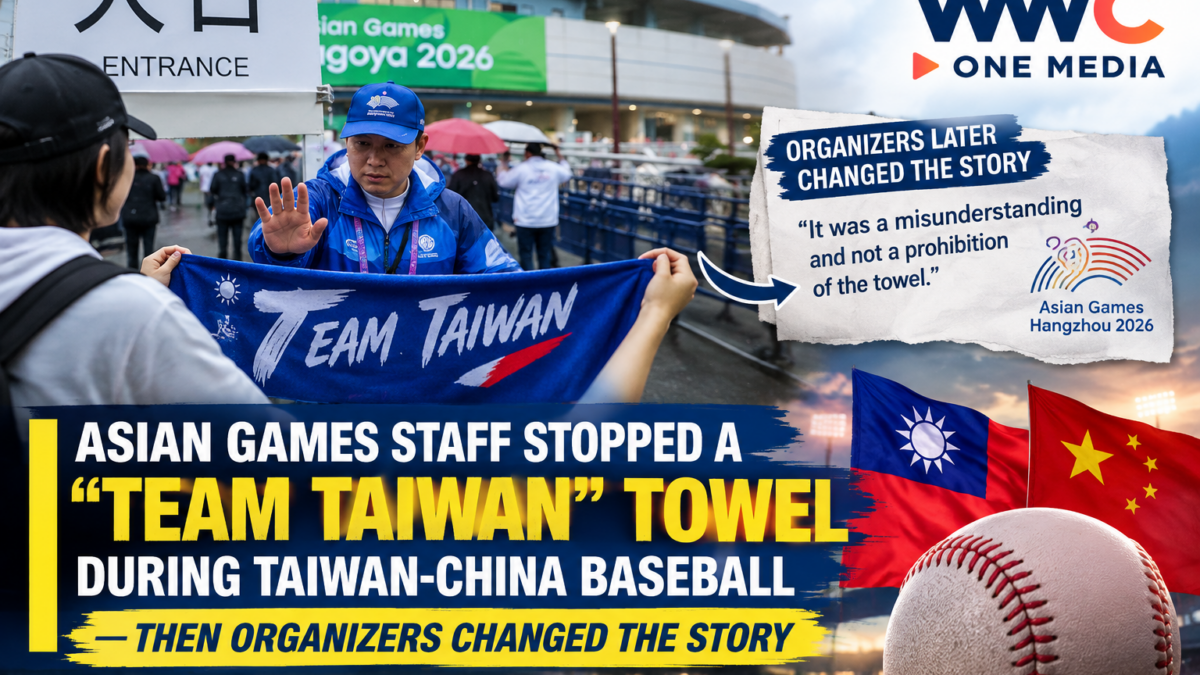
NAGOYA, Japan — What appeared to be a straightforward fan-support moment at the 2026 Aichi-Nagoya Asian Games quickly became a rules dispute after venue staff stopped a Taiwanese spectator from displaying a towel marked “Team Taiwan” during a baseball game against China.
The incident occurred on Sept. 25, when Taiwan defeated China 9-1. According to Taiwan News, tournament staff told the spectator to put away the towel or leave the venue. The fan questioned the instruction, arguing that the word “Taiwan” was not itself a political statement and that any restriction should be clearly stated in writing.
But the organizers later clarified that the towel was not actually banned.
Asian Games Organizers Blame a Misunderstanding
The Aichi-Nagoya Asian Games organizing committee initially said venue staff had asked spectators not to display towels carrying the names of countries or regions that were not represented by participating National Olympic Committees.
The committee said the measure was intended to avoid disputes between spectators and maintain a peaceful environment at the baseball venue.
However, the committee subsequently clarified that towels bearing the names of countries or regions that are not members of the International Olympic Committee were not prohibited.
It attributed the incident to a “mistaken understanding” by venue staff and the venue supervisor.
That clarification effectively changed the context of the confrontation: the spectator had been stopped over an interpretation of the venue rules that the organizing committee later said was incorrect.
The Incident Happened During Taiwan-China Baseball
The dispute unfolded during one of the tournament’s more closely watched baseball matchups.
Taiwan defeated China 9-1, with the Taiwanese fan attempting to show support using the “Team Taiwan” towel.
The incident subsequently drew attention because of the wording on the towel and the broader sensitivity surrounding how Taiwan is represented at international sporting events. Taiwan competes in many international sporting competitions under arrangements involving the name Chinese Taipei, although the specific rules and naming arrangements vary by event and governing organization.
In this case, however, the Asian Games organizing committee said the towel itself was not prohibited under its rules.
Organizers Clarify the Rules
The committee’s explanation came after an inquiry from Japanese outlet J-Cast News.
According to Taiwan News, the organizers initially confirmed that staff had asked spectators to avoid towels carrying names of countries or regions outside the participating National Olympic Committees.
The following day, however, the committee clarified that such towels were allowed and said the venue staff’s intervention resulted from a misunderstanding.
The clarification highlights the importance of consistent communication at major international sporting events, particularly when spectators, athletes and organizers operate under complex competition and venue rules.
Why the “Team Taiwan” Incident Matters
The episode has attracted attention beyond a single spectator because it touches on a recurring issue in international sports: how event organizers handle national and regional identities within competitions involving participants with different political and sporting designations.
In this particular case, the organizing committee’s final position was clear: the “Team Taiwan” towel was not banned, and the spectator was stopped because venue personnel misunderstood the applicable rule.
The incident therefore ended not with a new restriction on “Team Taiwan” merchandise, but with organizers acknowledging that their own staff had applied the rules incorrectly.
As the Aichi-Nagoya Asian Games continue, the episode could serve as a reminder that even seemingly simple venue instructions can become highly consequential when national identities and international sport intersect.
WWC ONE MEDIA G,A