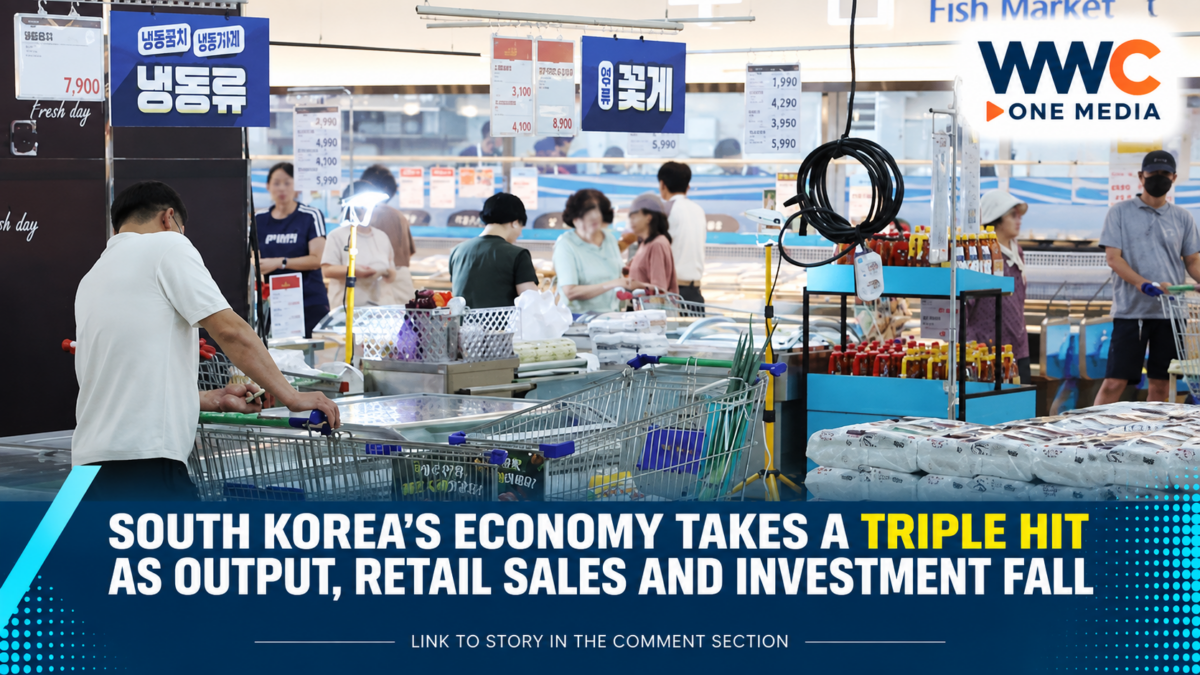
SEOUL — South Korea’s economic activity took a sharp step backward in August, with industrial output, retail sales and facility investment all declining from the previous month in a simultaneous drop that had not occurred since May.
Industrial production fell 1.3% month-on-month, according to data released September 30 by the Ministry of Data and Statistics. Manufacturing and mining output suffered an even steeper 4.8% decline, largely because of a sharp drop in automobile production.
The August figures present a contrasting picture for an economy that has also been benefiting from strong semiconductor exports and other areas of external demand.
Auto Production Takes the Biggest Hit
The automobile sector emerged as the biggest drag on August industrial production.
Vehicle production plunged 24.8% from July, the sharpest decline since May 2020, according to the latest data.
Officials attributed much of the weakness to automakers concentrating their summer vacation periods in August, reducing the number of production days. A strike also contributed to the decline.
The slowdown in automobile manufacturing also affected related industries. Production in the rubber and plastics sector fell 11%, reflecting weaker tire production.
By contrast, machinery production increased 3.1%, while the service sector expanded 0.5%.
The information and communications sector was particularly strong, rising 4.7% during the month.
Consumer Spending Also Loses Momentum
Retail sales, an important measure of private consumption, dropped 1.8% month-on-month in August.
Durable-goods sales fell 4.5%, with automobile sales among the major contributors to the decline. Nondurable-goods sales also slipped 1.6%, while sales of semidurable products such as clothing edged up 0.4%.
The decline followed an even larger 2.4% drop in retail sales in July, according to government economic data.
Facility Investment Plunges Nearly 10%
Investment activity delivered another major warning sign.
Facility investment plunged 9.5% from the previous month, with transportation-equipment investment collapsing 32.8%.
Machinery investment, which includes spending on semiconductor production equipment, moved in the opposite direction, rising 1.6%.
Construction activity provided another positive element, with completed construction increasing 1.9% during August, according to separate reporting on the latest data.
Triple Decline Raises Fresh Questions
The simultaneous decline in production, consumption and investment marks the first such “triple decline” since May.
However, the latest figures do not necessarily point to a broad-based collapse across every part of the economy.
The automobile industry’s concentrated summer shutdowns played a significant role in August’s manufacturing decline, making upcoming monthly data particularly important for determining whether the weakness persists.
At the same time, South Korea’s external sector has remained strong. Government data showed August exports rose 68.7% year-on-year, supported by semiconductors, computers and cosmetics.
That creates a striking split in the latest economic picture: export-heavy industries are benefiting from strong global demand, while several domestic indicators weakened in August.
What Comes Next for South Korea?
The August numbers put renewed attention on whether the declines in production, consumer spending and investment are temporary effects or signs of a broader slowdown.
The next round of industrial and consumption data will be closely watched for evidence of a rebound after the automobile industry’s summer shutdowns.
For now, South Korea’s economy is sending mixed signals — with a sharp August setback in key domestic indicators occurring alongside exceptionally strong exports.
And that leaves the next set of economic data with a much bigger question to answer: Was August simply a temporary interruption, or the beginning of a more persistent shift in Korea’s economic momentum?
WWC ONE MEDIA G,A