
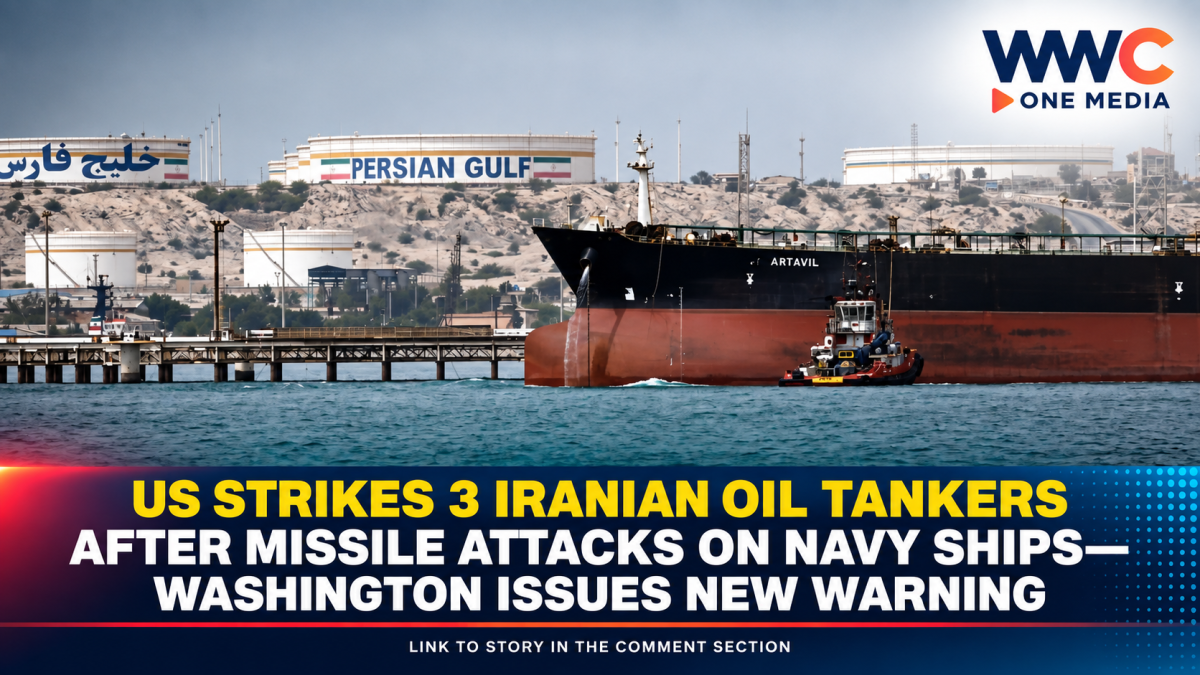
WASHINGTON — The conflict between the United States and Iran escalated sharply Saturday after the U.S. military said its forces struck three Iranian crude oil tankers following missile attacks directed at American Navy warships in the region.
U.S. Central Command (CENTCOM) said an American aircraft carrier and a guided-missile destroyer successfully evaded multiple Iranian attacks and that no U.S. personnel were injured.
According to CENTCOM, the three Iranian tankers were connected to a network that allegedly helps finance Iran’s powerful Islamic Revolutionary Guard Corps (IRGC) and affiliated armed groups.
But the U.S. military’s description of the damage provides an important distinction: two tankers were permanently disabled, while a third vessel, which was unladen, was destroyed.
The strikes occurred at several locations. The U.S. said one tanker was hit near Kharg Island, a strategically important Iranian oil-export hub, another was targeted near Jask, and the third was struck in the Gulf of Oman. CENTCOM also released video footage that it said showed the attacks.
US warns Iran over its oil fleet
The latest strikes represent another major escalation in Washington’s campaign against Iranian maritime and oil-related assets.
CENTCOM commander Adm. Brad Cooper warned that the United States would continue defending American forces and, if necessary, target Iran’s limited and exposed oil fleet.
The development follows a series of increasingly direct confrontations around the Strait of Hormuz, one of the world’s most important energy corridors.
Reuters reported that the latest strikes came after Iran launched ballistic missiles toward two U.S. Navy ships. No American personnel were reported injured.
Why the tanker strikes matter
The attacks are significant because Washington has increasingly expanded its targets beyond conventional Iranian military infrastructure.
Earlier this week, U.S. forces also targeted Iranian government-affiliated tankers. Axios, cited by other outlets, reported that the tanker attacks represented a shift toward a new U.S. “tanker for tanker” approach, in which Iranian shipping assets could be targeted in retaliation for attacks on commercial vessels and American forces.
Al-Monitor likewise reported that U.S. aircraft had targeted two Iranian government-affiliated tankers and described the move as a tactical shift from Washington’s earlier focus on military infrastructure.
Iran has accused the US of attacking its tanker
Iranian authorities have also reported an attack on an Iranian oil tanker near Kharg Island.
Reuters reported that Iran’s semi-official Tasnim news agency said four U.S. missiles struck a tanker approximately 10 kilometers from Kharg Island. The report said there were no casualties and that the crew was being evacuated, although the incident had not immediately been independently confirmed by U.S. Central Command.
The competing accounts underscore how rapidly the confrontation is developing and how difficult it remains to independently verify some battlefield claims in real time.
Strait of Hormuz remains a major flashpoint
The latest escalation comes amid continuing disruption to shipping through the Strait of Hormuz.
USNI News reported that shipping activity through the waterway has remained significantly below prewar levels, while commercial operators have faced growing risks from attacks, mines and other threats. Some vessels have continued using the route, while others have relied on alternative arrangements to move oil around the region.
The waterway is critical to global energy markets, making any prolonged disruption a potential threat to oil supplies and prices.
Reuters previously reported that the renewed U.S.-Iran fighting had already raised concerns about global energy markets as Washington and Tehran traded attacks around the strategic waterway.
A conflict that is rapidly widening
The latest tanker strikes follow a broader resumption of hostilities after a period of relative calm.
U.S. forces have recently targeted Iranian air-defense systems, radar installations, maritime assets, mine-laying capabilities and communications facilities, according to CENTCOM statements reported by Reuters.
Iran, meanwhile, has continued retaliatory missile and drone attacks against U.S. positions and other targets in the region.
With American forces now directly targeting Iranian oil assets and Tehran continuing to challenge U.S. military and maritime operations, the latest strikes raise a critical question: will the attacks remain limited to individual vessels, or will the confrontation move into a much wider battle over Iran’s ability to export oil and control the Strait of Hormuz?
For now, Washington is signaling that further strikes remain possible—putting the region on a potentially more dangerous path.
WWC ONE MEDIA J.M.D




Leave a Reply