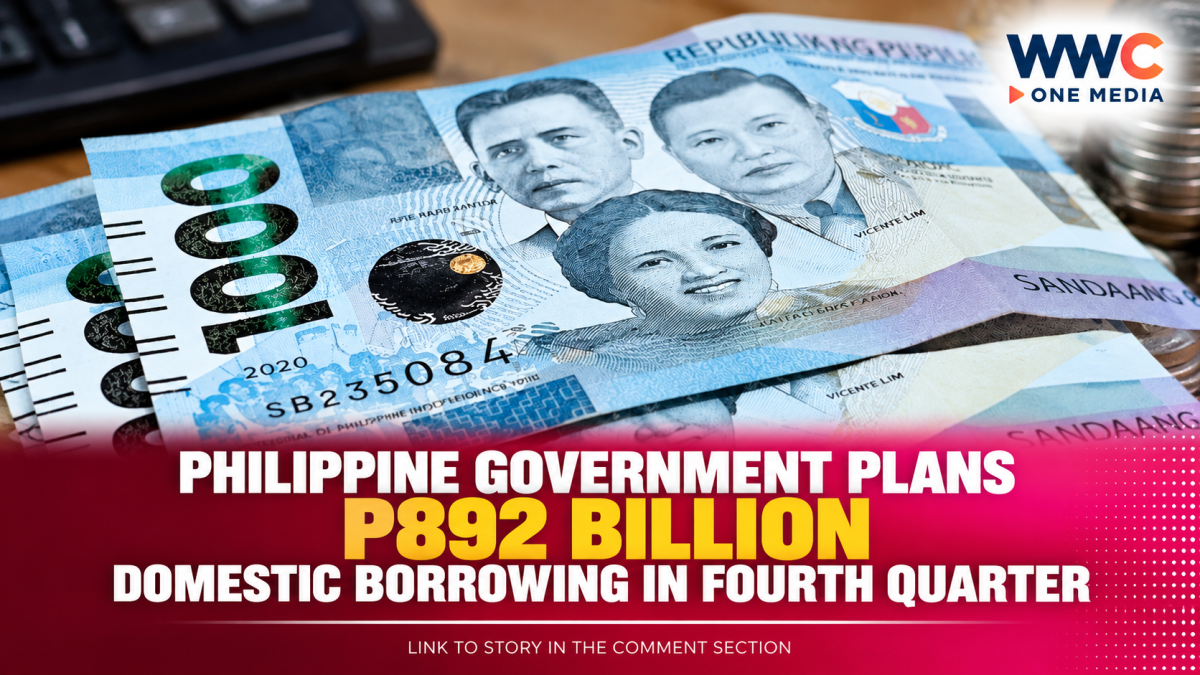
The Philippine government plans to raise P892 billion from the domestic debt market in the fourth quarter as it spreads out its borrowing schedule amid geopolitical tensions and uncertain interest-rate conditions.
The Bureau of the Treasury said the October-to-December program will consist of up to P462 billion in Treasury bills and P430 billion in Treasury bonds. The fourth-quarter target is more than twice the P437 billion programmed for the same period last year, but 20.4% lower than the P1.12 trillion borrowing plan for the third quarter.
Borrowing Schedule
For October, the Treasury plans to raise P418 billion, comprising P168 billion in Treasury bills and P250 billion in Treasury bonds. The November target is P283 billion, while December borrowing is set at P191 billion.
The October program also includes the latest retail Treasury bond offering. The government initially awarded P84.89 billion in 2.5-year retail Treasury bonds at a 6.875% coupon rate after receiving P188.64 billion in tenders, more than six times the original P30-billion offer.
National Treasurer Sharon Almanza said the government is spreading out its issuances because of the uncertain market environment, including the effects of the war involving Iran. The approach could also allow the Treasury to take advantage of lower interest rates if market conditions improve later in the year.
Why Borrowing Is Higher
The sharp year-on-year increase does not necessarily mean the government suddenly needs twice as much funding in the final quarter. Almanza said last year’s borrowing was more heavily front-loaded, leaving fewer bond auctions for the fourth quarter.
Economists have also pointed to wider budget deficits and delayed fundraising earlier in the year as factors behind the larger borrowing requirement. Higher government bond yields and elevated US Treasury yields have added to financing costs.
The government continues to rely heavily on domestic borrowing to finance its budget deficit. Its 2026 financing program calls for about P2.05 trillion in domestic financing, alongside P627.1 billion in external funding.
Rates Remain a Key Factor
The timing of the borrowing program will depend partly on the direction of interest rates. Almanza said there are projections that rates could moderate later in the year, although the Bangko Sentral ng Pilipinas’ policy decisions will remain an important factor.
For the Treasury, spreading out maturities and auction schedules provides greater flexibility while it manages borrowing costs and the government’s financing requirements through the final quarter.
The P892-billion program therefore gives the government a substantial pipeline of domestic funding for the final three months of 2026, while leaving room to adjust the timing of issuances as market conditions evolve.