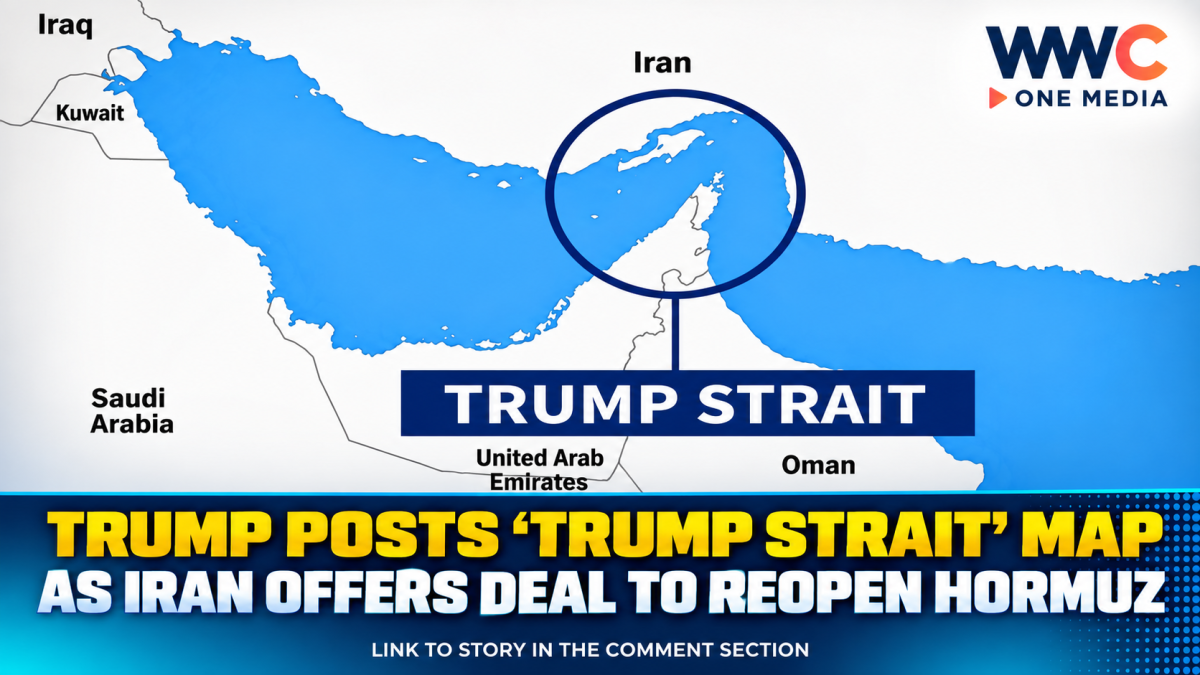
US President Donald Trump has posted an image labelling the Strait of Hormuz as the “Trump Strait,” drawing attention to the strategic waterway just hours after Iran proposed reopening it under a set of conditions.
Trump shared the map on his Truth Social account early Saturday, Sept. 26, in his first public indication of his response to Iran’s latest proposal. The move came as Washington and Tehran continued indirect discussions through mediators over the conflict and the future of the crucial shipping route.
Iranian Foreign Minister Abbas Araghchi said Tehran’s proposal would allow the Strait of Hormuz to reopen within seven days if the United States lifted its naval blockade of Iranian ports, waived sanctions affecting Iranian oil sales and observed a ceasefire that would include Lebanon. Iran also offered to resume negotiations over its nuclear programme.
The proposal came after several hours of indirect talks between Iranian and US representatives during the United Nations General Assembly in New York. The White House said US officials were engaged in positive and constructive conversations with mediators, although Washington had not publicly committed to accepting Tehran’s conditions.
The Strait of Hormuz has become one of the central pressure points in the conflict because it is a major route for global energy shipments. Vessel traffic has fallen sharply since the conflict began, with only a small number of commodity ships passing through the waterway compared with normal levels.
The disruption has already affected regional oil flows and added uncertainty to energy markets. Any sustained reopening of the strait could therefore have consequences well beyond Iran and the Gulf, particularly for countries dependent on Middle Eastern crude and liquefied natural gas.
Iranian President Masoud Pezeshkian has since left New York for Tehran, according to Iranian state-linked media. During his UN appearance, Pezeshkian rejected Trump’s threats against Iran while maintaining that Tehran remained open to diplomacy.
The situation remains volatile elsewhere in the region. Saudi Arabia said its forces intercepted a ballistic missile launched from neighbouring Yemen toward the southwestern city of Khamis Mushait, attributing the attack to Iran-backed Houthi rebels. The claim had not been independently verified at the time of reporting, and there was no immediate claim of responsibility from the Houthis.
The Gulf Cooperation Council condemned the reported missile attack as a serious escalation and called for an international response. The incident underscores how developments around the Strait of Hormuz are occurring alongside continuing military activity across the wider region.
Iraq is also seeking exemptions from US sanctions for Iranian airlines. Baghdad said it was discussing exemptions that would allow certain flights to continue for humanitarian purposes, including medical treatment, education and religious pilgrimages.
The wider conflict has also created pressure on other parts of the Middle East. In the occupied West Bank, Palestinian communities continue to face disputes over access to water sources, while Israeli settlers have expanded efforts to control springs and heritage sites, according to rights groups cited in the latest reporting.
Trump’s “Trump Strait” post therefore comes at a moment when the strategic waterway has become closely linked to diplomacy, sanctions, energy markets and the broader conflict. Iran has put forward specific conditions for reopening the route, while Washington’s position remains uncertain.
The bigger question now is whether the latest diplomatic contacts can produce an agreement that restores shipping through the Strait of Hormuz — or whether continued military and economic pressure will keep the world’s energy markets facing another prolonged period of uncertainty.