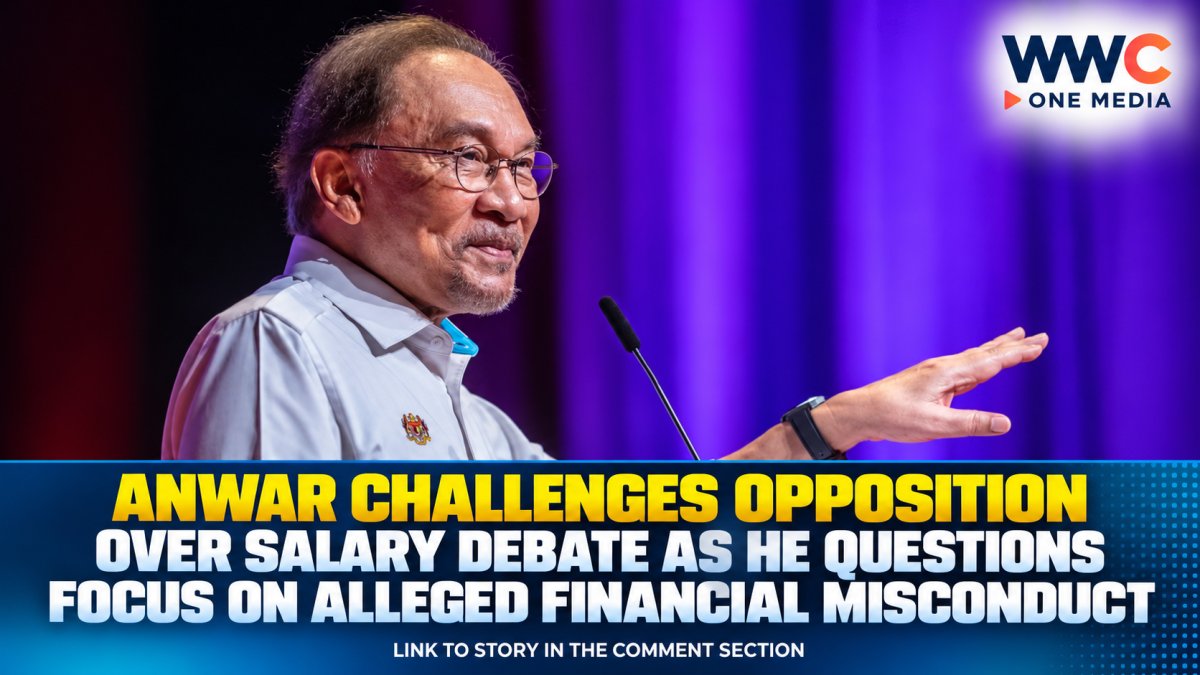
Malaysian Prime Minister Anwar Ibrahim has challenged the federal Opposition over its criticism of his decision not to draw a prime ministerial salary, questioning why the issue has received attention while allegations of financial misconduct have received less focus.
Speaking at a gathering of Universiti Teknologi MARA alumni and students in Shah Alam on Sept. 26, Anwar recalled being questioned in Parliament about how he could support himself without receiving the prime minister’s salary. He said he continues to receive his allowance as the MP for Tambun and receives official support including government-provided transport, accommodation and flights for official duties.
Anwar has declined to draw his salaries as both prime minister and finance minister since taking office in November 2022. He said his financial position was sufficient despite not receiving those salaries.
The prime minister then questioned the Opposition’s focus, saying its members were angry about his decision not to take a salary while, in his words, those who “sakau” — a colloquial Malay term meaning to steal or take money improperly — were not being discussed in the same way. He did not identify specific Opposition MPs or individuals whom he was referring to.
The remarks came against a wider backdrop of investigations and scrutiny involving Malaysian public institutions. Anwar recently referred to alleged past financial mismanagement at Lembaga Tabung Haji following the release of a Royal Commission of Inquiry report covering the institution’s management and operations from 2014 to 2020. The government has said investigations arising from the report would proceed where potential breaches of law are identified.
Anwar also addressed scrutiny involving UiTM Holdings during the same event, cautioning against assuming that financial losses automatically amount to wrongdoing. He said losses should be distinguished from fraud, abuse of power or theft and that investigations should establish the facts before any action is taken.
The discussion reflects a broader debate in Malaysia over government accountability, political scrutiny and the distinction between legitimate financial losses and alleged misconduct. Anwar has said investigations should be handled by the relevant authorities, with prosecutors and courts responsible for subsequent decisions.
His comments also revived an earlier political dispute over his decision to forgo his salary. In 2024, PAS president Abdul Hadi Awang was reported to have criticised the move in Parliament, arguing that Anwar was seeking to portray himself as more pious than the Prophet Muhammad by refusing a salary.
Anwar’s latest remarks therefore place his decision on personal remuneration within a larger argument about how Malaysia’s political leaders and institutions should be scrutinised — particularly when questions arise over public funds, governance and financial management.
The bigger issue now is whether the debate over Anwar’s decision to forgo his salary will continue to dominate political discussion, or whether greater attention will shift toward the investigations and institutional reviews he highlighted in his remarks.