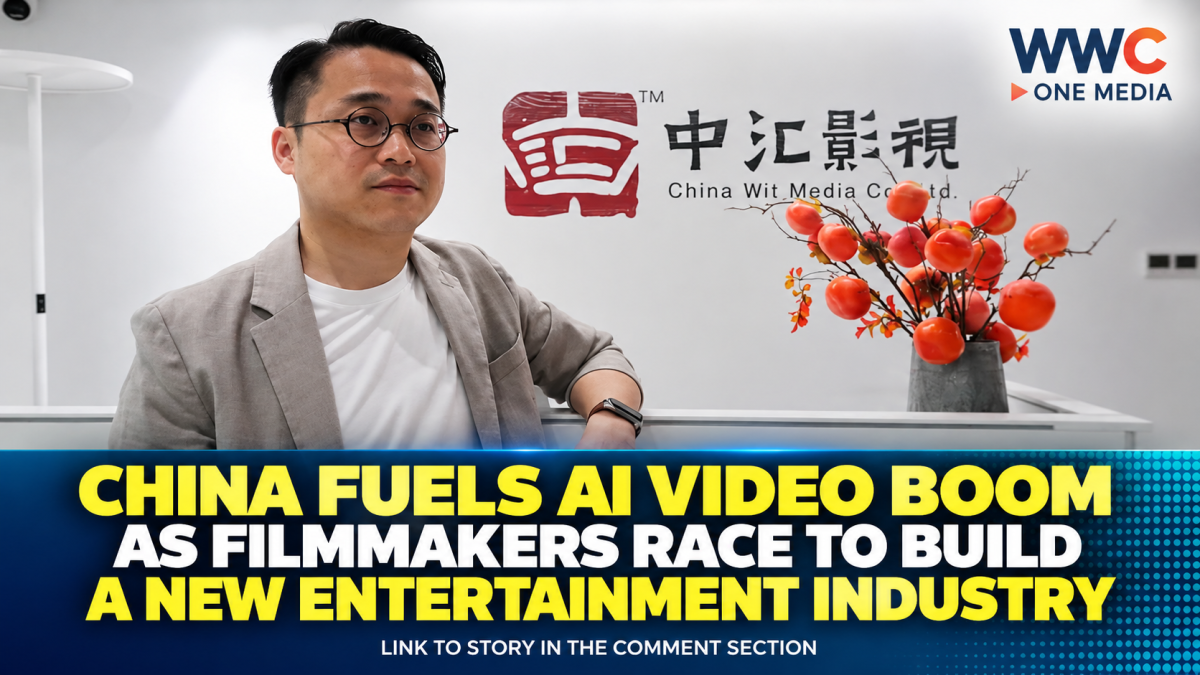
China is rapidly turning artificial intelligence-generated video from an experimental technology into a growing entertainment industry, with filmmakers, technology companies and local governments racing to capture a share of the emerging market.
AI filmmaker Zhu Zhili said he has recently received approaches from cities and industrial parks across China offering incentives to attract AI film businesses. The push reflects a broader effort to make AI-generated content part of the country’s expanding technology and creative industries.
The economics are helping drive the rush. In the first half of 2026, the cost of producing AI short dramas in China reportedly fell from around 5,000 yuan per minute to only a few hundred yuan, according to figures cited by state broadcaster CCTV. One filmmaker said a wedding scene that could cost about 60,000 yuan to produce conventionally could be recreated with AI for roughly 1,400 yuan.
Local governments are increasingly offering subsidies, computing resources, discounted facilities and other incentives. Shanghai has introduced measures supporting AI-powered micro-drama production, while Beijing and Shenzhen have also developed programs aimed at strengthening audiovisual and AI industries.
The scale of production is already becoming difficult to ignore. In the first half of 2026, about 221,900 new AI shows were launched on Douyin, China’s version of TikTok. However, only 1,055 attracted more than 100 million views, highlighting the enormous gap between producing AI content cheaply and producing something audiences actually want to watch.
AI is also transforming China’s short-drama market. Earlier reporting found that 128,000 micro dramas were produced in China during the first three months of 2026, with more than 95% reportedly using AI in their production. These short-form programs are particularly suited to AI because they can be produced quickly and consumed on smartphones.
Major technology companies are also pushing the development of increasingly sophisticated video-generation systems. Chinese platforms and developers have produced models capable of generating increasingly realistic scenes, characters and movement, creating new possibilities for filmmakers while lowering some of the traditional costs of production.
The technology, however, is far from replacing conventional filmmaking entirely.
Creators still face problems with inconsistent faces, backgrounds, lighting, movement and visual continuity. Producing a satisfactory short sequence can require multiple attempts, while directors continue to question whether AI-generated footage can consistently meet the standards expected of major film and television productions.
There are also growing concerns about copyright, performers’ likenesses and employment. Chinese actors have raised concerns about their faces being reproduced digitally, while audiences have criticized some AI productions for plagiarism and a lack of originality. China requires AI-generated content to be clearly labelled, but questions surrounding copyright ownership remain unresolved.
The industry is already moving beyond online experiments. A 90-minute science-fiction film, “Sanxingdui: Future Memories,” has received a public-screening licence and is expected to become the first AI film produced by a major Chinese studio to receive regulatory approval for theatrical release in China.
For China, the AI-video push is about more than cheaper filmmaking. Local authorities and technology companies are attempting to build an entire ecosystem around AI-generated entertainment, from computing infrastructure and production studios to distribution and overseas markets.
The bigger development may be what happens when dramatically lower production costs collide with an enormous supply of AI-generated content. China is already producing AI video at industrial scale, but the next challenge will be turning that flood of content into sustainable businesses, recognizable creative brands and productions audiences are willing to keep watching.