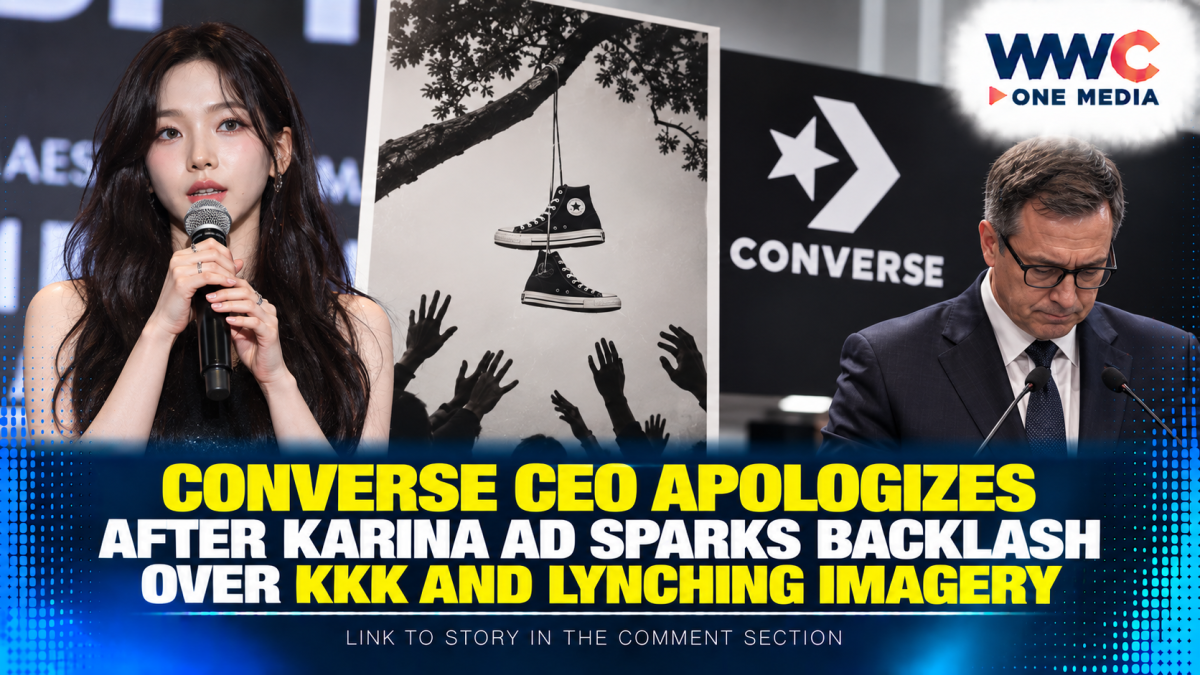
BOSTON — Converse CEO Aaron Cain has apologized to employees after a controversial advertising image featuring K-pop star Karina of aespa triggered widespread criticism over imagery that some viewers said evoked the Ku Klux Klan and lynching.
The Nike-owned sneaker company had already removed the advertisement and publicly apologized. Cain has now told employees that Converse will bring in an independent third party to examine its internal advertising processes, marking the company’s latest response to the backlash.
How the Converse Advertisement Sparked Backlash
The campaign promoted Converse’s Chuck 70 X sneakers and featured Karina in a white skirt while holding a pair of black high-top shoes.
Critics on social media focused on the photograph’s lighting and composition. They said a triangular white shape created by the lighting resembled the pointed hood historically associated with the Ku Klux Klan, while the positioning of the sneakers was interpreted by some viewers as resembling imagery associated with lynching.
Those interpretations rapidly spread online, prompting questions about how the image passed through Converse’s advertising review process.
Importantly, the criticism concerns how viewers interpreted the imagery. There has been no public evidence establishing that Converse deliberately intended the advertisement to reference the KKK or lynching.
Converse Pulled the Advertisement
Converse responded by removing the image from its social-media channels and saying it was working to eliminate it from other places where it appeared.
In its public apology, the company acknowledged that the image was deeply upsetting and said it recognized that it had made a mistake.
Karina and her management company, SM Entertainment, did not immediately respond to requests for comment in earlier reporting.
CEO Aaron Cain Promises a Review
The controversy has now moved beyond the advertisement itself and toward Converse’s internal approval system.
Cain told employees in a memo that the company’s leadership was examining the process used to review its creative work. In his latest meeting with employees in Boston, he apologized and said Converse would hire an outside party to evaluate those processes.
The Sept. 24 meeting was Cain’s first in-person address to the full Converse team since the advertisement was withdrawn, according to people familiar with the meeting cited by Bloomberg.
Cain has not publicly detailed every change that will result from the review.
Congressional Black Caucus Also Raised Concerns
The controversy attracted attention beyond social media.
Members of the Congressional Black Caucus issued a statement expressing concern about the advertisement and said they planned to contact Nike executives about the matter.
The episode has consequently become a broader discussion about how major brands review visual campaigns before they reach the public — particularly when advertising uses symbolism, cultural references or imagery that can carry different meanings for different audiences.
A Second Image Also Faced Criticism
The Karina advertisement was not the only image associated with the campaign to draw scrutiny.
Another Converse-related image featuring a person on a ladder near a tree while holding sneakers overhead was also circulated online alongside the Karina campaign, with some users drawing comparisons to historical lynching imagery.
Converse’s principal response, however, centered on the Karina advertisement that it removed and apologized for.
The Bigger Advertising Lesson
The controversy illustrates how quickly an advertising campaign can move from a controlled creative environment to a global public conversation.
For Converse, the immediate response has involved three steps: remove the disputed image, apologize for the impact, and examine how it passed through the company’s review system.
The outside review could now determine whether Converse changes the way it evaluates future campaigns.
The company is also dealing with a broader business challenge. Bloomberg reported that Converse has experienced 13 consecutive quarters of revenue contraction, making the latest controversy another significant moment for the Nike-owned brand.
For consumers, marketers and brands watching the episode unfold, the unanswered question is no longer simply why the advertisement caused backlash.
It is what Converse’s internal review will uncover — and what changes the company makes before its next campaign reaches the public.
WWC ONE MEDIA G,A