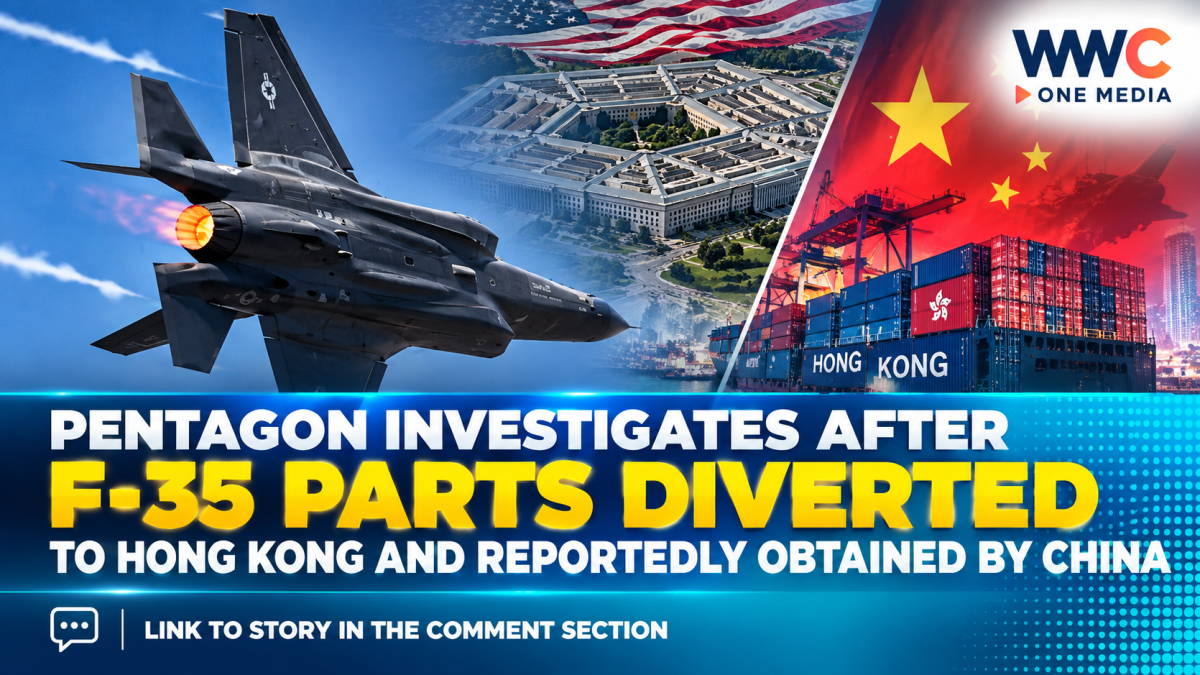
The Pentagon is investigating how components from an Australian F-35 stealth fighter ended up in Hong Kong after a shipment bound for the United States was unexpectedly diverted, with reports saying Chinese authorities later obtained the parts.
The F-35 Joint Program Office confirmed that the US Defense Department is aware of what it described as a “shipment issue” involving unserviceable F-35 components. US authorities and industry partners are working to recover the parts, determine what happened and introduce safeguards to prevent a similar incident.
The shipment reportedly left Australia in late May and was being sent to the United States for inspection, possible repair or disposal. According to Bloomberg reporting cited by multiple outlets, the consignment included an F-35 cockpit canopy and a weapons-bay door. The shipment travelled through South Korea before being diverted to Hong Kong, although it remains unclear why the route changed or whether the diversion was accidental or deliberate.
Reports say the Chinese government subsequently took possession of the components and has not returned them. However, US and Australian authorities have not publicly established that China deliberately caused the shipment to be diverted.
That distinction is important because the circumstances surrounding the incident remain under investigation. China’s Foreign Ministry has said it was not aware of the situation, while Hong Kong authorities have declined to comment on specific cases.
Australian Defence Minister Richard Marles confirmed that the F-35 components had ended up in Hong Kong but played down their sensitivity. He said Australia was working with the United States and Lockheed Martin, the aircraft’s prime contractor, to examine what happened.
Marles said his understanding was that the shipment did not contain “sensitive equipment” or “sensitive parts.” That assessment differs from reports describing the canopy as containing radar-absorbing material associated with the aircraft’s stealth characteristics.
The distinction between the components and the aircraft’s most sensitive systems is significant.
The F-35 is a fifth-generation fighter built around low-observable technology, advanced sensors, communications and data-sharing capabilities. The Congressional Research Service says more than 1,200 F-35s have been produced and that 19 countries have placed orders for the aircraft.
The canopy and weapons-bay door are not the aircraft’s flight computers or advanced radar systems. CBS News reported that the components would not contain the type of advanced avionics that could provide an adversary with direct access to the aircraft’s core electronic systems. Nevertheless, the canopy is coated with radar-absorbing material, meaning physical examination could potentially provide information about aspects of the aircraft’s stealth design.
At least two US congressional committees are also examining the incident. The questions extend beyond the missing components themselves to how an F-35 shipment moving through an international supply chain could have been redirected to Hong Kong in the first place.
The episode is particularly sensitive because Australia is a major F-35 operator and participant in the multinational program. Australia operates 72 F-35 aircraft and is part of the global support network for the fighter, with a regional spare-parts hub in New South Wales.
The F-35 program also depends on an unusually broad international supply chain. Components are produced and supported across multiple countries, while allied air forces rely on interconnected logistics and maintenance arrangements. That complexity creates additional challenges for tracking equipment and maintaining security across borders.
Security experts have warned that adversaries could potentially study recovered aircraft components to understand how they are constructed or identify possible vulnerabilities. But analysts have also cautioned against assuming that possession of individual parts would provide China with a complete blueprint of the F-35’s technology.
China already operates its own advanced stealth fighters and continues to develop next-generation military aircraft, meaning the precise intelligence value of the missing components remains uncertain.
For now, the central issue is not whether China has obtained the entire F-35 technology package — it has not — but what information, if any, could potentially be learned from the specific components and how the shipment was allowed to reach Hong Kong.
The Pentagon’s investigation will therefore have to address two separate questions: what was exposed, and how a tightly controlled military supply chain allowed the parts to leave their intended route in the first place.
The bigger question now is whether the investigation will uncover a simple logistics failure or reveal security weaknesses that could affect the wider F-35 supply network used by the United States and its allies.