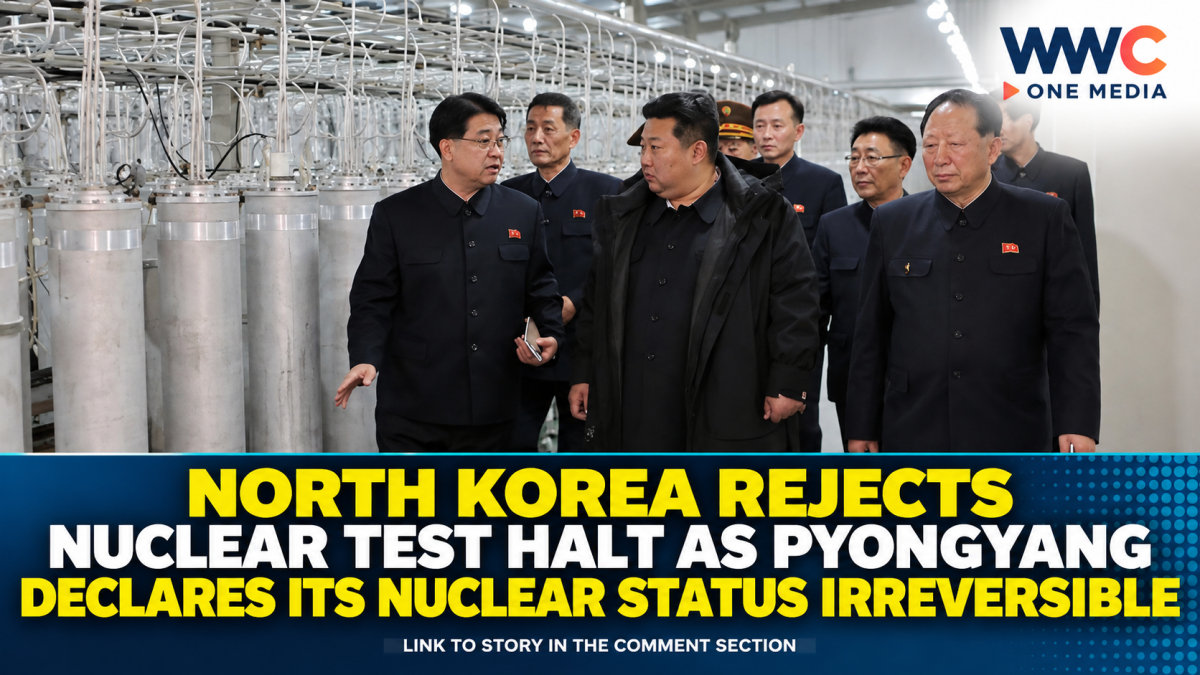
North Korea has rejected an international call to halt nuclear tests, dismissing the appeal as a political provocation and again declaring that its status as a nuclear-armed state cannot be reversed.
The rejection came after ministers from the Friends of the Comprehensive Nuclear-Test-Ban Treaty met in New York and warned that any new nuclear test by North Korea would be irresponsible and unacceptable. The group includes Australia, Canada, Finland, Germany, Japan and the Netherlands.
The ministers also urged Pyongyang to comply fully with relevant United Nations Security Council resolutions, which prohibit North Korea from conducting nuclear tests and require measures aimed at ending its nuclear weapons program.
North Korea’s Foreign Ministry rejected the statement on Sept. 24, describing it as a “grave political provocation” by what it called hostile forces.
The response came alongside even stronger language from Foreign Minister Choe Son Hui. In a separate statement carried by state media, Choe said North Korea’s nuclear weapons status was irreversible and reaffirmed Pyongyang’s intention to retain its nuclear arsenal.
The latest confrontation follows a separate meeting involving the United States, South Korea and Japan on the sidelines of the UN General Assembly. The three countries reaffirmed their commitment to the complete denuclearization of North Korea.
South Korean President Lee Jae Myung has meanwhile been advocating a phased approach that would first seek to stop the expansion of North Korea’s nuclear and missile capabilities before pursuing reductions and eventual dismantlement. His proposal reflects growing discussion over whether a step-by-step agreement could be more achievable than demanding immediate denuclearization.
North Korea’s position leaves a major gap between the two sides. Pyongyang continues to portray its nuclear arsenal as essential to national security, while Washington, Seoul and Tokyo continue to publicly support denuclearization.
The Comprehensive Nuclear-Test-Ban Treaty, adopted in 1996, prohibits nuclear weapon test explosions and other nuclear explosions. However, the treaty has not entered into force because several required states have yet to ratify it.
The dispute comes as North Korea continues to develop and test military capabilities. Recent missile launches have added to concerns about the country’s weapons programs and further complicated diplomatic efforts to bring Pyongyang back into negotiations.
With North Korea now openly describing its nuclear status as irreversible, efforts to revive negotiations face a fundamental disagreement over whether the country’s existing arsenal can even be placed on the negotiating table.
The latest rejection therefore leaves diplomacy facing a difficult new phase — with the bigger issue being whether international pressure can produce limits on North Korea’s expanding weapons capabilities when Pyongyang says its nuclear status is no longer negotiable.