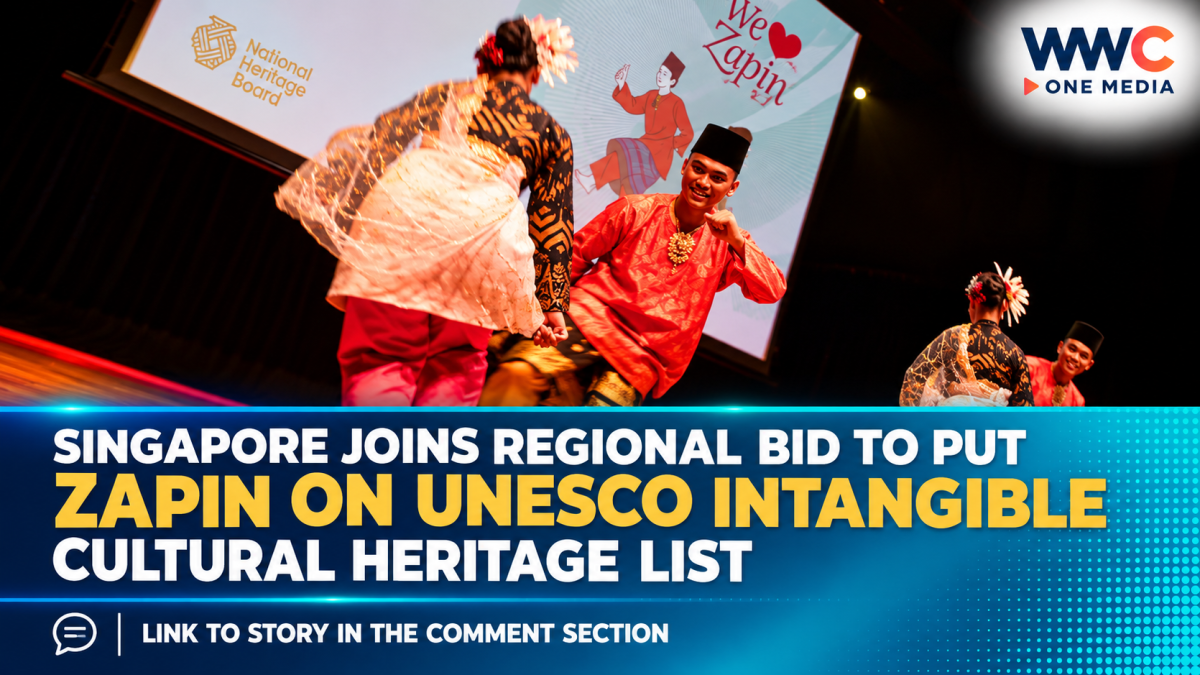
Singapore is joining Malaysia, Indonesia and Brunei in a multinational bid to have zapin, a traditional Malay performing art, inscribed on UNESCO’s Representative List of the Intangible Cultural Heritage of Humanity.
The four countries plan to submit their joint nomination file to UNESCO in March 2027, the National Heritage Board said on Sept. 24. The nomination would mark Singapore’s fourth submission to the UNESCO list and its first joint nomination involving a performing art form.
Zapin is a lively dance form characterised by rhythmic footwork and expressive movements performed alongside traditional music. Its roots are linked to Arab Muslim communities and the dance was introduced to the Malay Archipelago centuries ago. Different forms have since developed across Singapore, Malaysia, Indonesia and Brunei.
In Singapore, zapin is one of five dance forms commonly practised within the Malay dance community. Performances can feature instruments including the gambus, accordion and rebana, while some choreography incorporates movements inspired by animals and nature, including the fruit bat and swirling water.
The dance was once primarily associated with important or ceremonial occasions such as weddings. Today, it has expanded into festivals, performances and educational programmes, with traditional Malay dance groups and schools helping introduce younger generations to the art form.
Singapore has also developed its own local variations. Zapin Telok Blangah was choreographed to reflect the area’s port history, while Zapin Sungei Kallang commemorates the community that lived around the Kallang River in the 1970s.
Another important Singapore form is Zapin Asyik, which was brought to Singapore by Indonesian-born choreographer Liau Ah Choon and adapted locally after she encountered the dance at a wedding in Terengganu.
The proposed UNESCO nomination reflects the fact that zapin is shared across national borders rather than belonging exclusively to one country. Singapore’s heritage authorities said the multinational effort could strengthen cultural ties and cooperation among the four countries while supporting the practitioners who keep the tradition alive.
The nomination also has strong community involvement. Singaporean practitioners have continued teaching zapin through dance companies, community groups and school activities. Regional festivals, including the Muara Festival in Singapore, have also brought dancers and musicians from different parts of Southeast Asia together.
Veteran practitioners have welcomed the move. Cultural Medallion recipient Som Said, who has spent decades promoting Malay dance, said UNESCO recognition could help introduce zapin to more people. Era Dance Theatre founder Osman Abdul Hamid has also emphasised that different countries have developed their own versions of the dance, demonstrating how the tradition has evolved rather than remained fixed.
The nomination process itself will involve further documentation and consultation. Singapore’s National Heritage Board said it will conduct focus-group discussions to gather views on zapin’s social and cultural significance and safeguarding measures, while working with practitioners to document how the art form is taught and transmitted.
Singapore’s previous UNESCO intangible heritage successes include hawker culture, which was inscribed in 2020, and the kebaya, which was jointly nominated with Brunei, Malaysia, Indonesia and Thailand and inscribed in 2024. A separate joint nomination involving Singapore and Malaysia for Chingay is currently awaiting evaluation.
UNESCO’s decision on the zapin nomination will come later in the process. According to Singapore’s heritage authorities, results could potentially be announced two to three years after the March 2027 submission, depending on the evaluation process.
For the communities that practise zapin, the nomination is therefore about more than an international title. It is also an opportunity to document regional variations, encourage younger practitioners and ensure that a centuries-old performing tradition continues to evolve while remaining connected to its cultural roots.
The bigger question now is whether the joint UNESCO bid can give zapin a wider international audience while keeping the living traditions and community practices that have allowed the dance to survive across generations.