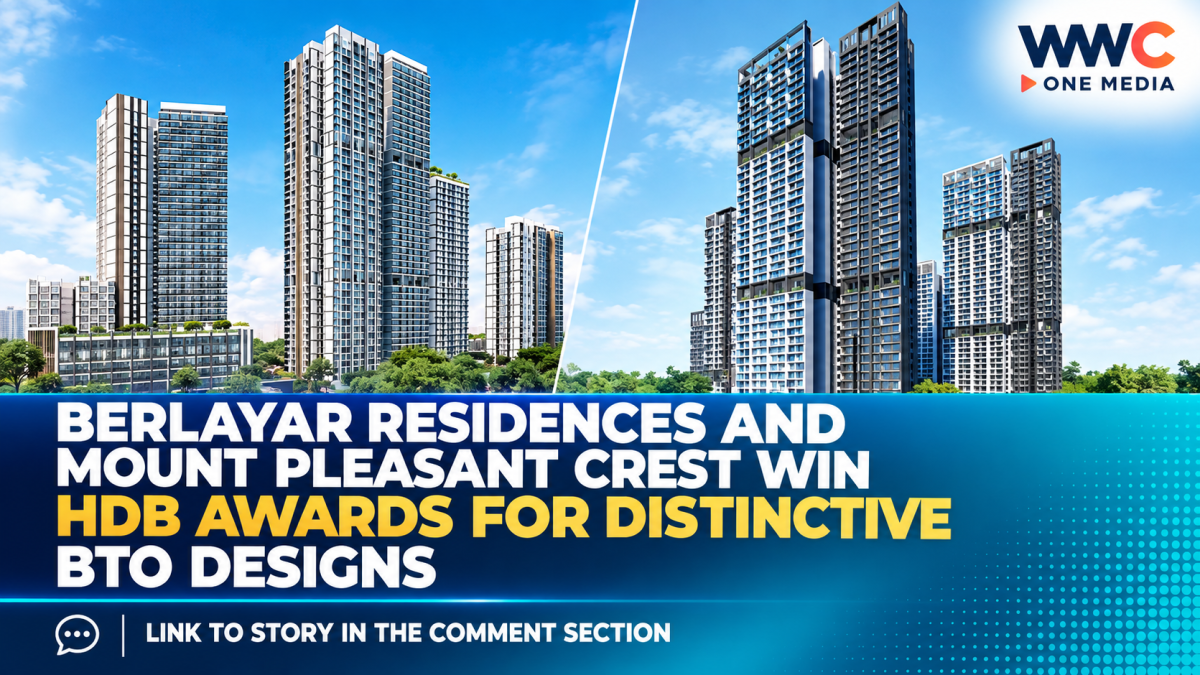
Singapore’s newest housing estates are gaining recognition for designs that combine public housing with nature, heritage and distinctive community spaces, with Berlayar Residences and Mount Pleasant Crest among 30 projects recognised at the HDB Awards 2026.
The two developments are the first Build-To-Order projects in their respective new estates and will receive HDB’s Innovative Design Awards. Their design consultants, LOOK Architects and 3PA, were recognised for creating projects that respond to the character and history of their locations.
Berlayar Residences, located on the former Keppel Club site, takes inspiration from the Southern Ridges and the Singapore Strait. Its colour palette of white, blue and brown reflects the surrounding greenery and waterfront, while blocks of varying heights are arranged in a stepped formation toward the coast.
The design is intended to open up views of the Southern Ridges and the sea while creating a distinctive skyline for the new Berlayar estate. Nature-inspired elements are also incorporated into communal spaces, including playgrounds based on smooth-coated otters and their habitats.
The Berlayar development forms part of a much larger transformation of the Greater Southern Waterfront. The 48-hectare estate is planned to eventually provide about 7,000 public housing units and around 3,000 private homes.
Berlayar Residences was launched in October 2025 with 870 BTO flats comprising two-room Flexi, three-room and four-room units, alongside 200 public rental flats. The project is classified as a Prime housing development, meaning eligible buyers are subject to additional conditions including a 10-year minimum occupation period and subsidy recovery when the flat is sold.
Mount Pleasant Crest, meanwhile, draws heavily from the history of the former Old Police Academy.
Its design incorporates elements of the former academy into the new residential environment. The old drill shed is being repurposed as a precinct pavilion, while remnants of the former swimming pool are being reused as seating around the drop-off area.
Architectural details such as clay-coloured roofs, white columns, louvred ventilation features, latticed panels and archways reference the site’s tropical colonial architecture. A police car-themed playground provides a more playful connection to the area’s former identity.
Mount Pleasant Crest was also launched in the October 2025 BTO exercise, offering 1,348 flats. Like Berlayar Residences, it is classified as a Prime project and comes with a 10-year minimum occupation period and subsidy recovery requirements.
The awards also highlight a broader shift in how HDB approaches public housing design. While HDB has introduced standardised unit plans to make design and construction more efficient, architects still have room to adapt building forms, facades, landscaping and communal spaces to the identity of individual sites.
HDB said standardised plans establish common parameters for recurring elements such as bedrooms, bathrooms, household shelters and service yards, while allowing parts of living, dining and kitchen spaces to be configured according to different project requirements.
Technology is also becoming part of the construction process. HDB launched a Building Information Modelling library in August 2026 containing digital models based on its standardised unit plans. The system allows consultants, engineers and contractors to reuse and adapt established designs, potentially reducing repetitive work and identifying coordination problems before construction begins.
Other HDB Awards 2026 recipients include Garden Vines @ Tengah, Garden Vale @ Tengah and Toa Payoh Ridge, while Costa Grove received a Construction Award for measures aimed at reducing construction impacts on surrounding biodiversity and protecting wildlife.
For Berlayar and Mount Pleasant, the recognition comes before residents fully experience the new neighbourhoods, making their designs an early indication of how Singapore is attempting to combine higher-density public housing with local heritage, nature and community identity.
The bigger question now is whether these design concepts will translate into neighbourhoods that are not only visually distinctive but also practical, comfortable and meaningful for the generations of residents who will eventually call them home.