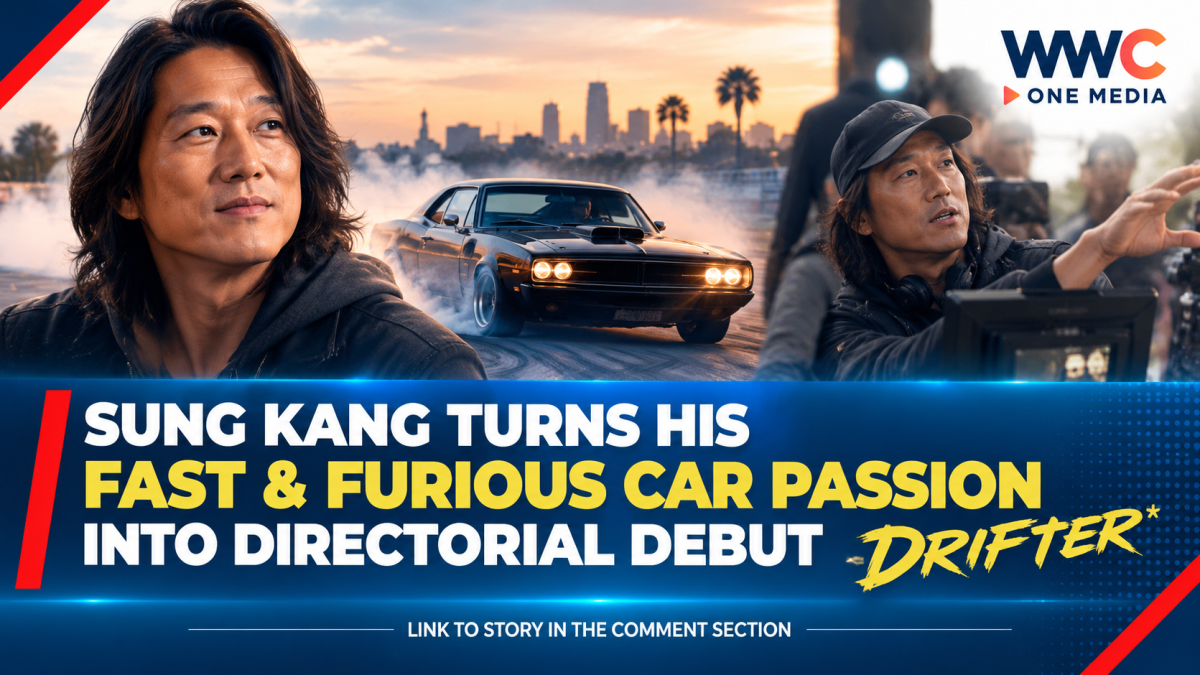
Sung Kang is stepping out from behind the wheel and behind the camera.
Best known worldwide as Han Lue in the Fast & Furious franchise, the Korean American actor has transformed his long-running passion for cars and drifting into Drifter, his feature directorial debut, which premiered at the 2026 Toronto International Film Festival (TIFF).
But Drifter isn’t simply an attempt to recreate the high-speed spectacle associated with Kang’s most famous role.
Instead, the film uses drifting, car culture and one struggling driver to explore belonging, trust, community and the difficulty of facing life alone.
From Han in Fast & Furious to Director’s Chair
Kang first entered the Fast & Furious universe in 2006 with The Fast and the Furious: Tokyo Drift.
At the time, he had little firsthand experience with drifting. His involvement with the franchise, however, introduced him to a car culture that would eventually become a major part of his personal life and creative identity.
Nearly two decades later, that experience has come full circle.
Rather than simply portraying someone immersed in car culture, Kang has created his own story around it.
In Drifter, he serves as director, co-writer, co-producer and lead actor, giving the project an unusually personal connection to his own relationship with the drifting community.
A Different Kind of Racing Story
The film follows Tree, a solitary racetrack custodian living in a forgotten desert town.
Tree possesses a remarkable natural ability behind the wheel, but his talent comes with emotional baggage. When he receives an opportunity to compete professionally, he discovers that technical skill alone cannot carry him to the finish line.
He must learn something much harder: how to trust other people and accept the community around him.
That makes Drifter less about simply winning a race and more about a person learning how to stop navigating life entirely on his own.
Kang has described the film as a love letter to the car community that gave him a sense of belonging, particularly during difficult periods of his life.
Kang Wanted the Drifting to Feel Real
Authenticity was a major priority during production.
Kang brought in figures from the professional automotive and drifting worlds, including Dai Yoshihara, Adam LZ, Rutledge Wood and Brian Scotto, to help ensure that the film’s depiction of the culture felt grounded in the real community.
The filmmakers also sought to capture the driving action without relying primarily on artificial movie magic.
Kang explained that he wanted real drivers and real cars to be central to the filmmaking approach, adopting what he called an “honest angle” as a guiding principle for the project.
That philosophy extends beyond the racing scenes.
For Kang, authenticity also meant allowing the characters and their relationships to feel imperfect and human.
One Massive Drift Event Became Part of the Film
One of the production’s biggest sequences was filmed around a fictional drifting event in New Jersey.
According to Kang, approximately 12,000 car enthusiasts volunteered as background extras to help create the atmosphere of a packed live event.
The production combined a traditional film crew with professional drone operators experienced in motorsport coverage to capture the action.
The result was intended to make the audience feel embedded in the drifting world rather than watching it entirely from a conventional Hollywood perspective.
The Toyota AE86 at the Center of the Story
A particularly important part of Drifter is Tree’s car: a Toyota AE86 named “Lola.”
The classic Japanese sports car isn’t merely transportation for the protagonist. The film’s official material presents Lola as the hero car, reflecting how deeply vehicles are woven into Tree’s emotional journey.
That choice also connects the movie to the Japanese roots of drifting culture.
Drifting originated in Japan in the late 1960s and later became increasingly visible in the United States during the 2000s, with films such as Tokyo Drift helping introduce the culture to a much wider audience.
Why Drifter Is Personal for Sung Kang
Kang’s relationship with car culture has evolved considerably since he first played Han.
The Fast & Furious character became closely associated with stylish cars, drifting and an almost effortless cool.
But Kang has said Drifter deliberately explores something different.
The protagonist isn’t a larger-than-life action hero who has everything under control. Tree is isolated, vulnerable and forced to confront the consequences of living without meaningful connections.
That distinction appears central to Kang’s creative approach.
He has described Drifter as a story for people who have ever felt unseen or as though they did not belong, rather than a movie exclusively designed for car enthusiasts.
TIFF Gives Kang’s Film Its First Major Spotlight
Drifter made its world premiere at TIFF on September 12, 2026, with additional festival screenings later in the event. TIFF included the movie in its 2026 Discovery programming.
The Toronto premiere was particularly fitting for Kang because the city has a large film audience as well as an established automotive community.
Festival coverage has highlighted the film’s combination of racing culture and personal drama, with Kang’s transition from franchise actor to filmmaker becoming one of the project’s central talking points.
More Than Another Car Movie
The easiest way to market Drifter would be as the latest racing movie from the actor who played Han in Fast & Furious.
But that description misses much of what Kang is attempting.
The cars provide the visual language. Drifting provides the adrenaline. But the story ultimately revolves around trust, community and belonging.
That is also why Kang’s move into directing feels significant.
After spending years playing a character associated with one of Hollywood’s most recognizable automotive franchises, he is now using his own experiences to tell a smaller, more personal story about the people behind the machines.
When Will Drifter Be Released?
The film currently has a 2027 release schedule, while its broader release plans continue to develop. South African distributor Avalon Group has announced plans to collaborate on a local release, with the global release date expected to be finalized later.
For now, the TIFF premiere has given audiences their first major look at what Kang has created.
And for an actor whose career became inseparable from one of cinema’s most famous car characters, Drifter represents a striking change of position.
This time, Sung Kang isn’t just playing the driver. He’s directing the entire journey.
WWC ONE MEDIA G,A