
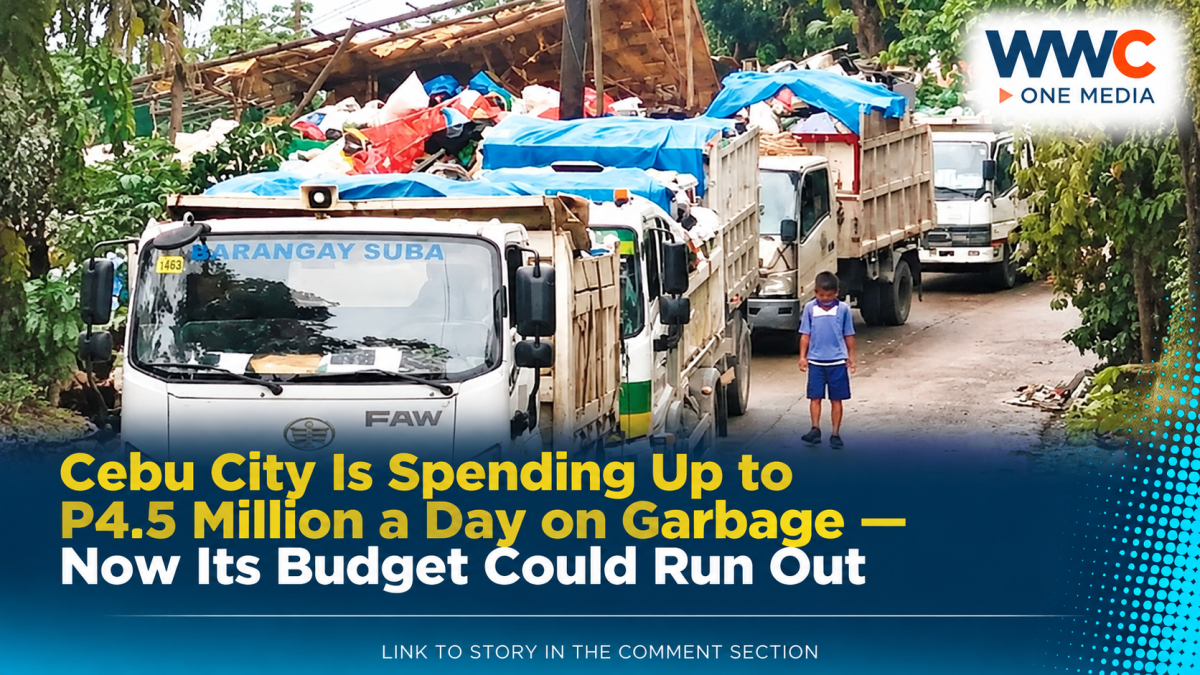
CEBU CITY, Philippines — Cebu City’s garbage crisis is no longer just a waste management problem.
It is now becoming a full-blown budget emergency.
The Cebu City Government is spending between P4.2 million and P4.5 million every day just to haul and dispose of garbage in Aloguinsan, with officials warning that the city’s existing funds could be exhausted within months if the costly arrangement continues.
Councilor Dave Tumulak, chairman of the City Council’s committee on budget and finance, warned that Cebu City could run out of money for garbage hauling and disposal as annual expenses approach levels that were once unthinkable for the city’s waste management program.
The problem is simple.
Cebu City still produces enormous amounts of garbage every day.
But after the deadly Binaliw landfill tragedy, the city lost access to its main disposal site and was forced to send waste much farther away.
Now, every truckload is costing taxpayers more.
And the bill is growing.
From P500 million to nearly P2 billion
Before the Binaliw disaster, Cebu City maintained an annual waste management budget of around P500 million.
But the closure of the landfill dramatically changed the economics of garbage disposal.
Waste now has to be transported to Aloguinsan, significantly increasing both hauling and disposal costs.
SunStar reported that the city’s projected annual garbage expenses could reach nearly P2 billion if the current system continues.
That would represent a massive increase over what Cebu City previously spent.
Earlier reporting also estimated that the city could face roughly P700 million in additional garbage-related expenses this year because of the need to transport waste to more distant disposal facilities.
The numbers reveal the scale of the problem:
Garbage disposal used to be a major city expense.
Now it is threatening to become one of Cebu City’s biggest financial burdens.
P4.5 million every day
The current arrangement comes with a punishing daily price tag.
According to the latest SunStar report, Cebu City is spending roughly:
- P4.2 million to P4.5 million per day
- About P3,900 per ton in combined hauling and tipping fees
- Millions more because waste must travel long distances to Aloguinsan
That daily cost adds up quickly.
A problem that lasts one week becomes tens of millions of pesos.
A problem that lasts several months becomes hundreds of millions.
And a problem that continues for a full year could push the city’s garbage spending close to the P2-billion mark.
The Binaliw tragedy changed everything
Cebu City’s current garbage crisis can be traced directly to the disaster at the Binaliw landfill on Jan. 8, 2026.
A garbage slide at the facility killed 36 workers and a volunteer rescuer, according to recent SunStar reporting.
The tragedy forced the city to stop using Binaliw as its regular disposal site while rehabilitation, safety assessments and inspections continued.
Without its primary landfill, Cebu City had to find alternatives.
Aloguinsan became a key disposal destination.
But the solution came at a steep price.
Instead of disposing of garbage closer to the city, trucks now have to travel much farther, adding fuel, labor, hauling and disposal costs to every load.
The longer the emergency arrangement lasts, the bigger the financial problem becomes.
Why Cebu City cannot simply return to Binaliw
For residents wondering why the city cannot immediately reopen its former landfill and stop paying millions every day, the answer lies in the continuing rehabilitation and safety process.
Cebu City officials have said the Binaliw facility cannot yet resume normal garbage dumping because inspections and rehabilitation activities are still ongoing.
Recent reports indicate that even as efforts continue to reopen or restore the facility, the city may still need months before it can fully return to using Binaliw.
That leaves Cebu City trapped in an expensive situation.
It needs somewhere to dispose of its garbage today.
But its cheapest and most established disposal site is not yet fully available.
So every day that passes brings another multimillion-peso bill.
Mayor says funds could run out by November
Mayor Nestor Archival had previously indicated that Cebu City’s existing garbage funds could be depleted by November.
That has forced officials to consider requesting another supplemental budget of between P100 million and P200 million to keep garbage hauling operations running.
But even a new supplemental budget may only provide temporary relief.
The bigger question is whether Cebu City can continue paying millions every day without creating pressure on other parts of the city’s budget.
Earlier this year, officials warned that escalating garbage costs could eventually place pressure on public services if the city failed to find a sustainable long-term solution.
Cebu’s garbage crisis is now a financial crisis
The numbers show why officials are increasingly alarmed.
Cebu City does not have the luxury of stopping garbage collection.
Waste continues to be generated every day.
Markets produce garbage.
Homes produce garbage.
Businesses produce garbage.
Hospitals and institutions generate waste.
The city therefore needs a disposal system that operates continuously.
That makes the current crisis particularly dangerous from a budget perspective.
Unlike a one-time infrastructure project, garbage hauling is a recurring daily expense.
If the city spends P4 million today, it must spend millions again tomorrow.
And the next day.
And the day after that.
There is no pause button on garbage.
A long-distance solution with a long-term cost
Before the Binaliw disaster, Cebu City spent significantly less because garbage could be disposed of at a nearby facility.
Earlier reporting showed that costs increased sharply after the city was forced to redirect waste to more distant sites.
The city is now dealing not only with disposal fees but also with the cost of transporting roughly large volumes of waste across a much longer distance.
That has transformed what was supposed to be a temporary emergency solution into a growing financial liability.
Officials now face a difficult balancing act:
Keep garbage moving to protect public health.
But find a way to stop the cost from draining the city budget.
Cebu City explores long-term solutions
The city has already explored several ways to reduce the cost of its waste crisis.
Among the options and projects previously reported are:
- Rehabilitating and eventually reopening Binaliw
- Improving waste transfer operations
- Building new waste management infrastructure
- Developing a material recovery facility in Mabolo
- Exploring alternative waste technologies
- Seeking additional funding for emergency hauling
Cebu City has also considered a P360-million Land Bank loan for a Mabolo waste facility as part of efforts to reduce dependence on expensive long-distance hauling.
Separately, the city has pursued improvements to the South Road Properties waste transfer system, including a proposed ramp system intended to speed up the movement of garbage and prevent waste from accumulating at the transfer site.
But infrastructure projects take time.
And Cebu City’s garbage trucks cannot wait for long-term projects to be completed.
The city needs a solution now.
Another supplemental budget may be the immediate answer
For the moment, another supplemental budget appears to be the city’s most immediate financial option.
If existing funds run out before a cheaper disposal system is operational, officials may have little choice but to ask the City Council for additional money.
That could mean another P100 million to P200 million just to continue the current arrangement.
But the repeated need for emergency funding could become a political issue.
Taxpayers may ask why garbage costs have grown so dramatically.
City officials, meanwhile, point to the extraordinary circumstances created by the Binaliw tragedy and the sudden loss of the city’s main disposal site.
The challenge now is preventing an emergency response from becoming a permanent system.
The real question: How long can Cebu City afford this?
Cebu City has managed to keep garbage collection and disposal moving despite one of the most serious waste management disruptions in its history.
But the financial clock is ticking.
At up to P4.5 million a day, every additional month of long-distance hauling costs the city more than P100 million.
If the current setup continues too long, the city could be forced to seek more money again.
And again.
The Binaliw tragedy created an immediate humanitarian and environmental crisis.
Months later, its consequences are still being felt across Cebu City — this time in the city’s finances.
Cebu City has found a way to keep its garbage moving.
The problem is that it may soon struggle to keep paying for it.
And with millions of pesos disappearing from the budget every single day, the question facing city officials is no longer simply where Cebu will put its garbage.
The bigger question is: How much longer can Cebu City afford to haul it away?
WWC ONE MEDIA J.M.D




Leave a Reply