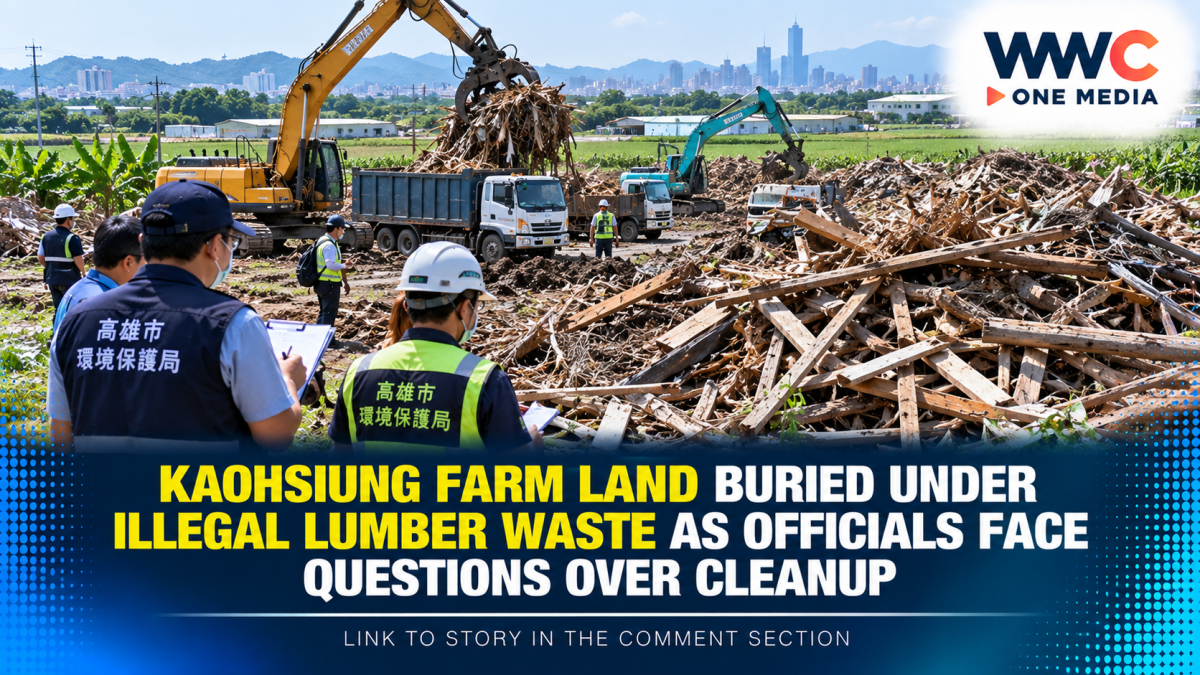
KAOHSIUNG, Taiwan — A large illegal waste site in Kaohsiung’s Yongan District has become a political flashpoint ahead of Taiwan’s 2026 local elections, after opposition politicians questioned why a farm area remained covered with discarded lumber and other materials months after authorities began investigating the case.
For more Taiwan local-government and accountability briefs, see our Taiwan hub and Politics desk.
The site covers roughly 5,900 square meters, or nearly 1,800 ping, according to United Daily News. Images presented during a city council session showed large piles of waste lumber, soil and machinery occupying the agricultural land. The material was reportedly stacked as high as 2.5 to 3 meters in some areas.
KMT Kaohsiung mayoral candidate Ko Chih-en and KMT city councilor Hsu Tsai-chen criticized the city government’s handling of the site and called for faster removal and stronger measures to prevent further illegal dumping. Taiwan News reported that Hsu questioned whether the city’s satellite-monitoring system had been effective enough to detect environmental damage.
Officials Say the Case Was Already Under Investigation
Kaohsiung’s Environmental Protection Bureau disputes the characterization that the site was only recently discovered.
Acting bureau director Chang Jui-hun said authorities inspected the site in October 2025 and transferred the case to prosecutors in February 2026 for investigation.
The bureau said it had imposed a NT$720,000 fine for violations involving waste storage and a separate NT$5 million penalty connected to air-pollution violations.
Authorities said the investigation has identified 44 waste-removal companies allegedly connected to the case. Of those, 24 reportedly held waste-removal permits, while 20 did not.
The city has ordered the relevant operators to submit cleanup plans and complete removal of the waste by the end of 2026. Officials said additional penalties could follow depending on the cleanup progress and conditions at the site.
The Waste Site Is Larger Than It First Appeared
The amount of material at the location has also drawn attention.
UDN reported that officials estimated the waste could amount to approximately 15,000 cubic meters, based on the site’s size and images. That estimate was presented by councilor Hsu and should be treated as an estimate rather than a finalized measurement.
A separate city-government account put the quantity of discarded lumber at about 13,900 metric tons. Authorities said they were tracing where the waste came from and who was responsible for bringing it to the site.
The discrepancy reflects different ways of measuring the material — volume versus weight — rather than necessarily representing two competing official totals.
A Fire Added to the Environmental Concerns
The investigation took another turn in August.
According to the Environmental Protection Bureau, its AI cloud-monitoring system detected a smoldering fire at the site on August 1, accompanied by visible particulate pollution. Authorities said the incident resulted in the maximum NT$5 million air-pollution penalty under the applicable provision cited by the bureau.
The bureau said it has continued using monitoring technology to track conditions while the cleanup process proceeds.
Opposition and City Government Offer Different Accounts
The political dispute centers largely on the timeline and effectiveness of the city’s response.
Hsu argued that historical Google imagery showed the agricultural land had previously been largely green and that waste accumulation became increasingly visible over time. She questioned whether the city’s monitoring systems could detect illegal dumping quickly enough.
Ko likewise called for authorities to explain why additional dumping allegedly occurred in March even after an investigation had begun. Taiwan News reported that he said the focus should be on preventing further environmental damage rather than simply establishing that officials already knew about the site.
The Kaohsiung city government, however, said the case was not ignored and that its environmental authorities had proactively investigated it, referred it to prosecutors and continued monitoring the property.
City spokesperson Sung Hsiang-yueh also said prosecutors indicted those involved in June and that the city expects the lumber to be removed by the end of 2026. He criticized what he described as an incomplete presentation of the case timeline during the election period.
What Happens Next?
The immediate issue is cleanup.
Authorities say the companies connected to the case have been ordered to remove the waste before the end of the year, while prosecutors and environmental officials continue pursuing potential administrative and criminal responsibility.
The case also highlights a broader challenge for local governments: detecting illegal waste disposal early, tracing the companies involved and ensuring contaminated or improperly used land is restored.
With Taiwan’s local elections approaching, the Yongan site has simultaneously become an environmental enforcement issue and a point of political debate. The eventual cleanup and the outcome of the legal proceedings will provide a clearer measure of how the case is ultimately resolved.
WWC ONE MEDIA G,A