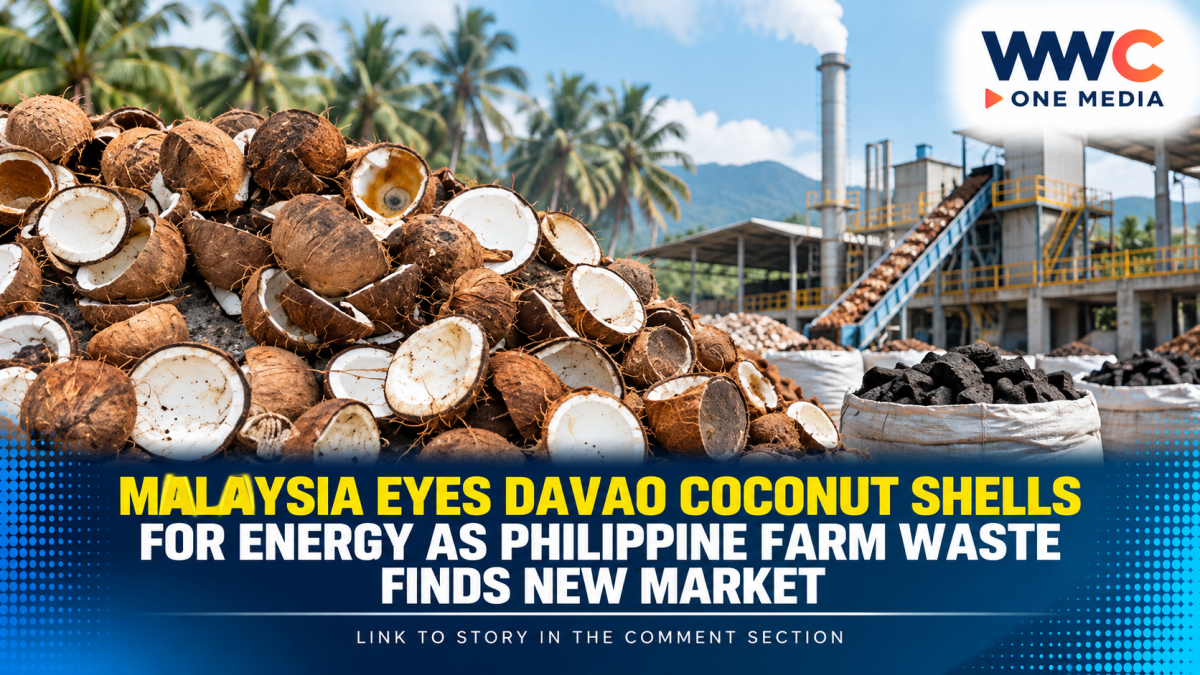
DAVAO CITY — What was once treated largely as a low-value coconut by-product could soon become an energy commodity, as a Malaysian company explores sourcing coconut shells from Davao Region for potential use in energy production.
The Department of Agriculture–Davao Region said Thursday that officials recently held discussions with Borneo New Energy, a Malaysian company interested in purchasing coconut shells for energy production.
The initial proposal involves approximately 100 metric tons, although the potential transaction remains subject to further assessment of the region’s available supply capacity.
From Coconut Waste to Potential Export Commodity
The talks are focused on finding additional markets for coconut by-products that can otherwise be treated as waste or sold at relatively low value.
The DA-Davao Region’s Agribusiness and Marketing Assistance Division met with representatives of Borneo New Energy to assess the availability and volume of coconut shells and other coconut-processing by-products in the region.
The agency said the potential partnership could create an additional market for coconut farmers while encouraging the more productive use of agricultural resources.
The development comes after the Sabah International Expo 2026, where Philippine agricultural commodities had opportunities to connect with potential international buyers.
A Davao Cooperative Could Help Supply the Market
One potential source is the Katipunan Small Coconut Farmers Multipurpose Cooperative in Panabo City, Davao del Norte.
According to the DA, the cooperative manages approximately 2,350 hectares of coconut farms and has about 800 members.
Its members collectively produce an estimated 400 to 500 metric tons of coconut products per month, making the cooperative a potential supply source for the proposed market.
However, the figures for overall regional coconut-shell availability still need to be assessed before any large-scale commercial arrangement can proceed.
That distinction matters: the 100-metric-ton figure is an initial requirement expressed by the Malaysian company, not a confirmed export volume or completed purchase.
Why Coconut Shells Are Attracting Energy Interest
Coconut shells are a form of biomass that can be processed and used as an energy resource. Their potential value extends beyond conventional agricultural uses, particularly in regions where coconut production generates substantial quantities of shells and other residues.
For coconut-producing communities, finding buyers for these by-products can create another revenue stream without requiring farmers to expand production.
The DA said its goal is to facilitate market linkages between farmer organizations and potential buyers while exploring value-adding opportunities for coconut-producing communities.
The broader biomass market in Southeast Asia has also attracted attention because agricultural residues such as coconut shells, palm residues and other biomass materials can serve as feedstocks for energy and industrial applications.
Malaysia-Philippines Trade Opportunity Emerges
The proposed Davao-Malaysia connection also highlights how regional agricultural trade is increasingly looking beyond traditional food commodities.
Instead of exporting only coconuts and conventional agricultural products, Philippine producers could potentially generate additional value from materials left behind during processing.
For Davao’s coconut sector, that could mean turning a by-product into a marketable commodity.
For Malaysia, sourcing biomass from neighboring countries could provide another potential feedstock stream for energy-related applications.
But several issues will still have to be addressed before the opportunity becomes a regular trade flow, including supply availability, collection, logistics, processing requirements, pricing and long-term demand.
The Bigger Question for Davao’s Coconut Industry
The proposed 100-metric-ton purchase may be modest compared with the region’s overall agricultural output, but the significance could lie in the model it represents.
If agricultural by-products that were previously considered waste can consistently attract international buyers, farmer organizations could gain new income streams without necessarily increasing the amount of primary crops they produce.
The DA-Davao Region said it will continue working through its market-linkage programs to connect farmer groups with potential buyers and explore value-adding opportunities.
For Davao’s coconut farmers, the next development to watch is whether the initial discussions can move from market exploration to an actual commercial arrangement.
What begins as 100 metric tons of coconut shells could ultimately test whether agricultural waste can become a new cross-border business opportunity for one of the Philippines’ major coconut-producing regions.
WWC ONE MEDIA G,A