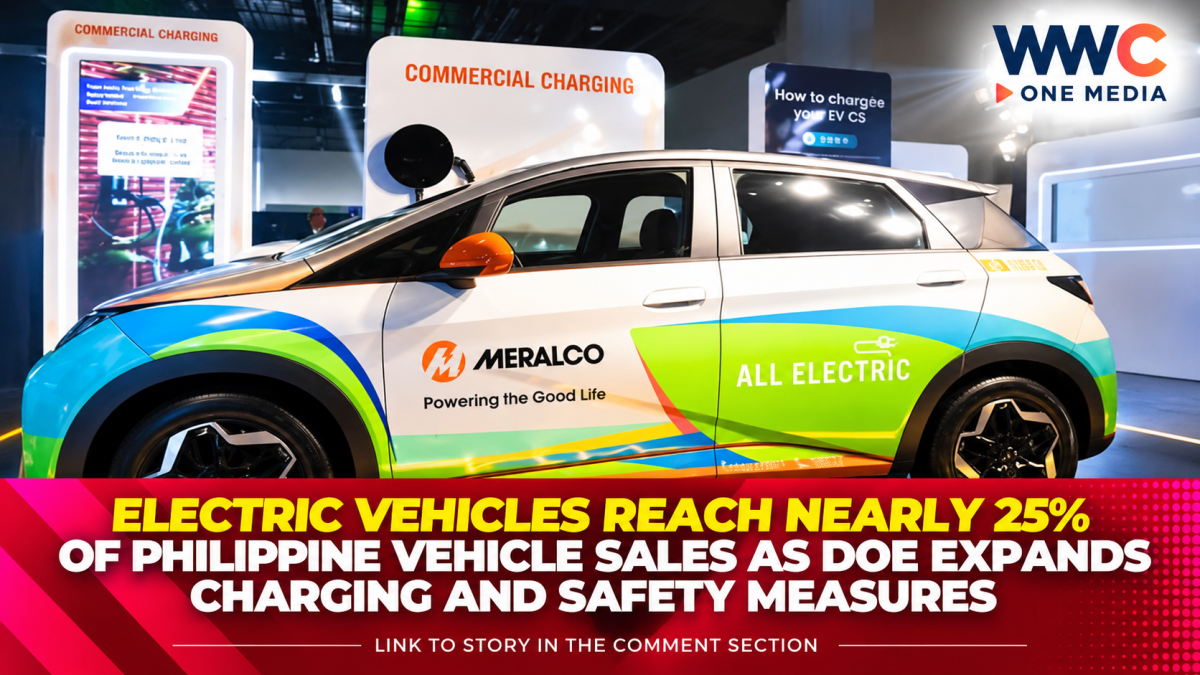
Electric vehicles are rapidly gaining ground in the Philippines, accounting for nearly one in every four vehicles sold during the first eight months of 2026 as the government expands charging infrastructure, safety programs and investment incentives.
The Department of Energy said at least 66,685 electric vehicles were sold nationwide from January to August, representing about 24.7% of an estimated 270,124 total vehicle sales during the period.
The total included 20,716 hybrid electric vehicles, 29,649 plug-in hybrid electric vehicles and 16,320 battery electric vehicles. The figures show that electrified vehicles are gaining a larger presence across different segments of the Philippine automotive market, rather than relying solely on fully battery-powered cars.
The expansion is also being accompanied by a wider selection of vehicles. By the end of August, the number of DOE-recognized EV models had reached 949, an increase of 67 from the previous month. Registered EV charging stations nationwide also climbed to 1,876.
The government is now focusing not only on encouraging EV purchases but also on making the supporting infrastructure and emergency systems ready for a larger electric vehicle fleet. The DOE said it is working with industry groups, local governments and emergency-response teams on EV safety, charging practices, battery care and procedures for dealing with high-voltage electrical hazards.
Charging availability remains an important issue for wider adoption. Earlier government plans called for the number of charging stations to expand significantly, while rules under the Electric Vehicle Industry Development Act require certain buildings with at least 20 parking spaces to dedicate 5% of those spaces for EV charging stations.
The government is also using financial incentives to encourage investment in the domestic EV industry. Under the Electric Vehicle Incentive Strategy created through Executive Order No. 121, qualified investments in electric vehicles and related industries may receive up to P60 billion in performance-based fiscal support.
The Philippines’ long-term roadmap calls for electric vehicles to account for 50% of the country’s vehicle fleet by 2040 under the Clean Energy Scenario of the Comprehensive Roadmap for the Electric Vehicle Industry. Reaching that target will require continued expansion of charging infrastructure, stronger safety capabilities and broader consumer access to EVs.
For motorists, the rapid increase in EV sales means the transition toward electric mobility is becoming more visible on Philippine roads. The next phase will depend not only on how quickly consumers adopt the technology, but also on whether charging networks, safety standards, emergency response and local infrastructure can keep pace with the growing fleet.