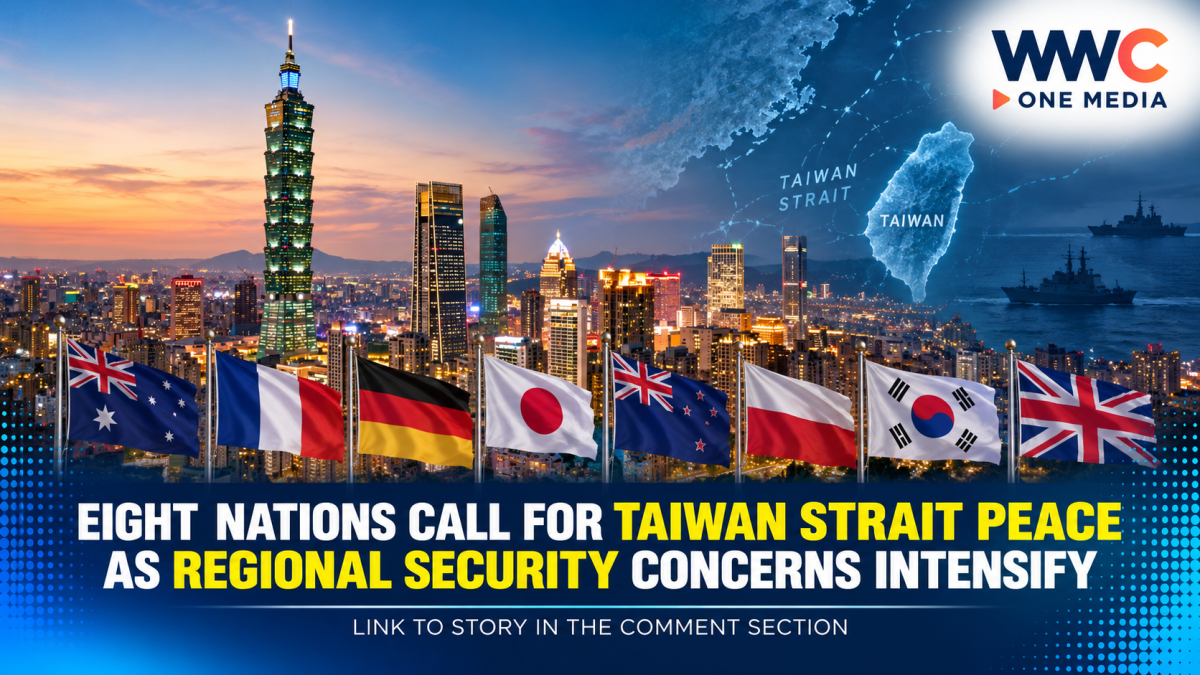
TAIPEI — Eight countries from Europe and the Indo-Pacific have jointly called for peace and stability in the Taiwan Strait, urging dialogue and opposing unilateral attempts to change the existing status quo as geopolitical tensions continue to reshape the region.
Foreign ministers and senior representatives from Australia, France, Germany, Japan, New Zealand, Poland, South Korea and the United Kingdom issued the statement following a meeting on the sidelines of the 81st United Nations General Assembly in New York.
The group emphasized the importance of maintaining peace and stability across the Indo-Pacific and said dialogue should remain central to managing tensions surrounding the Taiwan Strait.
Eight Nations Send a Unified Message
The joint statement specifically said the countries encourage dialogue and oppose unilateral attempts to change the status quo across the Taiwan Strait.
The wording is significant because the eight governments span both Europe and the Indo-Pacific, reflecting their increasingly shared concern over security issues that extend beyond their immediate regions.
The countries also said security and prosperity in Europe and the Indo-Pacific are becoming increasingly interconnected. They pledged to strengthen cooperation on shared challenges, including hybrid threats and the resilience of their societies.
The meeting also addressed wider international security concerns. According to Yonhap, the countries described disruptions to major sea lanes, including the Strait of Hormuz and Bab-el-Mandeb Strait, as unacceptable and reaffirmed their commitment to international maritime law, including the UN Convention on the Law of the Sea.
Taiwan Welcomes the Statement
Taiwan’s Ministry of Foreign Affairs welcomed the declaration, with Foreign Minister Lin Chia-lung expressing appreciation for the eight countries’ position.
Taiwan’s government said the statement demonstrates continued international attention to maintaining peace and stability across the Taiwan Strait.
Taipei also said it would continue strengthening its self-defense capabilities and whole-of-society resilience while expanding cooperation with international partners.
The statement comes amid heightened attention to Taiwan’s security environment. Taiwan has continued monitoring Chinese military activity around the island, while officials in Taipei have warned about broader strategic efforts involving the first island chain and the US military presence in the region.
Europe and Indo-Pacific Security Increasingly Linked
The latest declaration also highlights a broader shift in how European and Indo-Pacific governments frame security.
Rather than treating European and Asian security challenges as separate issues, the eight countries said developments in the two regions are increasingly connected. Their statement called for greater cooperation against hybrid threats and for stronger societal resilience.
This builds on previous cooperation among the same group. A similar meeting in September 2025 also brought together Australia, France, Germany, Japan, New Zealand, Poland, South Korea and the UK to discuss common security challenges spanning Europe and the Indo-Pacific.
For Taiwan, the latest statement adds another international expression of support for maintaining peace and avoiding unilateral changes to the status quo.
But the declaration itself does not announce a new military commitment to Taiwan, nor does it establish a new security alliance. Its language centers on dialogue, regional stability, international law and cooperation.
With tensions continuing to develop across the Indo-Pacific, the key question now is whether these diplomatic statements will translate into deeper practical cooperation among European and Indo-Pacific partners.
WWC ONE MEDIA G,A