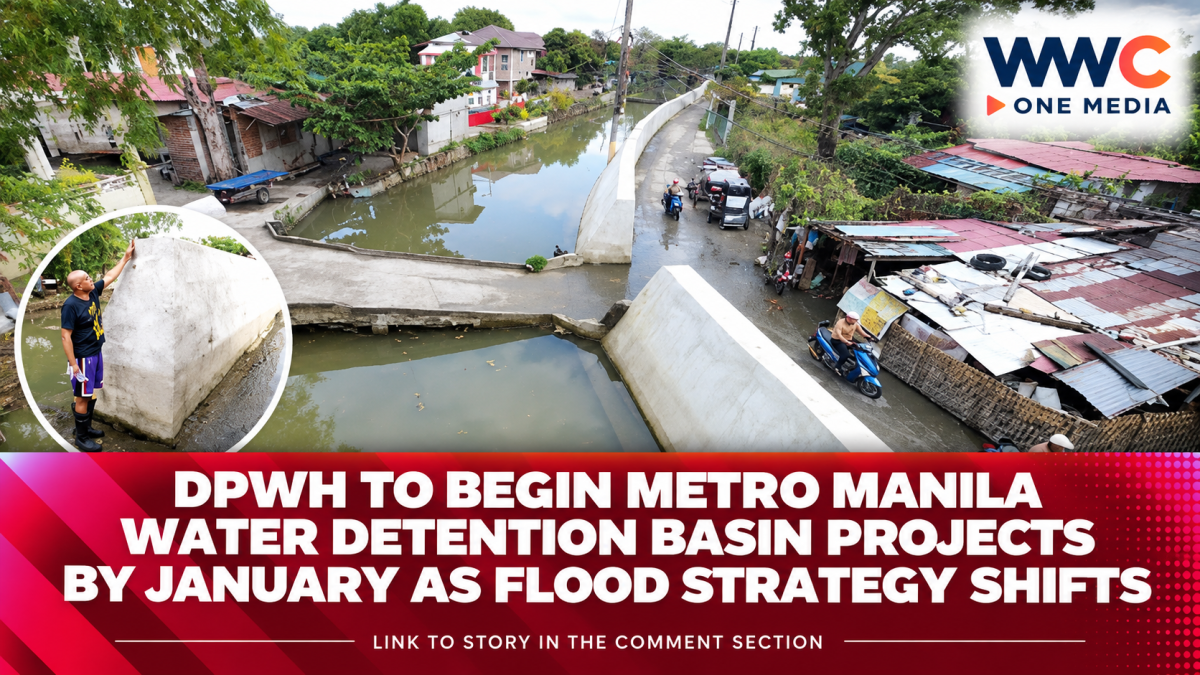
The Department of Public Works and Highways is preparing to begin construction of additional water detention basins in Metro Manila by January as the government accelerates efforts to reduce flooding and adopts a broader approach that combines traditional infrastructure with nature-based solutions.
Public Works Secretary Vince Dizon said detention basin projects that have already undergone studies could move ahead as early as January. The projects are intended to temporarily store excess rainwater and reduce the volume of water flowing into drainage systems during heavy rainfall.
The planned projects form part of a wider flood-management strategy in Metro Manila. The government is considering several rainwater impounding facilities in Quezon City, Manila and Pasay City, with five proposed sites expected to provide a combined storage capacity of about 107,600 cubic meters.
Among the projects already moving forward is a detention basin at Rajah Sulayman Plaza in Malate, Manila. The facility is designed to hold rainwater equivalent to about one-and-a-half Olympic-sized swimming pools and is expected to help reduce flooding in the surrounding area. Another basin is being developed in Malate to provide additional overflow capacity for the San Andres and Remedios Street drainage systems.
The DPWH is also preparing three larger detention basins in the Luneta area. Each is planned to cover about 4,000 square meters and hold the equivalent of roughly six Olympic-sized swimming pools, giving the three facilities a combined capacity equivalent to about 18 Olympic-sized pools. The basins are intended to capture water flowing from areas around Taft Avenue before it reaches flood-prone sections farther downstream.
Quezon City is another focus. The DPWH has been coordinating with the city government on a proposed basin in Barangay Kaingin Bukid, upstream of the San Juan River. The concept is to temporarily store floodwater and release it into the river after water levels have fallen, although securing suitable sites and right-of-way remains a major challenge in densely populated Metro Manila.
Beyond detention basins, the DPWH is changing its approach to flood control by combining concrete infrastructure with environmental measures. In flood-prone communities along Northern Manila Bay, including parts of Bulacan and Pampanga, the agency is studying earth dikes alongside mangroves, bamboo cribs and gabions.
Dizon said the planned earth dike project could begin implementation in the second quarter of 2027 after its design is completed. Partners including the Asian Development Bank and engineering consultants are helping develop the final concepts for the nature-based interventions.
The strategy reflects the government’s attempt to address flooding through several measures at once rather than relying solely on traditional flood-control structures. Detention basins can temporarily hold excess water, while drainage improvements, pumping stations and nature-based measures can help manage water before it overwhelms communities.
The projects are being pursued as Metro Manila continues to face recurring flooding during periods of intense rainfall and high tide. For residents, the immediate question will be how quickly the planned facilities can be completed and integrated with existing drainage systems — and whether the combined approach can translate into measurable reductions in flooding during future storms.