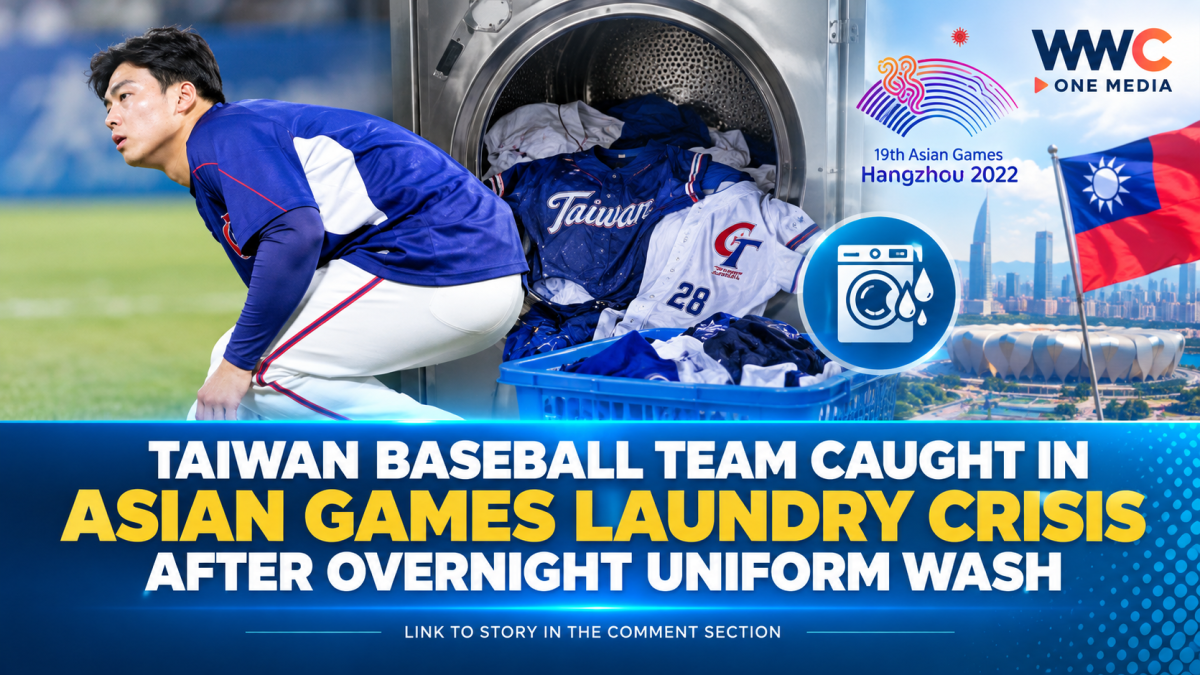
NAGOYA, Japan — Taiwan’s baseball team found itself fighting an unexpected opponent at the 2026 Aichi-Nagoya Asian Games: a shortage of timely laundry services.
After opening their tournament against South Korea on Sept. 21, Taiwanese players reportedly returned to their hotel and had to wash their own uniforms using a limited number of coin-operated machines because the official laundry service could not return uniforms quickly enough.
Taiwan captain Chen Min-chu said players finished washing their uniforms around 3–4 a.m. and had to wake up only a few hours later ahead of their next game. The team then faced Thailand on Sept. 22 and won 15–0.
The unusual situation was linked to the tournament’s accommodation and laundry arrangements. Baseball teams are staying together at a hotel in Nagoya rather than in a traditional athletes’ village, while the available laundry service reportedly takes several days to return clothing.
That schedule is particularly difficult for baseball teams because uniforms can need to be cleaned after every game and training session.
Teams turn to outside laundry companies
The problem was not limited to Taiwan.
SBS reported that players from several national teams also resorted to hotel coin-operated laundry machines because the available service could not keep pace with the baseball schedule. South Korea’s team was among those affected early in the tournament.
The Korea Baseball Organization, however, had already arranged an outside laundry provider. A KBO official said the organization hired a nearby company so players would not face disruptions involving uniforms for the following day’s games.
Yonhap reported that Taiwan, South Korea, Japan and China ultimately arranged separate external laundry services, with the teams covering the costs themselves.
Taiwan’s baseball association also moved to secure a private laundry company, meaning players would no longer need to spend the early hours of the morning washing their own uniforms.
A small logistical problem with a big sporting impact
For elite athletes competing on consecutive days, the issue goes beyond clean uniforms.
Late-night laundry can cut into sleep, recovery and preparation time, particularly when teams have little room between games.
The baseball tournament features a demanding schedule, with group-stage games followed by the super round and medal matches. South Korea, for example, completed its group stage with three victories and advanced to the super round after beating Taiwan, Hong Kong and Thailand.
The laundry controversy has therefore become another example of the logistical challenges surrounding the Aichi-Nagoya Games, where accommodation, transportation and training arrangements have also drawn attention.
For Taiwan, what began as a simple question of getting uniforms washed became an overnight test of endurance — one that the players were forced to solve themselves before stepping back onto the field.
And with the tournament moving into its decisive stages, teams are now relying on privately arranged services to ensure that something as basic as clean uniforms does not become another obstacle to medal contention.
WWC ONE MEDIA G,A