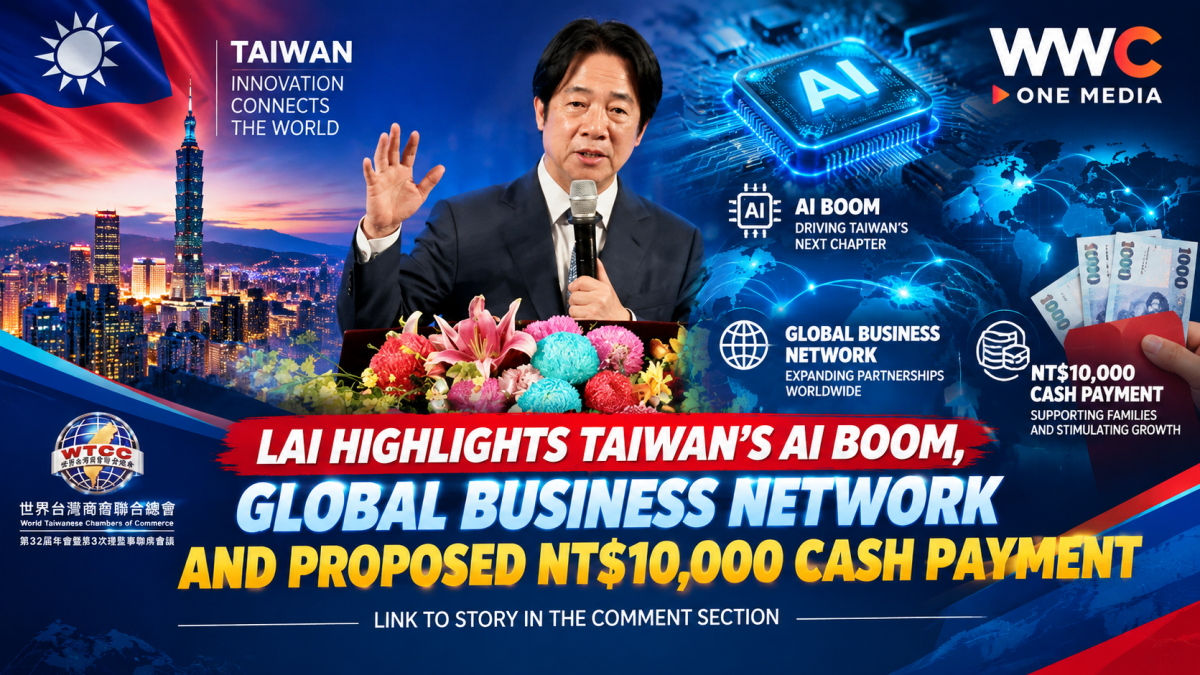
KAOHSIUNG, Taiwan — President Lai Ching-te highlighted Taiwan’s rapidly expanding AI-driven economy and the growing role of Taiwanese businesses overseas as he addressed the 32nd annual meeting of the World Taiwanese Chambers of Commerce in Kaohsiung.
Lai pointed to strong economic growth, Taiwan’s semiconductor and AI industries, and the contribution of Taiwanese companies operating around the world as evidence of the island’s increasingly global economic footprint.
Taiwan’s AI economy takes center stage
Lai said Taiwan’s economy grew 8.76% in 2025, while the government’s latest forecast calls for 11.05% growth in 2026.
He also pointed to Taiwan’s fourth-place position in the 2026 IMD World Competitiveness Ranking, the country’s highest placement since it entered the assessment in 1997.
The president linked much of the recent momentum to strong global demand for artificial intelligence, semiconductors and advanced computing, sectors that have boosted Taiwan’s exports, investment and technology supply chains.
Taiwan’s semiconductor industry remains central to the global AI hardware ecosystem, while Taiwanese companies have expanded manufacturing, investment and business operations across international markets.
Proposed NT$10,000 payment still needs approval
Lai also highlighted the government’s proposal to distribute NT$10,000 (about US$314) to each person next year.
The payment has been incorporated into the proposed 2027 central government budget, with NT$235.7 billion earmarked for the program.
However, the proposal is not yet final. The budget still has to go through the Legislative Yuan, meaning the amount, timing and implementation remain subject to the legislative process.
Lai previously described the payment as a way for people across Taiwan to share in what he called the economic benefits generated by the AI boom.
Overseas Taiwanese businesses seen as key economic bridge
Speaking to Taiwanese business leaders from around the world, Lai emphasized the role of overseas Taiwanese companies in connecting Taiwan with international markets.
He recalled the establishment of Taiwan’s first export-processing zone in Kaohsiung six decades ago, describing it as an important step in the island’s integration into the global economy.
Today, Taiwanese businesses operate across numerous industries and markets, with major companies playing significant roles in semiconductors, information and communications technology, manufacturing and increasingly AI-related supply chains.
The president said these overseas networks provide Taiwan with access to markets, capital, expertise and international business relationships.
Bigger spending plans ahead
Lai also outlined major spending priorities contained in the proposed 2027 budget.
The proposed defense budget would exceed NT$1.3 trillion, while public-works spending would surpass NT$700 billion.
The government also plans more than NT$1.3 trillion in social-welfare spending, including free tuition for high-school and vocational-school students and an annual NT$35,000 subsidy for tuition and miscellaneous fees at private universities.
Another proposed measure would provide a NT$5,000 monthly child-growth allowance from birth through age 18.
As with the NT$10,000 payment, these measures remain part of the proposed budget and therefore remain subject to legislative review.
Taiwan tries to spread growth beyond technology
While AI and semiconductors remain major drivers of Taiwan’s economic expansion, the government has also emphasized the need for other industries to benefit.
Taiwan’s economy includes a large base of small and medium-sized enterprises, traditional industries, services and tourism businesses that do not necessarily experience the same growth rates as the technology sector.
The government has therefore framed its economic agenda around strengthening technology while also expanding opportunities across different industries and regions.
The global supply-chain advantage
The message to overseas Taiwanese businesses was clear: Taiwan’s economic model is becoming increasingly interconnected with global supply chains.
The combination of semiconductor manufacturing, AI hardware, advanced technology and international business networks has strengthened Taiwan’s position in the global technology economy.
But the government’s next challenge will be ensuring that rapid technology-led growth translates into broader economic benefits — while getting its proposed 2027 spending plans through the legislative process.
WWC ONE MEDIA G,A