
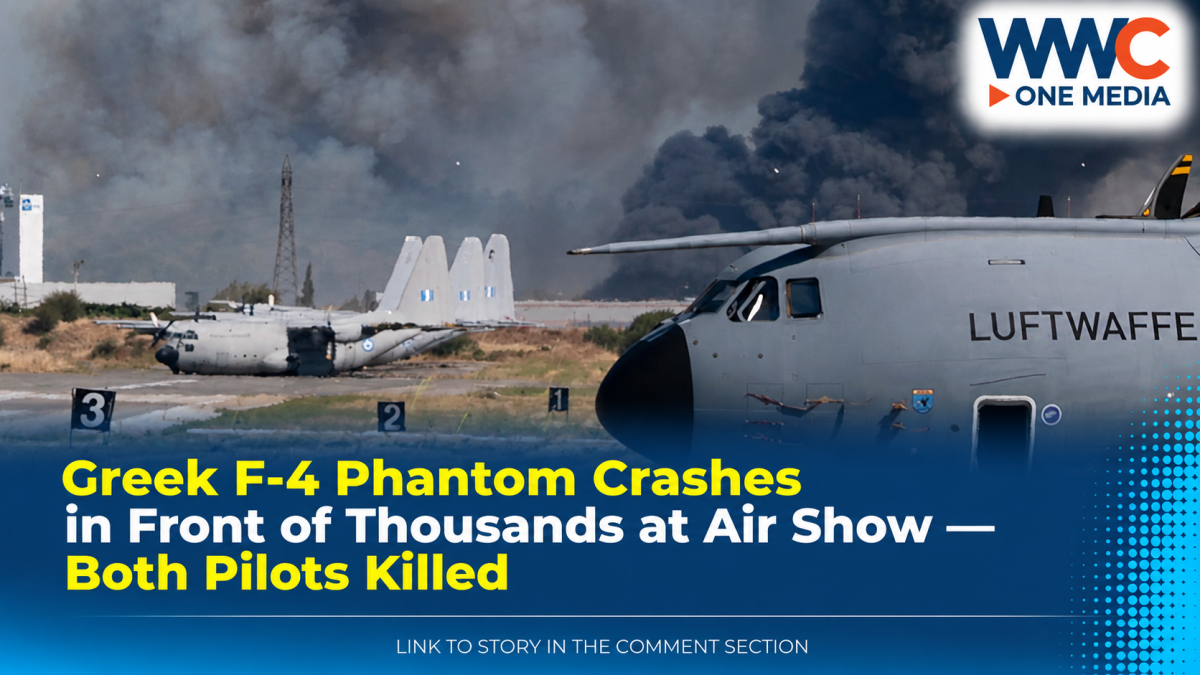
ATHENS, Greece — A Greek Air Force fighter jet crashed during a major aerial display north of Athens, killing both pilots as thousands of spectators watched in horror.
The twin-seat F-4 Phantom went down during a low-altitude manoeuvre at the annual Athens Flying Week event at Tanagra Air Base on Saturday, Sept. 5.
The aircraft erupted into flames after impact, sending thick black smoke into the sky and triggering a major emergency response.
Both pilots were killed.
But despite the crash happening during a public air show attended by thousands, Greek authorities reported no injuries among spectators or residents.
The cause of the crash has not yet been publicly established.
A low manoeuvre ended in disaster
The F-4 Phantom was performing during Athens Flying Week when it crashed.
Officials said the twin-seat fighter was carrying out a low-altitude manoeuvre before going down near Tanagra Air Base, about 60 kilometres north of Athens.
Reuters reported that the aircraft crashed roughly two kilometres outside the airfield, while eyewitness accounts described the jet making a low right turn before it lost control and crashed.
Video footage circulating after the incident showed smoke rising from the crash area, followed by another explosion as the aircraft broke apart.
The disaster unfolded just minutes into the jet’s display.
Both pilots were killed
Greek Air Force officials later confirmed that the two pilots aboard the aircraft had died.
Rescue operations were initially complicated by the fire that broke out following the crash.
Emergency crews had to battle flames while searching the crash area.
The deaths prompted an outpouring of grief from Greek officials, including Prime Minister Kyriakos Mitsotakis, who paid tribute to the risks faced by military aviators.
The Greek Air Force declared three days of mourning following the tragedy, according to Associated Press reporting.
Thousands watched — but no one on the ground was hurt
One of the most remarkable aspects of the disaster was that it occurred during a major public event.
Thousands of aviation fans had gathered at Tanagra for Athens Flying Week, an annual international event featuring military and civilian aviation teams.
Yet authorities said the crash site and resulting fire remained away from the main spectator area.
There were no reported injuries among spectators.
No injuries were also reported among residents in the surrounding area.
However, loudspeakers at the air base urged people to leave after the crash, and authorities issued an evacuation order for an area near the base as firefighters worked to contain the blaze.
Massive firefighting operation launched
The impact triggered a fire that spread into nearby terrain.
Greek emergency services launched a major response involving:
- 85 firefighters
- Multiple emergency vehicles
- 11 water-dropping aircraft and helicopters
The firefighting operation was aimed at preventing the blaze from spreading further.
Authorities eventually contained the fire, which remained some distance from the main viewing area.
The emergency response also allowed rescue teams to access the crash zone and recover the pilots.
The scale of the operation reflected the danger posed not only by the crash itself but also by the fire that followed.
Athens Flying Week events cancelled
The tragedy immediately disrupted the annual aviation event.
Organisers cancelled the remaining events planned for the weekend following the crash.
Athens Flying Week is one of Greece’s major aviation gatherings and attracts military and civilian aircraft and teams from multiple countries.
But after the F-4 crashed, attention shifted from aerial displays to emergency operations.
Spectators were urged to leave the area as firefighters and rescue personnel took control of the scene.
What caused the F-4 Phantom to crash?
That remains the biggest unanswered question.
Initial reports established that the jet crashed during a low-altitude manoeuvre.
However, Greek authorities have not publicly confirmed a definitive cause.
The incident should therefore not yet be attributed to:
- Pilot error
- Mechanical failure
- Ejection-seat failure
- Weather
- A specific technical malfunction
Those possibilities would require confirmation through an official investigation.
Some early reports cited by media discussed whether the crew had enough time to eject, but the circumstances surrounding the crash remain under investigation.
For now, the confirmed facts are simpler and more tragic:
The aircraft crashed during a display. Both pilots died. No spectators were reported injured.
The F-4 Phantom’s long history
The aircraft involved was a twin-seat F-4 Phantom, a legendary American-designed fighter aircraft whose history dates back decades.
The F-4 became one of the most recognisable military jets of the Cold War era and was operated by several air forces around the world.
Greece has operated variants of the Phantom for decades.
The aircraft’s appearance at Athens Flying Week was therefore particularly significant as older-generation fighter jets have increasingly been retired or replaced by newer aircraft.
But its long history also makes the latest crash especially notable for aviation observers.
A fighter aircraft that had become an icon of military aviation ended its display in tragedy before thousands of people.
Greece mourns its latest aviation tragedy
The deaths of the two pilots have renewed attention on the risks faced by military aviators.
Air show displays can involve demanding manoeuvres performed at low altitude, leaving little margin for recovery if an aircraft experiences a problem.
Military pilots routinely train for complex operations.
But public demonstrations can present additional challenges because aircraft are deliberately flown in highly visible manoeuvres for spectators.
That does not mean the display itself caused the crash.
Investigators will need to determine exactly what happened in the moments before the F-4 went down.
Until then, speculation should be avoided.
Video captures the horrifying moment
Footage from the event showed the aircraft flying low before the crash.
A plume of smoke then rose from the impact area.
Another explosion followed as parts of the aircraft broke apart.
The images quickly spread online and underscored how close the tragedy came to thousands of spectators.
But authorities said the crash occurred away from the main crowd.
That separation appears to have prevented what could have been a much larger disaster.
The two pilots were the only reported fatalities.
The investigation now begins
The immediate emergency may be over, but investigators now face the difficult task of determining why the aircraft crashed.
They will likely examine factors including:
- The aircraft’s technical condition
- The flight path
- The manoeuvre being performed
- Weather and environmental conditions
- Communications
- Maintenance records
- Flight data and available recordings
Authorities have not publicly announced a final explanation.
That distinction is critical as early reports and online speculation continue to circulate.
The official investigation will determine whether the crash resulted from a technical issue, operational factor or another cause.
A celebration of aviation turns into tragedy
Athens Flying Week was supposed to be a celebration of aviation.
Instead, thousands of spectators watched as a military aircraft crashed and a massive plume of smoke rose above the air base.
Emergency crews rushed to the scene.
The remaining events were cancelled.
Two Greek Air Force pilots never returned home.
Yet the tragedy could have been even worse.
Despite the crash happening during a major public event, no injuries were reported among the crowd.
Now Greece is mourning two pilots while investigators search for answers.
The crowd survived the disaster.
The two men flying the aircraft did not.
And the biggest question remains unanswered:
What went wrong during those final seconds of the F-4’s flight?




Leave a Reply