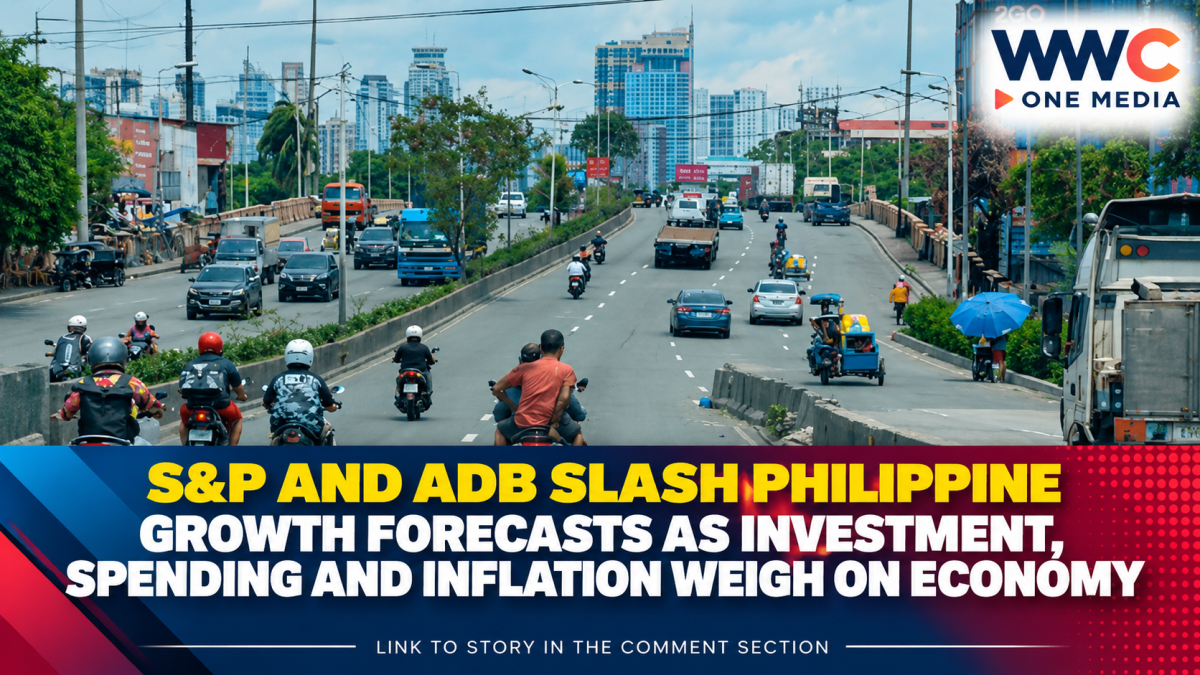
The Philippine economy faces a weaker growth outlook after S&P Global Ratings and the Asian Development Bank (ADB) sharply cut their 2026 forecasts, citing weak investment, subdued household spending, elevated energy and food prices, and continuing external shocks.
S&P lowered its Philippine gross domestic product (GDP) growth forecast for 2026 to 2.9 percent from 4.1 percent previously. The downgrade was the steepest among the Asia-Pacific economies covered by the ratings agency. ADB also reduced its forecast to 3.3 percent from 3.8 percent in July.
The revised projections point to growth falling below the Philippine government’s current 3.5-to-4.5 percent target for 2026. The economy grew by only 2.6 percent during the first half of the year, including a 2.3 percent year-on-year expansion in the second quarter.
Weak investment has emerged as one of the biggest constraints. Gross capital formation contracted by 9.2 percent in the second quarter, while fixed investment fell 13.7 percent. Government infrastructure and capital spending also dropped sharply in the first half as agencies faced tighter validation, auditing and documentation requirements for project disbursements.
Household spending has also lost momentum. Consumer expenditure grew by just 2.8 percent in the second quarter, its weakest performance outside the pandemic period since 2010, according to data cited in the reports. ADB said elevated inflation and weak consumer confidence were weighing on domestic demand.
External pressures are adding to the challenge. ADB pointed to the prolonged effects of the Middle East conflict, higher imported fuel and fertilizer costs, geopolitical uncertainty and weaker investment. S&P likewise cited energy and food price shocks, along with a pullback in public capital expenditure, as factors behind its downgrade.
Inflation is another concern. ADB kept its 2026 inflation forecast at 5.9 percent but raised its 2027 projection to 4.4 percent, partly because of the expected effects of El Niño on agricultural production. S&P expects inflation to average 5.5 percent this year before easing to 3.6 percent in 2027.
The weaker outlook could also influence monetary policy. S&P expects the Bangko Sentral ng Pilipinas to raise its policy rate by another 25 basis points before the end of the year, bringing it to 5.25 percent, before gradually cutting rates in 2027 as inflation pressures ease.
Both institutions nevertheless expect the Philippine economy to recover in 2027. ADB projects growth of 5.1 percent, down from its earlier 5.3 percent forecast, while S&P expects 5.4 percent growth, compared with its previous 5.8 percent projection. ADB said investment could begin recovering toward the latter part of 2026 as infrastructure projects accelerate.
S&P also expects longer-term growth drivers to remain in place, including the business-process outsourcing industry, private investment in special economic zones and expansion in sectors such as energy and electronics. The outlook, however, remains exposed to geopolitical tensions, energy and food prices and climate-related shocks.
With investment and consumer spending still weak, the latest forecasts put renewed attention on how quickly public infrastructure spending can recover and whether inflationary pressures can ease. The pace of that recovery will be important to the Philippines’ growth performance through the rest of 2026 and into 2027.