SEOUL — Korean entertainment is looking backward to move forward.
From the chilling 1994 horror drama “M” to the beloved variety series “Infinite Challenge,” iconic Korean television properties from the 1990s and 2000s are being revived, remastered and expanded for today’s streaming audience.
The latest example is “M: Reboot,” a new TVING series scheduled for 2027 that takes the identity of the original MBC horror hit and rebuilds it as a contemporary psychological thriller.
The revival is part of a broader retro wave sweeping Korea’s streaming industry, where familiar intellectual properties are being transformed into new series, spin-offs and streaming experiences.
From a 1994 horror phenomenon to ‘M: Reboot’
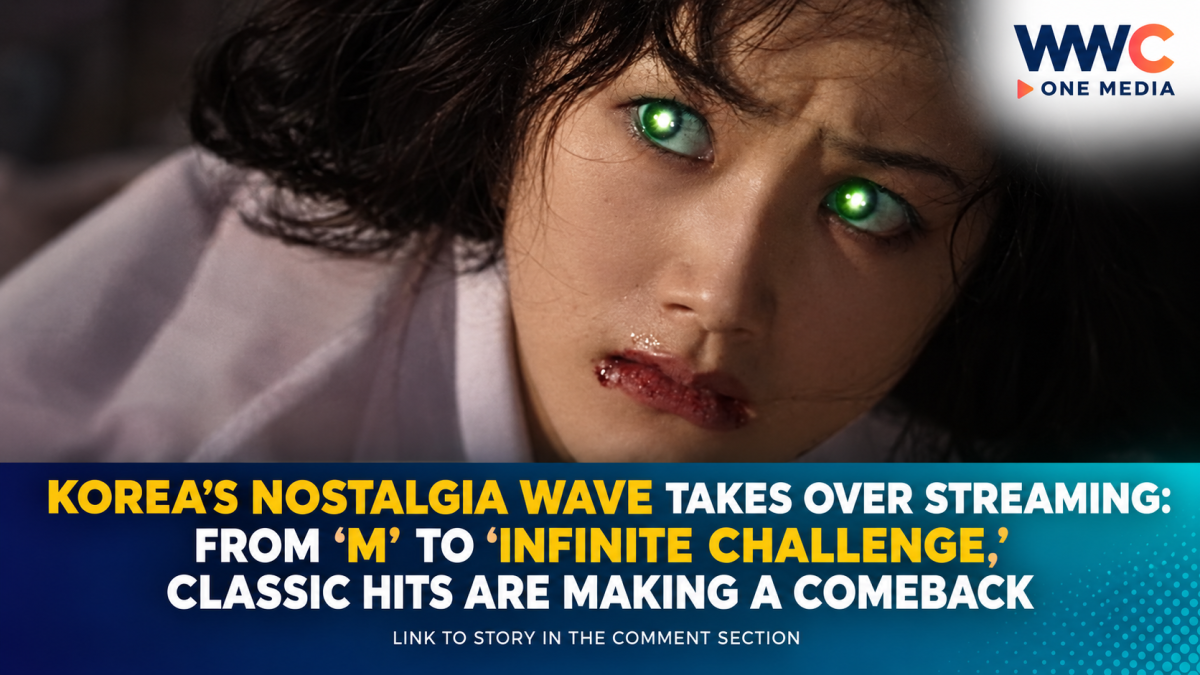
The original “M” became a landmark in Korean television when it premiered in 1994.
Starring Shim Eun-ha, the horror drama reached a peak nationwide viewership rating of 52.2 percent, while its eerie green-eyed imagery became one of its defining visual trademarks. The series also tackled the socially sensitive subject of abortion through a supernatural horror narrative.
More than three decades later, TVING is bringing the title back — but not simply repeating the original story.
“M: Reboot” shifts the concept toward psychological horror and dissociative identity disorder. Jung Chae-yeon plays three roles: Ma-ri, a high-school ballerina troubled by disturbing dreams; Jenny, a surgeon from the United States; and the mysterious alternate personality known as “M.”
Jung Gun-joo plays a detective investigating incidents connected to Jenny and a mysterious green light that leads back to memories from years earlier.
That change illustrates the industry’s current approach: preserve the recognizable identity of an old hit while changing its themes and storytelling for contemporary viewers.
‘Infinite Challenge’ returns through Muhan Company
Another major revival comes from one of Korea’s most influential variety shows.
The “Muhan Company” segment from MBC’s “Infinite Challenge” is being developed into a standalone series for Wavve.
The original sketches satirized Korean workplace culture, using exaggerated office personalities and corporate hierarchies to create comedy that resonated with viewers.
The new series brings back Park Myung-soo and Jeong Jun-ha, while introducing a new ensemble cast to a modern corporate setting. It is scheduled to premiere on Wavve in 2026.
The revival arrives after “Infinite Challenge” marked its 20th anniversary in 2025. Although the original show ended in 2018, it has continued to attract viewers through streaming and reruns. At its peak, it recorded a nationwide rating of 28.9 percent.
‘Hello, Franceska’ gets another life
The nostalgia boom isn’t limited to horror and variety.
Wavve is also preparing a spin-off expanding the universe of “Hello, Franceska,” MBC’s 2005 sitcom about a family of vampires trying to live an ordinary life in Seoul.
The original became known for its dark comedy, eccentric characters and satire of family and society. Its return demonstrates how streaming platforms can take a recognizable universe and develop it beyond the original television format.
Why are old Korean shows suddenly so valuable?
The retro boom is partly about nostalgia — but industry observers say economics and audience strategy are also driving it.
Culture critic Jung Duk-hyun told The Korea Times that established intellectual property gives streaming platforms a foundation with an existing history of audience interest. At the same time, modern adaptations can introduce those properties to younger viewers who never watched the originals.
The strategy is not entirely new.
In 2025, Netflix expanded its Korean catalog with older dramas including “The Sandglass,” “The Wild Days,” “All In,” “Stairway to Heaven” and “Cruel Temptation.” Wavve has also experimented with remastering and restructuring classic dramas for contemporary streaming habits.
Wavve previously reported strong results for its remastered classic-drama project, including renewed interest in titles such as “My Lovely Sam Soon” and “I’m Sorry, I Love You.”
Streaming platforms are turning nostalgia into a daily habit
The revival trend is also connected to a broader change in how Korean streaming services use their older libraries.
Wavve and TVING have increasingly experimented with free, ad-supported channels that stream older popular shows continuously.
TVING, for example, has offered classic programs such as “Infinite Challenge,” “High Kick Through the Roof” and “2 Days & 1 Night” through free live channels. Wavve has similarly placed popular older dramas into 24-hour channels.
The approach gives platforms a way to generate value from established catalogs while offering viewers an experience that resembles traditional television.
It also addresses a problem facing streaming users: having thousands of programs available can make deciding what to watch surprisingly difficult.
Familiar titles solve part of that problem because viewers already know the characters, format or reputation.
The real challenge: nostalgia isn’t enough
Bringing back a famous title does not automatically guarantee success.
A remake must satisfy viewers who remember the original while convincing younger audiences that the new version deserves attention on its own.
That balance may be particularly important for “M: Reboot.” The original’s themes were shaped by the social context of 1994, while the new production is approaching its story through contemporary psychological and social perspectives. Jung Duk-hyun told The Korea Times that successful remakes need to reflect modern sensibilities rather than simply reproduce the past.
The same challenge applies to “Muhan Company” and “Hello, Franceska.”
Their strongest asset is familiarity — but their survival as modern streaming properties will depend on whether that familiarity can be transformed into something audiences have a reason to watch today.
Korea’s past becomes streaming’s newest content
The resurgence of classic Korean entertainment shows that nostalgia is no longer simply about reruns.
Old intellectual properties are becoming starting points for new stories, new formats and new viewing experiences.
For longtime Korean TV fans, the appeal is obvious: characters and worlds they remember are returning.
For younger audiences and international viewers, the revivals offer an opportunity to discover the programs that helped shape Korea’s modern entertainment culture.
And as streaming platforms continue searching for recognizable stories in an increasingly crowded market, Korea’s next big entertainment trend may not come from something entirely new — it may come from something audiences thought they had already seen.
WWC ONE MEDIA G,A