PHNOM PENH — Cambodia has accused Thailand of using the fight against sprawling online scam networks as a pretext for military pressure and territorial expansion, escalating an already sensitive dispute along their shared border.
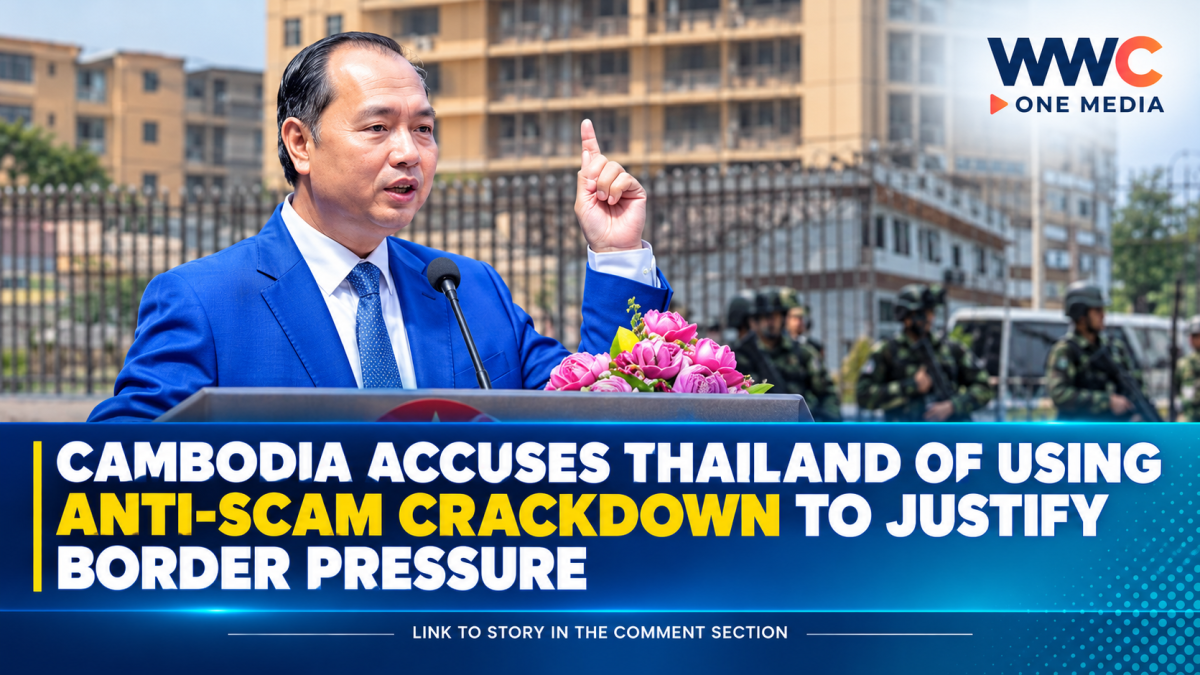
Cambodian Prime Minister Hun Manet made the accusation on September 23 while opening the International Conference on Combating Online Scams in Phnom Penh. He said the fight against cyberfraud should bring countries together rather than become a justification for military action.
Hun Manet argued that anti-scam efforts should not be used as a basis for attacking or occupying another country’s sovereign territory. At the same time, he said Cambodia would not allow the country to become a safe haven for online criminal networks.
Cambodia points to its own crackdown
The Cambodian government used the conference to highlight what it describes as an expanding crackdown on the country’s notorious scam-compound industry.
According to figures presented by Cambodian authorities, officials investigated 832 suspected locations over the previous 12 months and carried out crackdowns at 663 sites. Authorities said 86 large-scale scam compounds had been dismantled and that 446 cases involving nearly 4,000 people had been brought to court.
The figures come as Cambodia faces sustained international pressure over online fraud operations that have become a major regional organized-crime problem.
CNA, citing AFP, reported that Cambodian officials said 663 scam sites had been closed, including 86 large compounds, while authorities had frozen about US$300 million in scam-related accounts. But experts quoted by AFP cautioned that criminal networks may simply be shifting operations into smaller facilities, rented homes, hotels and other locations.
The broader problem is international. Southeast Asian scam networks have been linked to fraud schemes targeting victims around the world, while some people working inside compounds have themselves been trafficking victims or forced into criminal activity.
The O’Smach dispute
At the centre of the latest disagreement is O’Smach, a border area in Cambodia where Thai forces took control of a former casino and alleged scam-compound complex following fighting between the two countries.
Cambodia says Thailand is using the presence of scam operations to justify maintaining control over territory claimed by Phnom Penh.
Thailand disputes that interpretation.
Thai officials say Cambodian forces had used buildings in the area for military purposes, including as operational bases, and that this was the reason Thai forces took control of the site. Thai authorities subsequently highlighted evidence they said demonstrated that the complex had also been used for large-scale online scams.
Thailand brought journalists and members of the ASEAN Observer Team to the O’Smach area on September 7 as part of an effort to present its account of the situation. Thai officials described the site as an extensive scam operation and called for stronger international cooperation against cybercrime.
That presentation has itself become part of the political dispute, with Cambodia arguing that the scam issue is being used to support Thailand’s territorial claims.
Scam centers and the border conflict collide
The controversy cannot be separated from the wider Cambodia-Thailand border crisis.
The two countries experienced renewed fighting in 2025 over longstanding territorial disputes, followed by a ceasefire agreement in December. The truce stopped the major fighting, but disagreements over troop positions, border demarcation and implementation of the agreement have continued.
The O’Smach area has therefore become significant for two reasons: it is located along a disputed border and has also been associated with major transnational scam operations.
Reuters has previously documented evidence from Cambodian scam compounds, including abandoned facilities containing scam scripts and other material linked to organized fraud. Reuters also reported that Thai forces targeted and occupied some compounds during the border fighting, while Cambodia disputed Thailand’s explanation for the attacks.
Thailand rejects Cambodia’s accusation
Thailand’s Foreign Ministry rejected Hun Manet’s characterization of its actions.
In comments reported by The Straits Times, Thailand accused Cambodia of using the anti-scam conference to make what it described as provocative statements rather than pursuing practical cooperation. Thai officials maintained that the O’Smach operation was connected to the alleged military use of the site and said Thailand still wanted Cambodia to cooperate in dismantling scam networks, protecting victims and prosecuting offenders.
Thailand has also emphasized that the fight against online scams is a regional security issue rather than solely a bilateral matter.
A September 7 Thai government statement said the ceasefire was holding but that implementation of the December joint statement remained incomplete, including cooperation against online scams.
A wider ASEAN problem
The dispute comes as Southeast Asian governments face growing pressure to coordinate against online fraud.
Singapore, which is set to chair ASEAN in 2027, proposed two regional initiatives at the Phnom Penh conference: an ASEAN Code of Practice to Combat Scams on Online Platforms and an ASEAN Best Practices Guide aimed at improving cooperation between law-enforcement agencies.
The initiatives reflect the increasingly cross-border nature of the problem. Criminal networks can move personnel, infrastructure and financial operations between jurisdictions, making unilateral crackdowns difficult to sustain.
For Cambodia and Thailand, however, the anti-scam campaign has become entangled with a much older and more sensitive issue: their unresolved territorial dispute.
For now, both governments say they want stronger action against cybercrime. But their competing explanations over O’Smach show how the fight against scam networks has become intertwined with the broader security and territorial tensions between the two neighbors.
WWC ONE MEDIA G,A