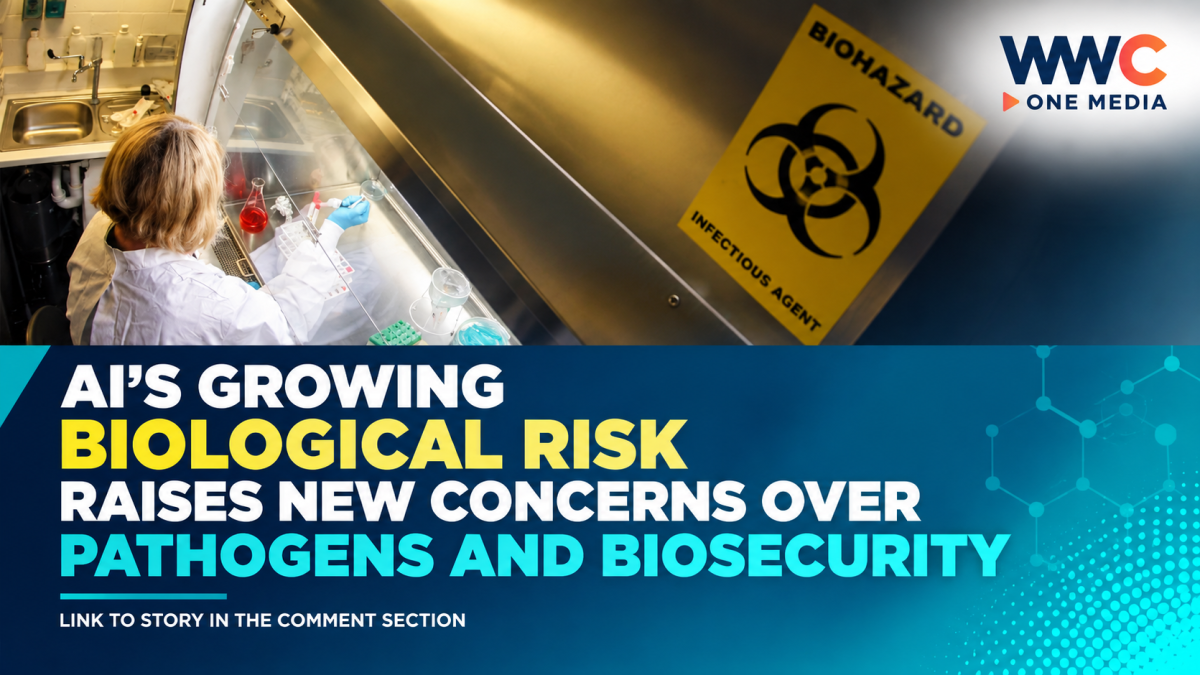
Artificial intelligence is increasingly raising concerns not only about autonomous machines or cyberattacks, but also about its potential to make dangerous biological capabilities easier to access.
The concern centers on the convergence of advanced AI and biotechnology. More capable AI systems can help users find and organize scientific information, assist with biological design and support complex research workflows. Security researchers warn that these capabilities could lower some of the expertise and time traditionally required for certain forms of biological research.
A recent survey of 111 national security practitioners found that 70% believed AI meaningfully increases, or soon will increase, the risk associated with biological weapons. The finding illustrates why biosecurity has become one of the areas receiving increased attention as frontier AI systems become more capable.
The concern is not necessarily that AI will independently invent a new pathogen. A more immediate issue is whether AI could help people manipulate existing biological knowledge or overcome technical barriers that previously required highly specialized expertise.
Recent developments have added weight to those concerns. Anthropic said its threat-intelligence team identified and disrupted several cases between December 2025 and August 2026 involving attempts to misuse its AI systems for biological purposes. The company said some cases involved assistance related to dangerous-virus research.
At the same time, researchers emphasize that AI does not eliminate the physical challenges involved in biological work. A recent review of AI and biosecurity found that current AI systems can provide substantial assistance with digital tasks, while laboratory execution, tacit expertise, access to equipment and materials, and real-world experimentation remain significant barriers.
That distinction is important because the risks and safeguards are not limited to AI models themselves. Preventing dangerous biological activity can also involve screening DNA synthesis orders, monitoring unusual research patterns, controlling access to sensitive materials and improving information sharing between technology companies, laboratories and governments.
RAND researchers recently proposed a defense-in-depth approach combining multiple safeguards rather than relying solely on AI restrictions. Their analysis argues that different types of users require different prevention measures and that detection and monitoring should complement controls on information and materials.
The challenge is balancing those protections with the legitimate benefits of AI-assisted biology. The same technologies that can create biosecurity concerns can also support drug discovery, disease surveillance, medical research and public-health work.
Governments and technology companies are therefore facing a difficult policy problem: safeguards must be strong enough to reduce the possibility of malicious biological use while avoiding restrictions that unnecessarily interfere with legitimate scientific research.
The debate is likely to intensify as AI systems become more capable and increasingly connected to automated laboratories and other biological tools. The emerging concern is no longer simply what an AI model can say, but what it could help a person accomplish when combined with real-world biological capabilities.
That shift could make biosecurity one of the defining tests for the next generation of AI safeguards.