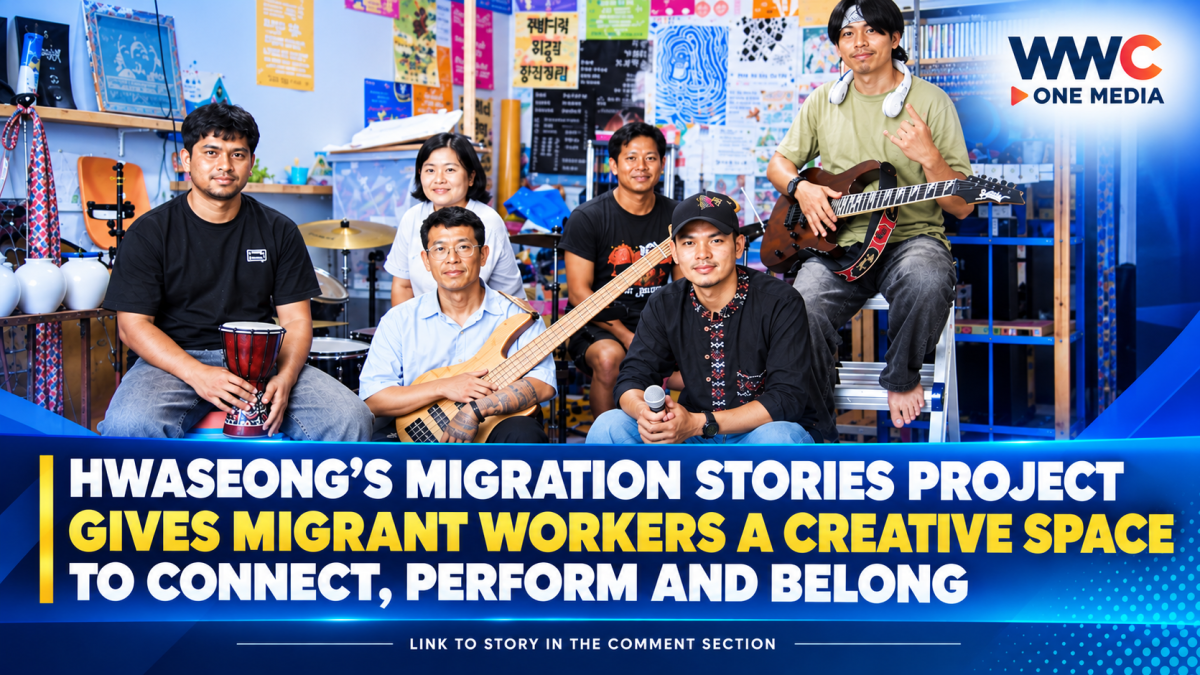
HWASEONG, South Korea — In a city shaped by manufacturing and migration, a small community art space is giving migrant workers something often difficult to find: a place to tell their stories, make music and build friendships beyond the workplace.
The Migration Stories Project, based near Balan Manse Market in Hyangnam, Hwaseong, Gyeonggi Province, was launched in 2020 by Korean artist Kim Yang-woo under the slogan “World is Our Home.”
The project brings migrant communities and local residents together through music, storytelling, photography, video, sound, workshops and other cultural activities.
Rather than portraying migrants solely through their jobs or immigration status, the project creates opportunities for them to participate as artists, musicians and community members.
From Factory Floors to a Music Studio
One of the project’s most visible activities is the Yatri band, a five-member group made up mostly of Nepali migrants living and working in Korea.
The band’s name refers to a traveler or someone who journeys — a fitting description for musicians who left Nepal and built new lives in an unfamiliar country.
The group performs older Nepali songs while developing original music and experimenting with its own sound. Its members also participate in community gatherings and cultural events.
Among them is Rai Prakash, who came to South Korea in 2016 and works at a sponge factory.
His work schedule can extend from Monday through Saturday, leaving limited time for personal interests. Yet he has continued learning drums at the Migration Stories Project and also plays guitar and flute.
For Prakash, earning a living and pursuing music are not mutually exclusive.
He has expressed a desire to create Nepali music in Korea and develop original lyrics and compositions with fellow migrants.
Art Becomes a Common Language
Kim, who studied painting before moving toward video, performance and sound-based art, said her interest in migration grew from her own experiences of moving between Seoul and her hometown.
During the COVID-19 pandemic, restrictions on movement prompted her to think more deeply about migration and the similarities between Korean and migrant communities.
The project now connects with migrants from several communities, including Nepal, Thailand, Sri Lanka and the Philippines.
Its activities range from music-making and print experiments to painting, handmade instruments and silk-screen T-shirt workshops.
The project also collaborates with Korean artists, creating opportunities for migrant participants and established artists to work together.
For Kim, the goal isn’t simply to produce artwork.
The activities create situations where people from different backgrounds can spend time together, exchange ideas and form relationships.
A Community Beyond the Workplace
The project comes as South Korea continues to experience growing interaction between local communities and foreign residents.
Hwaseong, in particular, has become an important destination for migrant workers because of its manufacturing industries and expanding industrial base.
Song Hyun-joong, director of the Hwaseong Community Support Center, said migrant workers and other foreign residents should be viewed as members of local communities rather than simply temporary outsiders.
Some migrants spend years living in the same neighborhoods, working at nearby businesses, raising families and developing relationships with Korean residents.
But inclusion does not happen automatically.
Language barriers, cultural differences and social isolation can create distance between migrants and local residents, Song said. Community initiatives can help create opportunities for interaction and strengthen neighborhood relationships.
Recent Korean reporting on migrant workers during the Chuseok period similarly shows how many foreign workers have developed lives and communities in Korea, even when returning to their home countries is difficult because of travel costs and limited holiday time.
Keeping the Project Alive Is Another Challenge
The Migration Stories Project is not designed primarily as a commercial venture.
Kim acknowledged that the space is not particularly profitable and has relied on government and local community-center support to continue operating.
Funding is not the only obstacle.
Communication across different languages and cultural backgrounds can also be challenging, particularly when participants come from very different social and cultural environments.
Still, Kim wants to expand the network.
Her goal is to work with more migrant communities in Hwaseong and use music and artistic activities as a shared point of connection.
From Migrant Workers to Community Storytellers
The project highlights a broader shift in how migrant communities can participate in local life.
A factory worker may spend most of the week working long hours, but outside the workplace that same person can also be a musician, artist, parent, neighbor or cultural contributor.
For the members of Yatri, music provides a way to maintain a connection with Nepal while creating something new in Korea.
For Kim, the project provides a space where Korean and migrant residents can meet through creativity rather than simply through work or administrative systems.
And for Hwaseong, such initiatives offer another way of building connections in communities where migration has become part of everyday life.
The Migration Stories Project may be small, but its message is bigger: migrants are not only people who come to Korea to work — they also bring stories, music, culture and creativity that can become part of the communities they call home.
WWC ONE MEDIA G,A