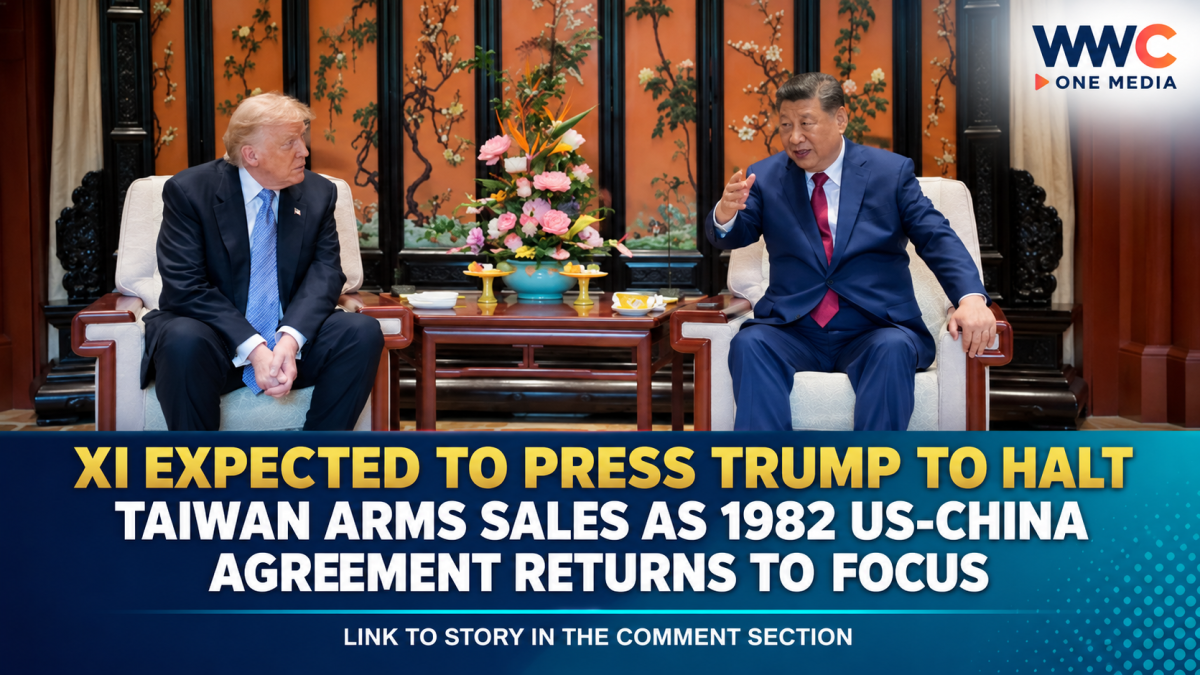
Chinese President Xi Jinping is expected to press US President Donald Trump to halt American arms sales to Taiwan when the two leaders meet in Washington this week, putting one of the most sensitive issues in US-China relations at the centre of their summit.
People familiar with preparations for the talks said Beijing is expected to invoke the 1982 US-China Joint Communiqué on arms sales to Taiwan. The agreement stated that the United States did not intend to pursue a long-term policy of arms sales to Taiwan and intended to gradually reduce such sales.
China has repeatedly cited the communiqué when opposing US weapons sales to Taiwan. Beijing considers Taiwan part of China and regards the issue as a core sovereignty concern.
The United States, however, has continued providing Taiwan with weapons under its domestic legal framework. The Taiwan Relations Act requires Washington to make available defence articles and services necessary for Taiwan to maintain a sufficient self-defence capability, despite the absence of formal diplomatic relations between Washington and Taipei.
There is also an important complication in how Washington interprets the 1982 agreement.
Then-President Ronald Reagan issued assurances to Taiwan in 1982 stating, among other things, that Washington had not agreed to establish a date for ending arms sales to Taiwan and had not agreed to consult Beijing before approving such sales. The US government has continued to maintain that its Taiwan policy is guided by the Taiwan Relations Act, the three US-China communiqués and the Six Assurances.
That difference in interpretation is likely to make the issue particularly sensitive during the Trump-Xi meeting.
The timing is also significant because the Trump administration has yet to announce a new US$14 billion arms package for Taiwan. Earlier in 2026, Trump delayed the package, while Taiwan has continued to strengthen its military capabilities and conduct exercises involving drones, missiles and other systems.
The potential arms-sales discussion comes as Washington and Beijing try to manage several other disputes, including trade, technology and wider security issues.
For Beijing, stopping US arms sales would address a longstanding objection and reinforce its position that Taiwan-related matters should not involve foreign military support.
For Washington and Taipei, however, continued access to US defence equipment remains closely connected to Taiwan’s ability to maintain its own defence capabilities. Taiwan’s government rejects Beijing’s sovereignty claims and maintains its own democratically elected government and armed forces.
The issue could therefore become a major test of how the two governments manage disagreements while attempting to maintain broader diplomatic and economic engagement.
Xi’s expected push does not itself mean that Washington has agreed to change its policy. It instead places the competing interpretations of the 1982 agreement, US domestic law and Taiwan’s security needs directly into the agenda of the upcoming summit.