
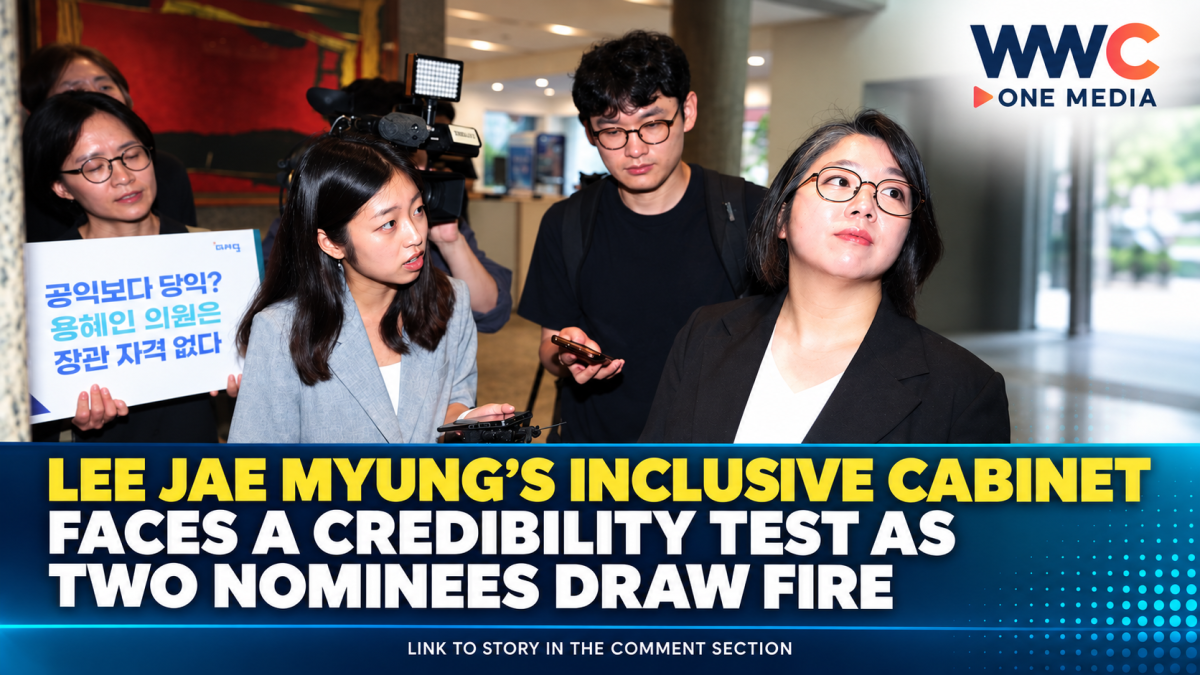
SEOUL, South Korea — President Lee Jae Myung’s attempt to broaden his Cabinet is facing an unexpected credibility test, with two high-profile nominees becoming the focus of controversies that threaten to overshadow the political message behind his latest reshuffle.
Lee announced a major Cabinet reshuffle on August 30, replacing six ministers as his administration entered its second year. The changes affected key portfolios including finance, justice, national defense, land and housing, gender equality and family, and small and medium-sized enterprises.
The reshuffle was widely interpreted as an effort to inject fresh momentum into Lee’s administration while widening its political base.
But the question now confronting the president is increasingly straightforward:
Can an inclusive Cabinet still succeed if some of its most controversial nominees become distractions from the government’s policy agenda?
An ambitious reshuffle with a broader political message
Lee’s personnel overhaul was larger than many observers had expected.
The president nominated six new ministers, including Lee Hyoung-il for deputy prime minister and finance minister, Hong Ji-seon for land and transport, Kim Seung-won for justice, Kang Shin-cheol for national defense, Lee So-young for SMEs and Startups, and Yong Hye-in for gender equality and family.
Analysts viewed the reshuffle partly as an attempt to address public dissatisfaction over issues such as housing and economic policy while also strengthening unity among forces on the political left.
The move came as Lee’s approval rating had weakened.
Recent reporting said a Gallup Korea survey conducted in late August put Lee’s positive job rating at 42 percent, while negative assessments reached 50 percent, marking a challenging point for the president as he entered his second year in office.
That made the personnel changes particularly important.
The administration needed ministers capable not only of carrying out policy but also of restoring public confidence.
The Justice Ministry nomination becomes a major test
The most serious controversy surrounds Kim Seung-won, the Democratic Party lawmaker nominated to become justice minister.
Questions have emerged over his role in a 2021 request involving Genencell, a biotechnology company seeking approval for clinical trials of a COVID-19 drug candidate.
According to reporting summarized by Korea JoongAng Daily and other Korean outlets, Kim sent a message to then-Food and Drug Safety Minister Kim Gang-lip in October 2021 after being asked by an acquaintance to seek an expedited review of Genencell’s clinical-trial application. The application was approved later that month.
The issue has resurfaced during the confirmation process.
The controversy intensified after reports about an attempted donation by a Genencell shareholder and questions surrounding the speed of the regulatory review.
However, it is important not to turn those allegations into established facts.
Kim has denied that he improperly lobbied for preferential treatment. He has argued that his involvement amounted to conveying a public-interest request and has disputed claims that the approval received unusually favorable treatment.
That distinction matters because the controversy is still part of a political and confirmation process—not a final finding of wrongdoing.
Yong Hye-in creates a different political problem
The second major controversy involves Yong Hye-in, the Basic Income Party lawmaker nominated as minister of gender equality and family.
Her nomination was intended to demonstrate Lee’s willingness to bring figures from outside the Democratic Party into government.
Instead, it has sparked a separate debate over whether she should give up her proportional-representation seat in the National Assembly if she takes the Cabinet post.
Yong has indicated that she intends to retain her parliamentary seat, a position that has drawn criticism because proportional representatives have traditionally resigned their seats when entering the Cabinet.
The dispute has become sufficiently significant that an opposition lawmaker introduced a bill on September 4 that would require proportional-representation lawmakers to surrender their parliamentary seats before serving as Cabinet members.
So far, the controversy is primarily about political convention, institutional roles and parliamentary representation rather than a simple question of whether the appointment is legally possible.
Why the two controversies matter
The two nominees face very different issues.
Kim’s controversy centers on allegations concerning his involvement in a regulatory matter before his nomination as justice minister.
Yong’s dispute centers on whether a proportional lawmaker should simultaneously retain her legislative position while joining the Cabinet.
Yet politically, they create the same problem for Lee:
They risk shifting public attention away from why the president made the reshuffle in the first place.
The administration wanted to emphasize policy momentum, political inclusion and a renewed push during Lee’s second year.
Instead, questions about individual nominees are competing for the headlines.
That is precisely the concern raised by the Korea Times editorial, which argued that bringing people from outside the ruling party into government can be a worthwhile form of political diversity—but that inclusion becomes counterproductive if the administration fails to put qualified and appropriate people in key positions.
Inclusion can broaden a government—but it also raises the stakes
There is a genuine strategic argument behind Lee’s broader personnel approach.
A president governing with a large parliamentary majority does not necessarily need to limit Cabinet appointments to members of the governing party.
Bringing in figures from smaller progressive parties, civil society and other parts of the political spectrum can potentially broaden representation and create a wider coalition.
Lee’s reshuffle appears to reflect that thinking.
Yong Hye-in’s nomination is perhaps the clearest example.
She comes from the Basic Income Party, a smaller political force outside Lee’s Democratic Party, and her selection signals an effort to embrace a wider progressive bloc.
But political diversity comes with another requirement:
Every nominee must still meet a high standard for competence, ethics and public accountability.
That is where the current controversies become politically dangerous.
The opposition sees an opening
Lee’s reshuffle has already faced criticism from the opposition.
The People Power Party has attacked several of the nominations, while individual controversies surrounding Kim and Yong have given opponents additional ammunition.
The opposition’s argument is essentially that a Cabinet reshuffle should strengthen government credibility—not create new questions about the people being appointed.
The ruling camp, meanwhile, has defended Kim and sought to manage the political fallout surrounding Yong.
The confirmation process will therefore become an important test of how much political capital Lee is willing to spend defending his choices.
The reshuffle comes at a sensitive moment for Lee
The political timing makes the controversy more consequential.
Lee’s administration is simultaneously pushing an ambitious economic agenda.
The government has proposed a record 821 trillion won ($596.9 billion) 2027 budget, with major spending increases focused on artificial intelligence, semiconductor infrastructure, youth programs and other strategic sectors.
The government is also pursuing major diplomatic initiatives, including stronger cooperation with Europe and a strategic partnership with France covering areas such as defense, AI, aerospace and biotechnology.
In other words, Lee’s Cabinet needs to concentrate on a wide range of major policy challenges.
Every political controversy consuming the administration’s attention makes that task harder.
The real test is bigger than two nominees
The Korea Times editorial’s central argument is ultimately about personnel standards, not whether Lee should pursue a more inclusive government.
An administration can welcome people with different political backgrounds while still demanding rigorous standards for Cabinet appointments.
Those goals are not inherently incompatible.
In fact, they may be complementary.
A broader Cabinet can provide different perspectives and challenge political assumptions—but only if ministers have the competence, integrity and independence needed to perform their jobs.
For Lee, the immediate challenge is therefore not simply defending an “inclusive Cabinet.”
It is proving that inclusion does not mean lowering the bar.
What happens next?
The controversies surrounding Kim and Yong will continue through the confirmation process, and neither dispute should be treated as settled merely because it has generated political criticism.
Kim continues to deny allegations of improper lobbying, while the dispute surrounding Yong centers on her decision to retain her parliamentary seat and the political convention surrounding proportional lawmakers entering government.
For President Lee, however, the political calculation is already becoming clear.
His Cabinet reshuffle was designed to signal renewal, broader representation and a stronger push into his second year.
Now his nominees must demonstrate that those principles can coexist with strict standards of competence and accountability.
Because an inclusive government can win political support by opening its doors.
But it can lose that support just as quickly if the public begins asking whether the wrong people were allowed through them.



Leave a Reply