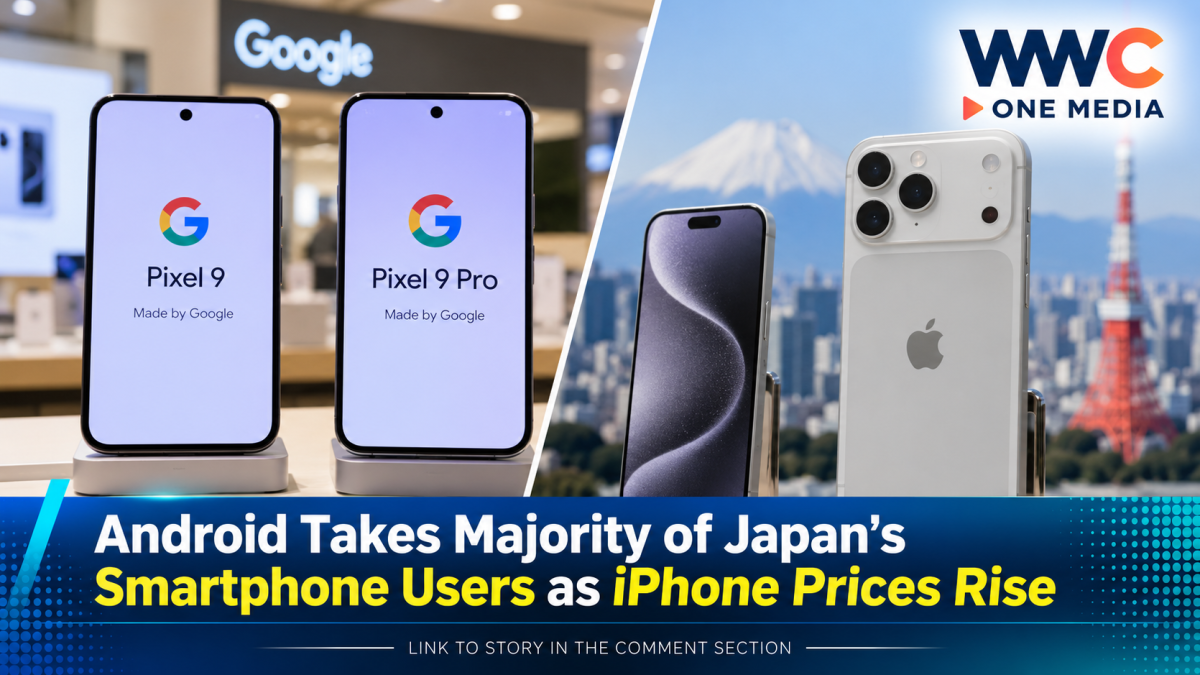
TOKYO — Android has taken a clear lead over the iPhone among smartphone users in Japan, according to a new survey, as Apple’s higher prices appear to be adding pressure to its traditionally strong position in the market.
Android accounted for 54.1% of the smartphones primarily used by respondents in August 2026, compared with 45.6% for Apple’s iPhone, according to the latest survey from Japan’s MMD Research Institute.
The results represent a 3.3-percentage-point increase for Android from the institute’s February survey, while the iPhone share fell 3.4 points over the same period.
The figures are particularly notable in Japan, where the iPhone has maintained an unusually strong position compared with many other major smartphone markets.
Japan’s iPhone Lead Has Reversed
MMD’s historical data shows how quickly the balance has shifted.
In September 2023, iPhone users represented 50.0% of respondents, compared with 49.7% for Android.
By September 2024, the figures had essentially flipped, with Android at 50.1% and iPhone at 49.6%.
In September 2025, Android’s share reached 51.4%, while iPhone stood at 48.3%.
The February 2026 survey showed Android at 50.8% and iPhone at 49.0%.
The August results therefore represent a more substantial widening of the gap.
Rising iPhone Prices Add to the Pressure
The timing has drawn attention because Apple has raised prices for several iPhone models in Japan.
The iPhone 17, for example, originally launched in Japan at ¥129,800 for the 256GB version. Its price was subsequently raised to ¥142,800 in July.
The iPhone 17e also moved from an initial ¥99,800 to ¥107,800 in July, before reaching ¥124,800 in September, according to recent Japanese market reports.
Apple’s latest premium devices also carry significantly higher price tags. The new iPhone 18 Pro starts at ¥219,800 in Japan, while the company’s new foldable iPhone Duo starts at ¥364,800 for the 256GB configuration, according to the latest market coverage.
The increases come against a broader smartphone-industry environment in which component costs are rising and manufacturers are reassessing pricing.
Google Pixel Is Gaining Ground
The Android story is not simply about Samsung.
Google Pixel has been making significant progress among Japanese consumers.
MMD’s August survey put Pixel’s share of the Japanese smartphone market at 9.5%, a substantial increase from 2.1% in November 2021.
The survey also identified AQUOS, Google Pixel and Galaxy among the leading Android brands used by respondents.
Japanese consumers looking around the ¥100,000 price range have increasingly had options from Pixel and Samsung, giving Android manufacturers additional opportunities to compete as Apple’s prices rise.
But the Data Does Not Mean iPhone Sales Have Collapsed
There is an important distinction behind the headline.
MMD’s 54.1% figure measures the operating system of respondents’ main smartphones, not monthly unit sales, shipments or revenue.
Other data also shows that Apple’s position in Japan remains substantial.
Counterpoint Research, for example, reported that the iPhone 17 sold 57.6% more units in its first five months in Japan than the iPhone 16 did during its comparable period, based on its carrier and retail sell-through panel.
That means the latest MMD survey should be interpreted as evidence of a shift in the installed user base—not proof that Apple has suddenly lost the Japanese smartphone market.
The Bigger Problem: Smartphones Are Getting More Expensive
Japan’s smartphone market is also being affected by broader global cost pressures.
IDC forecasts that worldwide smartphone shipments will fall 16.7% in 2026, while the average selling price rises 27.6% to $581.
The research firm attributes much of the pressure to a severe memory shortage that has pushed component costs higher.
Japan has an additional factor: currency movements can affect the local pricing of imported electronics.
The result is a market where consumers are increasingly being asked to pay more for new devices, potentially making price differences between premium smartphones and more affordable alternatives more important.
A New Test for Apple in Japan
For years, Apple’s ecosystem, brand recognition and strong carrier presence helped make the iPhone a dominant force among Japanese smartphone users.
The latest MMD numbers suggest that the competitive landscape is changing.
Android’s majority position in the August survey does not necessarily signal a permanent reversal. Apple’s pricing, future iPhone releases, carrier promotions, trade-in programs and the strength of competing Android models could all affect the next round of consumer choices.
But the shift is significant enough to put a spotlight on one question:
How much more can Japanese consumers absorb in iPhone price increases before affordability begins to reshape the country’s smartphone preferences?
For Apple, Japan’s unusually strong iPhone loyalty has long been an important advantage. The latest data suggest that advantage is facing a more complicated pricing environment than before.