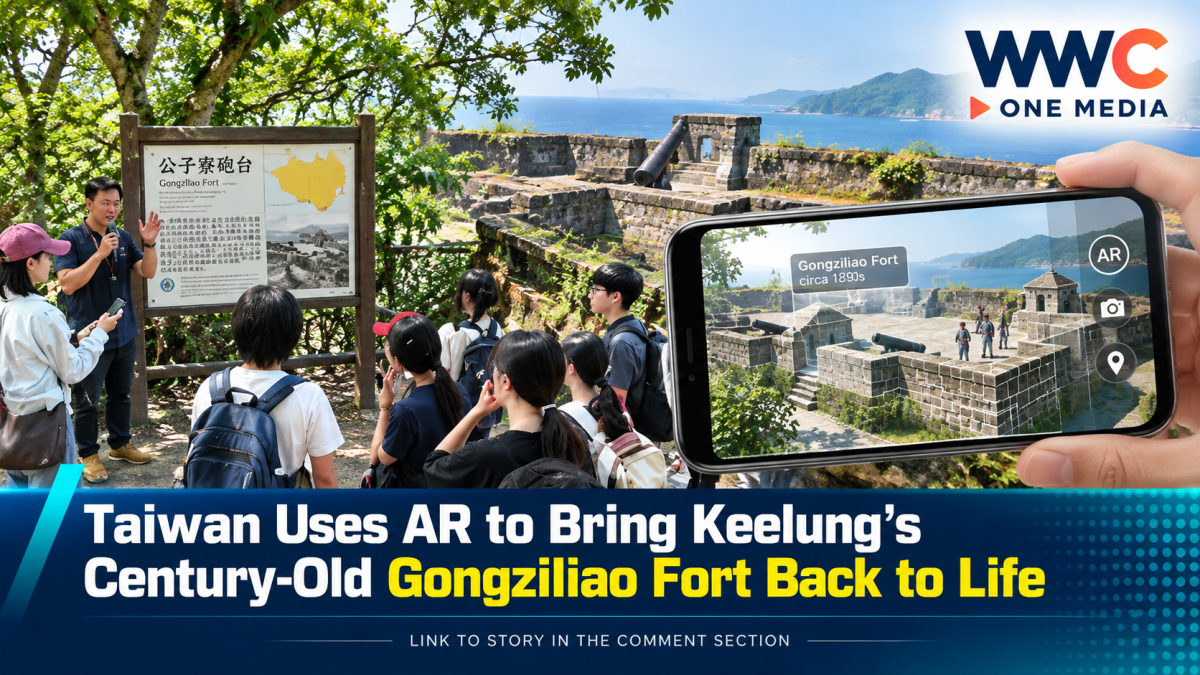
KEELUNG, Taiwan — A century-old coastal fortress in Keelung is getting a high-tech makeover—not through reconstruction, but through augmented reality (AR) that allows visitors to digitally visualize the military landscape that once protected northern Taiwan.
National Taiwan Ocean University, with support from Taiwan’s Ocean Affairs Council (OAC), has developed an AR project that digitally recreates missing structures and historical military facilities at Gongziliao Fort (槓子寮砲台) in Keelung.
The project, presented on September 16, brings together historians, students, designers, digital-technology specialists and military-history enthusiasts to explore how technology can preserve and reinterpret Taiwan’s maritime heritage.
A Fort That Has Lost Much of Its Original Equipment
Gongziliao Fort is a nationally designated historic monument located in Keelung’s Xinyi District. The fortress was constructed by Japan in 1904 as part of the coastal defense system around Keelung Harbor.
Taiwan’s National Historic Monument database says the fort was strategically positioned between the mountains and the sea east of Keelung Port. Its original layout included artillery positions, barracks, observation facilities, tunnels, ammunition-related structures and a water reservoir.
Today, however, much of the original military equipment is gone.
That created a challenge for visitors: while the remaining structures reveal that the site was once an important defense position, it can be difficult to understand how the complete fortress looked or how its different facilities were connected.
The new AR project aims to bridge that gap.
AR Reconstructs the Lost History
Rather than physically rebuilding the vanished facilities, the project uses augmented reality to place digital versions of historical structures into the existing landscape.
Through a smartphone, users can see digitally reconstructed elements of the fort, including former military facilities and barracks, overlaid on the surviving ruins.
The Ocean Affairs Council describes the approach as “digital reconstruction, not physical reconstruction,” allowing the historic site itself to remain unchanged while giving visitors a clearer picture of its past.
The AR experience is designed to help users understand not only individual structures but also the broader relationship between Gongziliao Fort and other coastal defense positions around Keelung.
That turns the site from a collection of ruins into a more understandable historical landscape.
Connecting Technology With Taiwan’s Maritime Heritage
The project is part of the OAC’s Ocean Culture Pilot Program, which supports museums, schools and civic groups working to preserve and promote Taiwan’s maritime culture.
According to the council, the initiative goes beyond protecting physical monuments. It also seeks to preserve the historical memories and stories connected to those places and make them accessible to contemporary audiences.
For younger visitors especially, AR provides a more interactive way to explore history without altering the original site.
The National Taiwan Ocean University project is being led by Associate Professor Chuang Yu-li (莊育鯉) of the university’s Oceanic Cultural Creative Design program.
The September 16 field activity brought together participants from different backgrounds to examine the fort through historical, cultural, design and technological perspectives.
Why Gongziliao Fort Matters
Gongziliao was part of a wider defensive network designed to protect Keelung Harbor and monitor maritime approaches.
Taiwan’s heritage authorities note that the fort was built into the hillside and designed around the area’s terrain. Its original facilities included living quarters, storage areas, artillery positions and observation posts.
The site therefore offers a glimpse into how geography, military planning and maritime activity shaped Keelung more than a century ago.
The fort also reflects a broader chapter in Taiwan’s history under Japanese rule, making its preservation relevant not only to military-history enthusiasts but also to researchers studying architecture, urban development and Taiwan’s relationship with the sea.
A New Model for Historic-Site Preservation?
The Gongziliao project highlights how AR could become an additional tool for heritage preservation.
Instead of reconstructing missing buildings with new physical materials, digital technology can recreate historical scenes while leaving archaeological and architectural remains untouched.
Taiwan’s Ocean Affairs Council said the approach demonstrates how digital technology can expand the ways cultural heritage is interpreted and experienced while maintaining the integrity of historic locations.
For Keelung, a city whose identity is closely tied to its harbor and maritime history, the project could also offer a new way of connecting residents and visitors with places that might otherwise be difficult to understand.
What once existed only as fragments of a century-old fortress can now be explored through a digital layer—giving Taiwan’s coastal history a distinctly 21st-century way to tell its story.