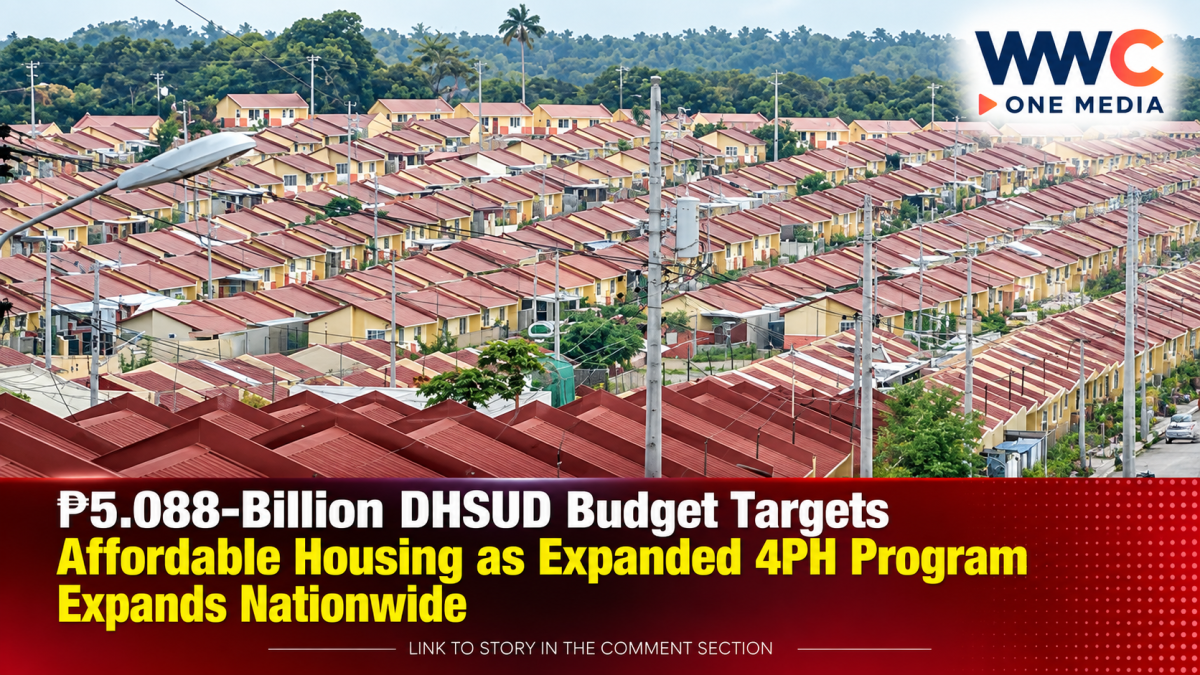
MANILA — The Philippine government is seeking a ₱5.088-billion budget for the Department of Human Settlements and Urban Development (DHSUD) for 2027, with funding expected to support affordable housing, subsidized financing and the continued expansion of the government’s flagship housing program.
The proposed allocation was presented during House plenary deliberations as lawmakers examined the proposed ₱7.2-trillion national budget.
According to the House of Representatives and Philippine News Agency, ₱1.1 billion of the DHSUD proposal is earmarked for housing interest subsidies and the administration and implementation of the Expanded Pambansang Pabahay para sa Pilipino (4PH) Program.
Expanded 4PH Posts Major Increase in Housing Pipeline
The Expanded 4PH Program has significantly broadened the government’s approach to housing.
According to figures presented by Iloilo City Rep. Julienne “Jam” Baronda, the program had generated 135,758 housing units across its different modalities as of August 2026.
That figure includes projects beyond the original condominium-focused model, with the expanded program covering vertical and horizontal housing, the Enhanced Community Mortgage Program, Presidential Proclamation sites, rental housing, modular shelters, high-density housing, Pag-IBIG-acquired properties and financing assistance.
Of those units, 15,543 vertical housing units and 15,775 horizontal units had been completed, according to the House presentation.
As of September 7, more than 11,700 beneficiary families had availed themselves of housing units under the program, with more than 70 percent coming from the country’s lowest three income deciles.
Government Sets 1.13-Million Housing Target
The administration has set a broader goal of producing, financing or providing 1.13 million housing units by June 2028.
The Expanded 4PH Program is expected to account for approximately one-fourth of that overall target.
The distinction is important because the government’s housing strategy is not limited to directly constructing homes.
Officials have emphasized that addressing the country’s housing needs also involves financing, community development, home improvements and assistance that allows families to access privately developed housing.
Housing Program Moves Beyond Condominiums
The expansion of 4PH represents a shift from its original emphasis on vertical housing.
Under the expanded framework, horizontal developments have been incorporated alongside condominium-style projects, allowing housing approaches to be adapted to different locations and community needs.
The Philippine Information Agency reported earlier this year that DHSUD had expanded the program partly because vertical development is not practical in every area. The agency has also highlighted subsidized financing through Pag-IBIG Fund, including interest rates that can be as low as 3 percent for qualified beneficiaries.
The government has also been taking the program directly to potential beneficiaries.
On September 14, DHSUD and Pag-IBIG Fund held a nationwide simultaneous open house involving 14 housing project sites across Luzon, the Visayas and Mindanao, allowing prospective buyers to inspect units and learn about financing options.
Climate Resilience Becomes Part of Housing Planning
Housing expansion is also being linked to disaster resilience, particularly in flood-prone parts of the country.
Baronda said during the House deliberations that climate-resilience considerations are incorporated into housing project designs and site selection, including assessments of flood-prone and other hazard-sensitive areas.
For Western Visayas, she cited coordination involving DHSUD, the National Housing Authority and hazard information associated with Project NOAH, the nationwide hazard-assessment initiative.
The approach reflects a broader concern: increasing the number of housing units without adequately considering flooding and other hazards could expose beneficiaries to additional risks.
The Housing Gap Remains a Major Challenge
Despite the expansion of government programs, the country’s housing requirement remains substantial.
Baronda cited Philippine Statistics Authority figures indicating an estimated 3.77-million-unit housing need, including a 2.2-million-unit housing backlog. She emphasized that the figure should not be interpreted as a requirement for the government to physically construct every unit.
Instead, the response is expected to combine direct government housing with private-sector development, financing programs, community initiatives and home improvement assistance.
Pag-IBIG Fund remains a major component of that financing strategy, supporting socialized and economic housing and offering loans of up to ₱10 million under applicable programs and eligibility rules.
What the ₱5.088-Billion Budget Could Mean
If approved, the proposed DHSUD allocation would provide funding for programs designed to make housing more accessible while supporting the government’s wider housing strategy.
The ₱1.1-billion allocation for interest subsidies and Expanded 4PH is particularly significant because financing costs can determine whether lower-income families are able to purchase or maintain a home.
But the government’s broader housing target also depends on implementation by DHSUD, the National Housing Authority, Pag-IBIG Fund, local governments, private developers and other agencies.
The numbers therefore tell only part of the story.
The larger test will be whether housing projects are completed, occupied, financially sustainable and located in communities where families can safely live and access jobs, transportation and essential services.
For millions of Filipino families facing housing pressures, the proposed 2027 DHSUD budget puts affordability, financing and actual delivery of homes at the center of the country’s housing agenda.
WWC ONE MEDIA G,A