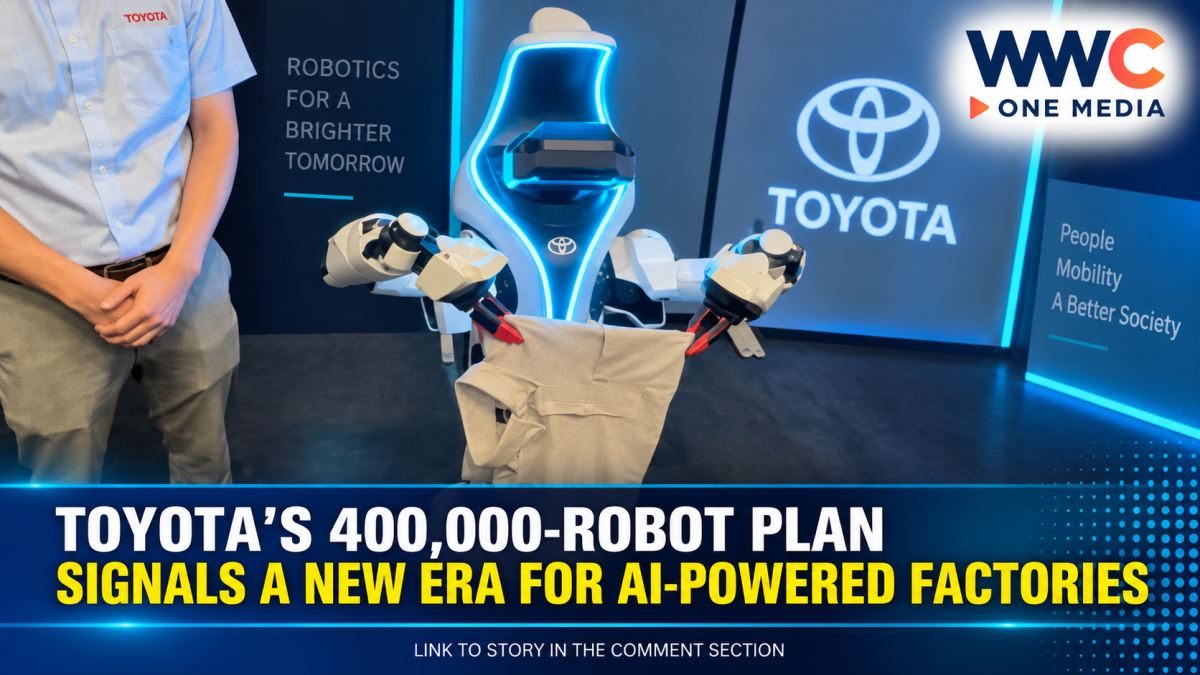
TOKYO — Toyota is preparing for a major expansion of robotics across its manufacturing ecosystem, with the automaker planning to invest heavily in factory automation and upgrade a robot fleet numbering around 400,000 units from 2028 onward.
But the headline figure needs context.
Toyota is not saying it will suddenly send 400,000 humanoid robots onto factory floors. The plan covers robots operated across Toyota, the wider Toyota Group and suppliers, with the company exploring increasingly advanced systems powered by physical AI and so-called Large Behavior Models.
According to Japanese automotive publication Car Watch, Toyota plans to invest approximately ¥1 trillion annually from 2028 in renewing its factories and robotics infrastructure. The roughly 400,000 robots referenced include about 150,000 robots operated by Toyota and Toyota Group companies and another 250,000 at suppliers.
Toyota Wants Humans and Robots Working Together
Toyota’s robotics strategy is not being presented simply as a replacement programme for factory workers.
The company says its goal is to use robotics to improve productivity, create more comfortable working environments and address challenges associated with an aging society.
Toyota’s latest financial presentation describes factory applications already under demonstration, including parts transportation and parts picking. The company says it wants workers and robots to develop as partners rather than treating automation as a substitute for human expertise.
That distinction is significant as manufacturers worldwide confront labor shortages and rising pressure to automate repetitive physical tasks.
Humanoid Robots Are Already Entering Toyota Operations
Toyota’s strategy is not purely theoretical.
In February, Toyota Motor Manufacturing Canada signed a commercial agreement with Agility Robotics to deploy the company’s Digit humanoid robots following a pilot programme.
Seven Digit robots were contracted for Toyota’s Canadian operations, where they are intended to support employees with manufacturing, supply-chain and logistics work.
The initial application is relatively straightforward: Digit can handle containers of automotive parts and move them between areas of the production operation.
That may sound less dramatic than a humanoid robot assembling an entire vehicle, but these repetitive logistics tasks are precisely the kind of work robotics companies are targeting first.
Physical AI Could Change How Robots Learn
Toyota is also investing in a newer generation of robotics based on physical AI.
The company’s research programme includes the Embodied Learning for Yield (ELEY) system, which is designed around teaching robots physical tasks and allowing them to improve through experience.
Toyota’s official research materials show that the company is developing humanoid and partner-robot technologies while pursuing what it describes as “automation with a human touch.”
The broader objective is to move beyond conventional industrial robots that repeatedly perform a narrowly programmed task.
AI-powered robots could eventually be capable of adapting to changing environments, recognizing objects and responding to different production situations.
Why Toyota Is Making the Push Now
Japan faces a major demographic challenge, with an aging population and a shrinking working-age population putting pressure on manufacturers.
The shortage of workers is not unique to Japan.
The Japan Times reported that labor shortages are becoming an important driver of humanoid-robot development worldwide, with manufacturers looking toward physical AI to help fill gaps in repetitive industrial work.
Other major automakers are pursuing similar strategies.
Tesla, Hyundai, Volkswagen and Mercedes-Benz have all explored humanoid robotics for industrial applications, while Boston Dynamics is developing its Atlas humanoid for future manufacturing use.
At Toyota’s Canadian plant, the company has already moved beyond experimentation and into a commercial agreement with a humanoid-robot maker.
The Bigger Race Is Not Just Between Humans and Robots
Toyota’s push also comes as Japan faces increasing competition from Chinese robotics companies.
At the Humanoids Summit Tokyo in May, AP reported that Chinese robotics companies were attracting significant attention with humanoids designed for industrial and other practical applications.
The development has raised questions about whether Japanese manufacturers, despite their long history of robotics expertise, can translate that advantage into large-scale commercial deployment.
For Toyota, the answer appears to involve combining its manufacturing expertise with newer AI technologies.
The automaker says its production plants, skilled workforce and Toyota Production System provide a foundation for developing robots that can work alongside employees.
What Happens to Factory Workers?
Toyota’s own materials emphasize that automation does not necessarily mean eliminating skilled workers.
In its integrated report, the company describes how workers whose traditional duties become automated can move toward higher-level roles involving logistics-system design, robot management and other advanced manufacturing tasks.
The idea is to use workers’ accumulated manufacturing knowledge to improve automated systems rather than simply remove them from the production process.
Whether that approach can be implemented at massive scale remains an open question.
The technology still faces challenges involving reliability, safety, cost, battery life, dexterity and the ability of AI systems to handle unpredictable real-world environments.
Toyota’s 400,000-Robot Number Could Be Just the Beginning
The most striking part of Toyota’s announcement is therefore not that 400,000 humanoid robots are about to replace workers — that is not what the company has announced.
Instead, it signals something potentially larger: Toyota is preparing to modernize a vast existing robotics ecosystem while gradually introducing AI-powered machines capable of handling more flexible physical tasks.
The company already has humanoid robots entering real manufacturing operations, while its broader robotics strategy is moving toward physical AI and closer human-machine collaboration.
If those technologies scale successfully, the factory of the future may not be fully automated or fully human.
It could be a production floor where people provide judgment, experience and problem-solving while intelligent robots handle increasingly complex physical work.
And Toyota’s massive planned investment suggests the company is preparing for that transition long before the technology reaches its final form.
WWC ONE MEDIA G,A