
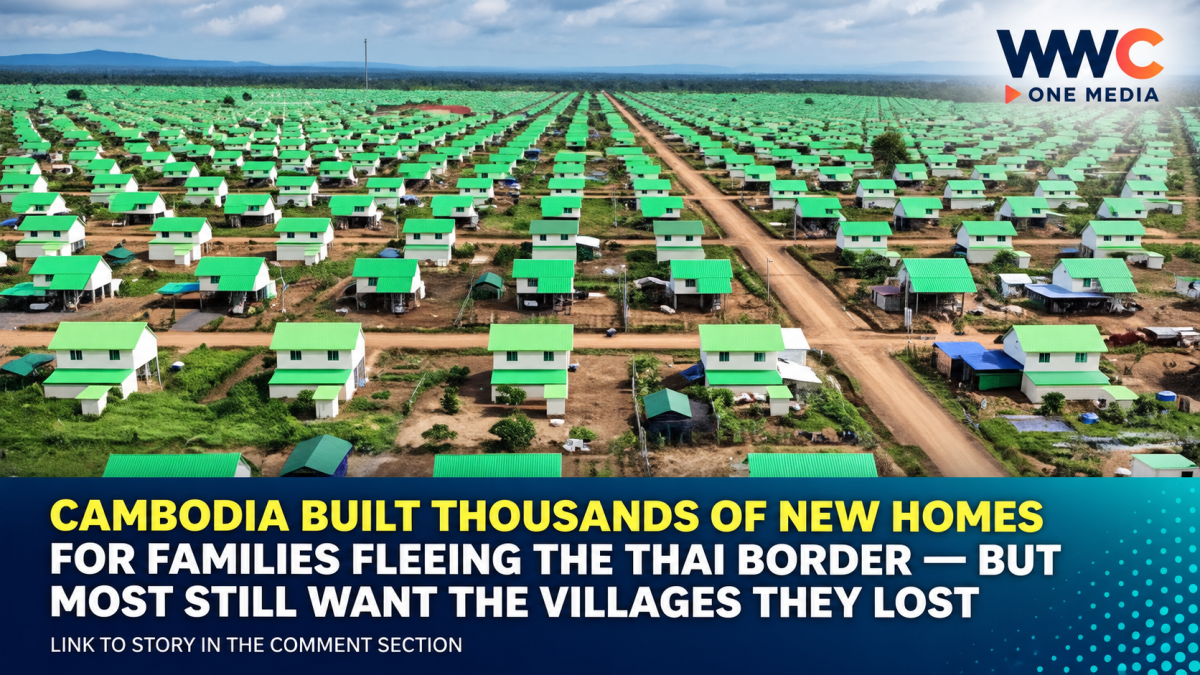
BANTEAY MEANCHEY, Cambodia — Rows of newly built stilt houses now stretch across the countryside near Cambodia’s border with Thailand, giving thousands of families something they have lacked for months: a roof, running water, schools and a place to begin again.
But for many residents, the settlement is not home.
The Cambodian government has established six so-called “waiting villages” for families displaced by the violent border conflict with Thailand that erupted in July 2025 and flared again in December. More than 3,000 houses have been constructed for families still unable to return to communities near the disputed frontier.
After months spent living in tents around Buddhist temples and emergency sites, the new homes are a major improvement. They come with small plots for vegetables, subsidized utilities, schools, a health center and basic commercial activity that is beginning to make the settlements look more permanent. Residents have opened coffee stalls, salons, grocery stores and roadside businesses while trying to rebuild their livelihoods.
Yet the name “waiting village” captures the uncertainty better than any official description.
Many families say they are waiting for one thing: the chance to go back.
More Than 20,000 Still Unable to Return
AFP reported that more than 20,000 Cambodians remain unable to return to their previous homes, even though most people displaced during the fighting have since gone back to their communities. Cambodian residents interviewed by AFP said Thai forces now control access to areas where they once lived.
Thailand disputes that interpretation.
Bangkok says some of the affected settlements expanded onto Thai territory after Cambodia’s civil-war era, when Thailand temporarily sheltered Cambodians fleeing violence. Thailand’s Foreign Ministry says those residents later remained in areas Bangkok regards as Thai land despite repeated objections. It has also rejected Cambodian allegations that Thai troops improperly expanded their positions after the ceasefire.
That disagreement is crucial.
This is not simply a refugee-return problem. It is also part of a century-old border dispute in which both countries use different maps, historical interpretations and legal arguments to determine where the frontier should lie.
The Fighting Displaced Hundreds of Thousands
The scale of last year’s crisis was far greater than the roughly 20,000 people still unable to return today.
UNHCR says the military confrontations in July and December 2025 newly displaced about 649,200 people inside Cambodia. By the end of 2025, roughly 131,600 returns had been recorded, while around 517,600 people were still displaced at that point.
The July fighting was the worst armed confrontation between Thailand and Cambodia in more than a decade. Heavy artillery, rockets and airstrikes were used during several days of combat before a ceasefire was negotiated in Malaysia following pressure and mediation involving Malaysian Prime Minister Anwar Ibrahim, the United States and China.
That truce did not last.
Large-scale fighting erupted again in December 2025. A new ceasefire signed on December 27 halted weeks of renewed combat after both sides suffered military and civilian casualties and hundreds of thousands of people were evacuated from border areas.
Reuters later reported that the two rounds of fighting killed nearly 150 people and displaced hundreds of thousands across both countries.
The Border Dispute Is More Than 100 Years Old
The underlying conflict stretches back to colonial-era border mapping.
Thailand and Cambodia share an approximately 817-kilometer land border, parts of which remain undemarcated. Many of the disagreements stem from maps drawn when Cambodia was under French colonial rule in the early 20th century.
The most famous dispute involves the 11th-century Preah Vihear temple.
The International Court of Justice ruled in 1962 that the temple belonged to Cambodia and clarified the ruling in 2013. But disputes over surrounding areas and other sections of the frontier have continued, periodically fueling nationalist tensions in both countries.
The temple itself was heavily damaged during the 2025 fighting. Cambodian authorities reported hundreds of points of damage, while Thailand maintained that its military targeted military positions rather than the historic site itself. Cambodia denied militarizing the complex.
Satellite Images Deepen the Dispute
The question of what happened to abandoned homes after the December ceasefire has become another source of tension.
Cambodian human-rights group LICADHO says high-resolution satellite imagery from around March 2026 shows that at least 627 homes and other structures were razed or cleared in Chouk Chey, Boeung Trakuon and Prey Chan villages after the December ceasefire.
LICADHO counted approximately 270 structures in Chouk Chey, 299 in Boeung Trakuon and 58 in Prey Chan. Importantly, the organization said it was not endorsing either country’s territorial claims when presenting the imagery.
Its earlier analysis also noted that the affected zones include both disputed territory and areas whose status is interpreted differently by the two governments.
Thailand rejects accusations that its forces unlawfully seized Cambodian territory.
The Thai government says its positions comply with the December ceasefire arrangements and that activities along the frontier are intended to protect Thai sovereignty and public safety. Bangkok has repeatedly accused Phnom Penh of presenting misleading territorial claims, while Cambodia has made similar accusations against Thailand.
That is why claims that Thailand simply “took Cambodian villages” should be treated cautiously in news coverage unless specifically attributed.
Families Are Rebuilding — But Permanence Brings Another Fear
For the displaced residents themselves, the geopolitical argument is far less abstract.
Many had farms, businesses and family homes in their previous communities for decades.
AFP interviewed 39-year-old cosmetics seller Keo Sotheary, whose family had lived in the border village of Boeung Trakuon since 1992. She fled during the renewed December fighting and told the news agency she dreams about returning every day.
Another resident, Im Chreb, has established a café in the new settlement and says business is doing reasonably well. But she remains emotionally attached to the home and property she spent decades building.
The Cambodian government is meanwhile making the temporary communities increasingly livable.
Former Prime Minister and current Senate President Hun Sen announced during a June visit that residents would receive land titles for their new properties—a move that provides security but also signals that displacement could last much longer than many families hoped.
A Ceasefire Without a Final Settlement
For now, the guns are largely silent.
But peace at the border remains incomplete.
Cambodia has increasingly pushed for international legal mechanisms to settle its boundary disputes, while Thailand has generally preferred direct bilateral negotiations. That disagreement over how the border should be settled has itself become part of the broader conflict.
The December ceasefire stopped large-scale combat. It did not determine ownership of every contested strip of land, restore every destroyed house or answer whether thousands of displaced families will ever be able to return to their former villages.
And that is what makes Cambodia’s “waiting villages” such a powerful symbol of the conflict.
They look increasingly permanent.
They have schools, shops, electricity, water and newly planted gardens.
But many residents still describe their lives there as temporary.
Cambodia has given them somewhere to live. The unresolved border dispute will determine whether it becomes somewhere they must stay.
WWC ONE MEDIA M.J.E




Leave a Reply